Why some bathrooms never dry: the ceiling-level bottleneck
Some bathrooms in New Zealand have a pattern that feels unfair.
You clean.
You open the window.
You run the fan.
And yet the bathroom still feels damp.
Towels never quite dry.
Corners return with mould.
The ceiling looks tired before the rest of the house does.
When this happens, most people assume the problem is “too much steam”.
But in many homes, the real issue is more specific.
The bathroom has a ceiling-level bottleneck.
Moisture is gathering at the top of the room and not clearing efficiently.
Until that top layer of air is managed, the bathroom will keep behaving the same way.
This article explains why bathroom moisture NZ homeowners deal with so often is usually a “ceiling problem”, and what actually changes the outcome.
The simplest explanation: moisture rises, then stalls
After a shower, the warmest, wettest air moves upward.
It forms a layer near the ceiling.
If that layer cannot exit quickly:
- it spreads to corners
- it cools
- and it condenses onto the coldest surfaces
That is why you often see:
- mould at the ceiling line
- dampness on upper walls
- peeling paint starting from the top
It is not random.
It is physics behaving consistently.
Why “opening the door” doesn’t always fix it
Opening the bathroom door helps air movement, but it often does not remove the top layer effectively.
Because the moist air is sitting high.
If there is no strong pathway to pull it out from the ceiling level, it simply mixes slowly and lingers.
This is why some bathrooms feel damp even when people think they are ventilating.
The method exists.
The clearance is weak.
The four most common ceiling-level bottlenecks in NZ bathrooms
1) Extraction that is not capturing the top layer
Many extractor fans are installed, but their performance depends on:
- placement
- ducting
- and whether they are vented outside properly
If the system does not effectively clear ceiling-level air, moisture hangs around.
This article is not a technical compliance guide, but it is worth remembering: the top layer matters most.
2) Bathrooms with limited natural ventilation (privacy + cold winters)
In many NZ homes, bathroom windows stay shut in winter.
Sometimes for privacy.
Sometimes because opening a cold window makes the room unpleasant.
So the room relies on mechanical ventilation — and if that’s weak, moisture becomes a daily pattern.
3) Cold surfaces at ceiling level
Some bathrooms have ceilings and corners that stay colder than the rest of the room.
When warm moist air meets a cold surface, condensation forms.
If it happens every day, the bathroom never fully dries.
4) Lifestyle patterns that trap moisture
This is common and not anyone’s fault.
Examples:
- multiple showers back-to-back
- short intervals between showers
- busy households where fans aren’t run long enough
Even a good system can struggle if the bathroom never gets a “dry-out window”.
The “never dry” test: look up, not down
If you want a practical diagnostic, do this.
After a shower, wait ten minutes and then look at:
- the ceiling line
- the top corners
- the upper half of the mirror
If those areas stay damp or fogged long after the shower, the bottleneck is likely at ceiling level.
This is also why mould often appears above eye height first.
Where skylights can help (and where they won’t)
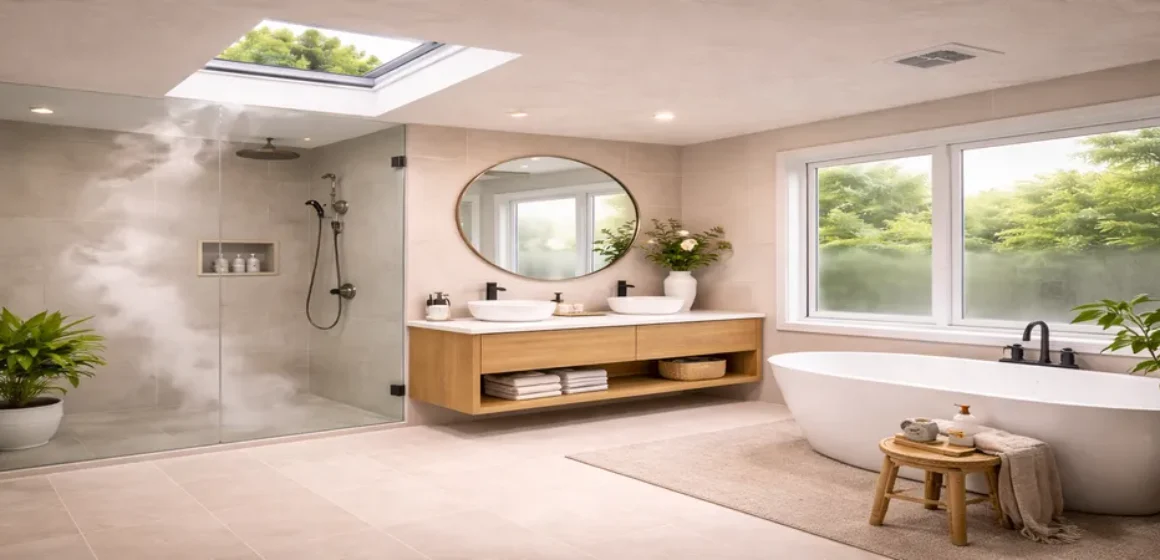
A skylight can be a meaningful part of solving bathroom moisture, but only in the right role.
A skylight helps when it supports drying behaviour
Daylight can:
- warm and brighten the room
- make the space feel less damp and enclosed
- encourage better daily habits (opening, airing, using the fan long enough)
In some bathrooms, a vented skylight can also contribute to air movement — but it should be considered alongside extraction, not as a replacement.
A skylight won’t help if the moisture source is elsewhere
If moisture is coming from:
- plumbing leaks
- hidden water ingress
- failed seals
Then daylight alone will not change the core problem.
It may simply make it easier to notice.
The ceiling-first solutions (in order of impact)
This is a comfort-and-behaviour playbook, not a technical specification.
Solution 1: Make sure moisture is actually being removed
The goal is not “air movement”.
The goal is “moist air out”.
Solution 2: Give the bathroom a dry-out window
If possible, create a routine where the bathroom gets time to clear and dry between showers.
This might mean:
- running extraction for longer
- leaving the door open once privacy is no longer needed
Solution 3: Improve the room’s relationship with daylight
Bathrooms that are naturally brighter tend to feel drier.
Not because light is magic.
Because brighter rooms usually dry surfaces faster and reduce that constant damp feel.
Solution 4: Add comfort control if the bathroom becomes too hot or glaring
Some bathrooms can become harsh in summer with roof glazing.
Controls help keep the room usable without undoing the daylight benefit.
Illustrative example only: a bathroom that stayed damp at the top
A homeowner in Lower Hutt noticed their bathroom “never dried”, especially in winter.
The towel rail helped a little, but the ceiling corners kept returning with mould.
Once they focused on the ceiling-level bottleneck — how moisture was sitting and cooling at the top of the room — the fix became clearer.
They improved clearance after showers and made sure the bathroom had a realistic dry-out period.
When the top layer stopped staying wet, the whole room felt different.
Not perfect overnight.
But steadily better.
A quick checklist you can use today
- Do mould spots appear near the ceiling line first?
- Does the ceiling stay damp after showers?
- Does the mirror stay fogged long after you finish?
- Do you have a dry-out window between showers?
- Is the bathroom naturally bright, or always dim?
If you answered yes to most, treat it as a ceiling-level bottleneck.
That is the problem to solve.
A calm next step
Bathroom moisture NZ homeowners struggle with is often not about “steam”.
It is about clearance.
If you share a couple of photos of the bathroom, tell us whether you have an extractor fan, and describe how long the ceiling and mirror stay damp, we can point you toward the most likely bottleneck and the best daylight and ventilation options for your home.
Start here: https://inquiry.skylights.co.nz/inquiry