Grey-day daylight: why Auckland homes can feel dull even when it’s “bright outside”, and what fixes it
If you live in Auckland, you know this moment well.
You look outside and it’s clearly daytime. The sky is bright, just grey. But inside, the house feels flat. The hallway is a tunnel. The kitchen needs lights on. The lounge looks fine near the window and dull two steps back.
This is the classic overcast daylight Auckland homes deal with: bright sky, low contrast, and light that doesn’t travel far indoors.
The good news is the cause is usually predictable, and the fixes are practical. You do not need to accept “grey days equal dim rooms”. You need a better daylight plan.
A simple reflection that sums it up:
When the light outside is soft, your house needs help distributing it.
What is actually happening on grey days
On clear days, sunlight is directional. It creates strong beams that push deeper into rooms.
On overcast days, light becomes diffuse. It comes from the whole sky rather than a single direction. That means:
- windows brighten the area near them, but the light drops off quickly
- rooms with deep layouts or long corridors lose usable daylight fast
- ceilings stay slightly grey, which makes rooms feel smaller and heavier
- contrast disappears, so everything feels a bit muted
In Auckland’s mix of humidity, cloud cover, and quick weather shifts, this “soft sky” pattern is common. Many homes are built with layouts that work well in sun, but struggle on diffuse-light days.
The 7-minute overcast daylight Auckland audit
Do this once on a typical grey day. You will learn exactly where your home is losing daylight.
Step 1: Find your “switch points”
Walk through the home at midday and notice where you automatically turn lights on.
Common Auckland switch points:
- hallways and entries
- internal bathrooms
- kitchens where the work zone is away from windows
- stairwells and landings
- open-plan centres (bright edges, dull middle)
Write down the top two.
Step 2: Check the ceiling, not the floor
Stand in the dullest room and look up. If the ceiling looks grey or flat, the room is underlit where it matters most.
A bright ceiling lifts perceived space. A dull ceiling compresses it.
Step 3: Check the “middle of the room” test
Stand two metres away from the main window line. Can you comfortably read a label or a page without switching lights on?
If not, the room is suffering from distribution, not a lack of outdoor brightness.
Step 4: Identify whether the problem is layout or glass
Ask one question: is there any window that could realistically reach this zone with light?
- If yes, you may be able to improve daylight with layout and surface choices.
- If no, you likely need overhead daylight for a real change.
Why Auckland floorplans often struggle on grey days
These are the most common daylight blockers in Greater Auckland homes.
Deep plan layouts
A lot of homes have living areas that extend back from the window wall. On overcast days, light simply does not reach the centre.
Central hallways with bedrooms either side
These corridors have no side daylight source. Overcast light cannot “bend around corners” the way people hope it will.
Covered outdoor areas and deep eaves
Great for shelter, but they can reduce the effective sky view from windows, which matters more on grey days.
Privacy planting and close neighbours
Auckland sections often rely on hedges and screening. That can reduce the amount of usable sky light entering side windows.
Fixes that actually work (in the right order)
Fix 1: Improve daylight distribution first
If you want the home to feel brighter on grey days, the goal is not brightness at the window. The goal is usable light in the middle.
Practical ways to improve distribution:
- keep heavy curtains open during the day where privacy allows
- avoid blocking key window lines with tall furniture
- use lighter ceiling finishes where appropriate (ceilings do a lot of work on grey days)
This helps, but it does not solve deep zones on its own.
Fix 2: Add overhead daylight where the home has a “dead zone”
This is where many Auckland homes change dramatically.
Overhead daylight is often the cleanest solution for:
- hallways
- internal bathrooms
- stairwells and landings
- open-plan centres
- kitchens with deep work zones
A useful analogy:
A window lights one side of a room. Overhead daylight lights the room itself.
If you want a plain-English breakdown of options:
https://www.skylights.co.nz/types-of-skylights/
Fix 3: Match the skylight type to the problem
Different skylight styles solve different grey-day problems.
- Tubular skylights are often ideal for corridors, bathrooms, pantries and smaller zones that need efficient daylight where windows cannot reach.
- Fixed skylights suit areas where you want a broader lift to the ceiling and central space, especially in open-plan zones.
- Opening skylights are helpful when ventilation is part of the comfort issue, but they should be chosen for airflow reasons, not just daylight.
For Auckland coverage and context:
https://www.skylights.co.nz/skylights-auckland/
Fix 4: Stop designing for “sunny days only”
Many homes are effectively designed around the best-case light scenario. Auckland needs a more realistic baseline: if the home works well on grey bright days, it will feel excellent on sunny days.
Room-by-room: where grey-day improvements show up fastest
Hallways
The most reliable upgrade in many Auckland homes. If the hallway improves, the whole home feels more open.
Bathrooms
Overcast daylight still provides excellent usable light overhead. Bathrooms often feel cleaner and more liveable when daylight is introduced, even before any renovation.
Kitchens
The goal is a usable work zone without switching lights on at lunch time. Overhead light can make the kitchen feel less heavy on humid grey days.
Open-plan living
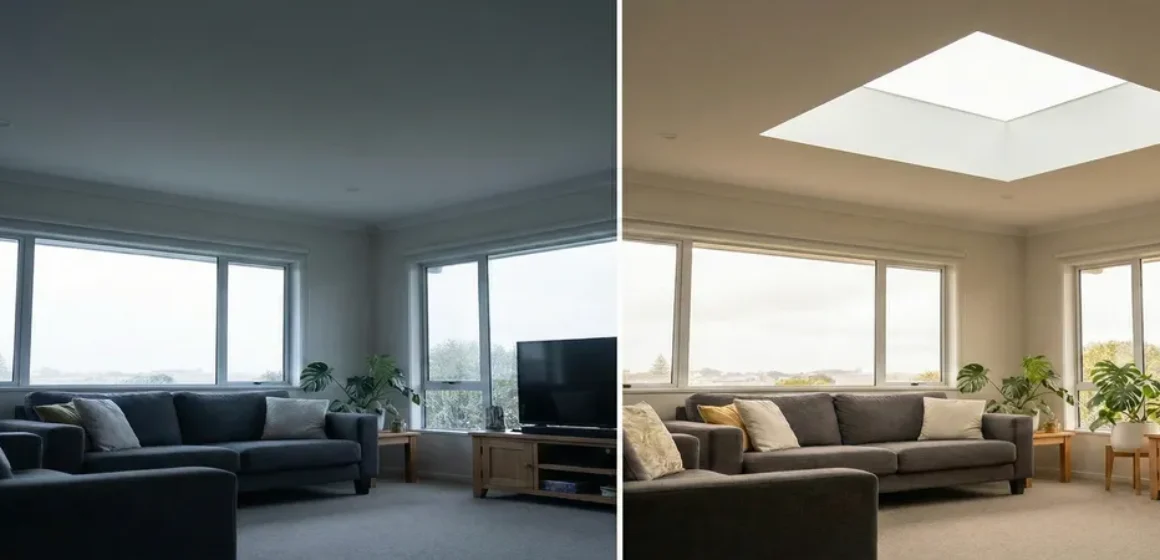
If the centre of the space is dull, overhead daylight can make the room feel larger and more balanced, not just brighter at the edges.
A micro-quote that captures what people notice:
“It feels like the day finally reaches the middle of the house.”
Illustrative Example Only: the “bright outside, dim inside” home
A homeowner described a living space that looked fine on sunny days, but felt muted on overcast days. The windows were not the problem. The layout was. Light reached the edges and stopped.
Once the daylight plan targeted the dead zone, the house stopped feeling dependent on perfect weather. The difference was not dramatic glare. It was a steady, usable brightness that made the home feel more awake.
If you want a clear recommendation for your home
The best results come from solving the specific dead zone rather than adding “a bit of light” somewhere convenient.
If you want guidance based on your Auckland roof type, room layout, and where your switch points are, start here:
https://inquiry.skylights.co.nz/inquiry
FAQs (unique to this topic)
Why does my house feel dark on grey days when it’s clearly bright outside?
Overcast light is diffuse and low contrast. It brightens areas near windows, but it drops off quickly in deeper parts of the home, leaving ceilings and centre zones underlit.
Do skylights help more on overcast days than sunny days?
They can be especially valuable on overcast days because overhead daylight captures a large portion of the bright sky and delivers usable light into the middle of the home where windows often cannot reach.
What rooms benefit most from overhead daylight in Auckland?
Hallways, internal bathrooms, stairwells, and open-plan centre zones typically see the biggest improvement on grey days.
Is a tubular skylight enough for a hallway?
Often, yes, because it delivers efficient light into narrow spaces. Longer corridors may need more than one light point depending on length and layout.
Will adding overhead daylight cause glare on grey days?
Glare risk is usually lower on grey days because the light is diffuse. Comfort depends more on placement and avoiding harsh direct sun patches on clearer days.