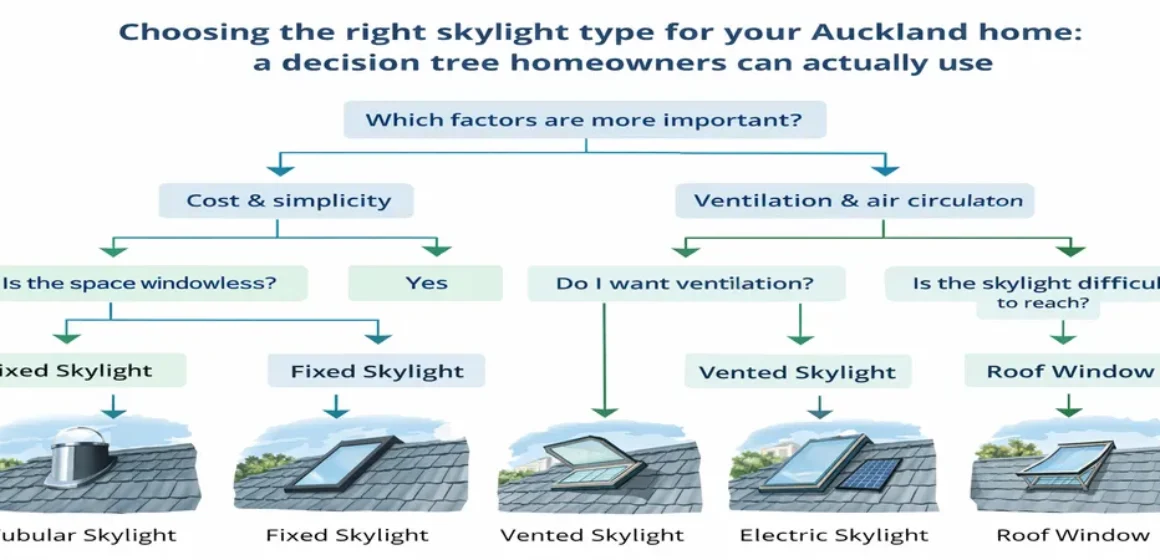
Choosing the right skylight type for your Auckland home: a decision tree homeowners can actually use
Most people do not struggle with whether skylights are a good idea.
They struggle with the moment the options arrive.
Tubular. Fixed. Opening. Flat roof. Low pitch. Glazing options. Shafts.
It is easy to end up either overwhelmed or defaulting to whatever a friend installed.
This guide is different.
It is a decision tree you can actually use. No jargon, no brand arguments, and no one-size-fits-all advice. Just a structured way to choose the right option for your home and Auckland’s real conditions.
Primary keyword focus: types of skylights Auckland
Step 1: Start with the room, not the product
Pick the room you are trying to improve. Most Auckland homeowners fall into one of these motivations:
- internal bathroom that stays damp and dim
- hallway that forces lights on during the day
- kitchen work zone that feels flat on overcast days
- open-plan centre that is bright at the edges and dull in the middle
- stairwell or landing that feels like a shadow tube
Once you name the room, the best skylight type becomes clearer.
Step 2: The Auckland daylight question
Ask one simple question:
Do you need consistent light on overcast days, or do you mainly want to capture direct sun?
In Auckland, most homes benefit from skylights that perform well on diffuse, grey-bright days. That usually points towards solutions that deliver even, usable overhead light rather than a harsh sun patch.
The decision tree
Follow this in order. Stop when you find your best match.
Branch A: Is the space small, internal, or narrow?
Examples:
- hallway
- internal bathroom
- pantry
- laundry
- walk-in wardrobe
If yes → Start with a tubular skylight.
Why it usually works:
- strong daylight delivery in small zones
- modest ceiling footprint
- often easiest to fit around roof space constraints
- tends to feel natural rather than “feature” in heritage or compact interiors
If no → go to Branch B.
Branch B: Do you want to lift a larger room or an open-plan centre?
Examples:
- living room
- kitchen-dining centre zone
- open-plan area where the middle feels dull
If yes → Start with a fixed skylight.
Why it usually works:
- broader ceiling lift
- better for spaces where one small light point would feel insufficient
- can be placed to balance daylight and reduce reliance on harsh side windows
If no → go to Branch C.
Branch C: Is ventilation a primary goal, not just daylight?
If you are trying to solve:
- late-summer humidity that lingers
- upstairs heat build-up
- bathrooms that never reset between showers
- stale air in stairwells or upper landings
If yes → Consider an opening (vented) skylight, but only after two checks:
- Do you have a clear air path (inlet + outlet) to make ventilation meaningful?
- Is it safe and practical to operate (manual reach vs powered)?
If the answers are yes → opening skylight is a strong option.
If the answers are no → fixed skylight plus proper extraction or airflow improvements often delivers a better, simpler outcome.
Branch D: Is the roof space constrained?
If your roof has:
- tight truss webs
- ducting and wiring conflicts
- limited clear cavity above the room
Then your “best” skylight might be the one that fits cleanly.
In many cases:
- Tubular skylights are easiest
- Fixed skylights can still work with correct framing solutions
- Opening skylights add complexity and should be chosen only when ventilation is genuinely needed
If you want a roof space reality guide:
Next: match the skylight type to the behaviour you want
A skylight should not just look good. It should behave well.
Here is a plain-English match guide.
If you want the room to feel calmer and more even
- aim for overhead light that spreads across ceiling and upper walls
- avoid placements that create a bright patch on the floor
Best starting point:
- tubular (small zones)
- fixed (bigger rooms)
If you want moisture-heavy rooms to dry and feel fresher
- Daylight helps, but extraction still matters
- Opening skylights can help when used correctly
Best starting point:
- tubular for bathrooms
- opening skylight for bathrooms only if ventilation benefit is real and workable
If you want to reduce “lights on at 3pm” behaviour
- target hallways and centre zones
- choose skylights that perform in diffuse daylight
Best starting point:
- tubular for hallways
- fixed for open-plan centres
The three mistakes that make people choose the wrong type
Mistake 1: Choosing based on looks alone
A feature skylight in the wrong spot can disappoint. A quiet skylight in the right spot can transform the home.
Mistake 2: Oversizing to compensate for poor placement
Bigger does not fix wrong. It often creates glare and hot patches.
Mistake 3: Choosing opening skylights when the real issue is extraction
If a bathroom fan is weak or ducted poorly, an opening skylight does not solve the core moisture problem.
Illustrative Example Only: the homeowner who nearly chose the wrong type
A homeowner wanted “a skylight” for a dim hallway and assumed a large fixed unit was the best option.
The roof space was truss-heavy and ducted, and the hallway needed even daylight rather than a feature opening.
A tubular skylight delivered a cleaner ceiling finish, easier installation, and the exact behaviour the space needed.
Their reflection afterwards:
“We stopped thinking about skylight types and started thinking about what the hallway needed.”
Quick decision summary (save this)
If you want a simple snap guide:
- Hallway / internal bathroom / pantry → tubular skylight
- Kitchen centre / open-plan living → fixed skylight
- Upstairs stale air / humidity relief → opening skylight (only if air path and operation make sense)
- Tight roof space constraints → tubular first, then fixed if feasible
If you want a recommendation tailored to your Auckland home layout and roof type:
For Auckland coverage:
FAQs (unique to this topic)
What are the main types of skylights Auckland homeowners choose?
The main categories are tubular skylights (great for small internal spaces), fixed skylights (for broader daylight lift), and opening skylights (when ventilation is a key goal).
Which skylight type is best for Auckland’s overcast days?
Skylights that deliver diffuse overhead light well are usually the best fit. Tubular skylights and well-placed fixed skylights often perform strongly in grey-bright conditions.
Are opening skylights always better because they ventilate?
Not always. Opening skylights help when there is a clear airflow path and the room benefits from high-level venting. If ventilation is not the real issue, a fixed skylight can be the better choice.
Can I choose the type before checking the roof space?
You can shortlist, but roof space constraints can change what is feasible. A quick roof space check prevents wasted design decisions.
What is the most common mistake when choosing skylight types?
Choosing based on appearance rather than the room’s actual problem. The best skylight type is the one that delivers the right light behaviour in the space.