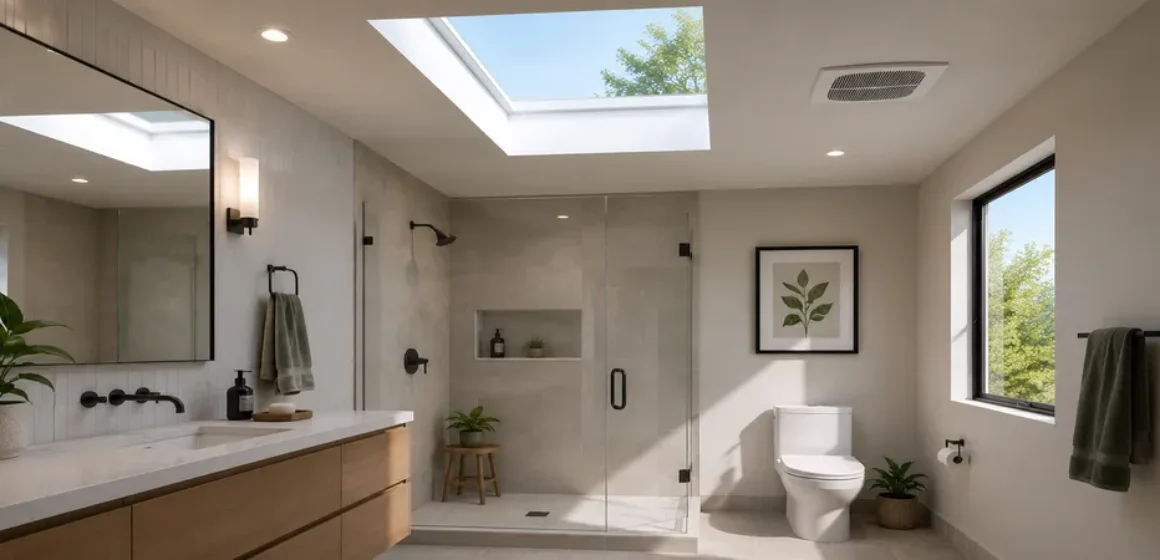
Bathroom skylight or extractor fan? Why some rooms need both
A dark bathroom can feel like a ventilation problem.
A steamy bathroom can feel like a daylight problem.
In reality, they are often two different issues happening in the same room.
Many New Zealand bathrooms are small, private and shaded. They may have a frosted window, a weak extractor fan, older ceiling linings, limited natural light, tiled surfaces and a morning routine that fills the room with steam before the day has properly started.
A skylight can make the bathroom feel brighter. An extractor fan can help remove moist air. A vented skylight may support airflow in some bathrooms. A tubular skylight or Sky tube may bring practical daylight into a compact bathroom.
But one product should not be expected to solve every problem.
That is why the bathroom skylight extractor fan question matters. The right answer is not always “one or the other”. In many bathrooms, the best result comes from understanding daylight and ventilation separately, then deciding whether the room needs one solution, the other, or both.
The simple difference: light and air are not the same problem
A bathroom skylight improves daylight.
An extractor fan removes moist air.
A vented skylight may allow airflow when opened.
These may sound related, but they solve different parts of the bathroom problem.
Daylight problems usually sound like this:
- The bathroom feels dull even during the day
- The window is small, frosted or shaded
- The light is used every morning
- The room feels enclosed or flat
- Privacy limits the use of larger wall windows
- The room never feels as fresh as it looks
Ventilation problems usually sound like this:
- Steam lingers after showers
- The mirror fogs heavily
- Condensation forms on windows or walls
- The room feels damp or stale
- Paint peels near the ceiling
- Mould appears around corners or ceilings
- Towels stay damp for too long
A bathroom may have one problem, or both.
The mistake is assuming daylight will remove moisture, or that a fan will make a dark bathroom feel naturally bright.
Why bathrooms are difficult rooms
Bathrooms are small rooms with demanding conditions.
They need privacy, daylight, task lighting, airflow, moisture control, easy cleaning and a feeling of freshness. They also contain reflective and moisture-prone surfaces such as mirrors, tiles, glass screens, painted ceilings and cabinetry.
In many homes, bathroom design is constrained by:
- Privacy from neighbours
- Small wall windows
- Frosted glass
- Shaded side yards
- Internal or semi-internal layouts
- Limited ceiling space
- Existing fans, heat lamps and downlights
- Roof framing and ducting above the ceiling
- Older extraction systems
- Cold winter mornings
- High shower use
A bathroom skylight can be an excellent way to improve natural light, especially where wall-window options are limited.
But moisture must still be managed properly.
A brighter bathroom may feel better, but it is not automatically a better-ventilated bathroom.
When a bathroom skylight makes sense
A bathroom skylight may be worth considering when the main issue is poor daylight.
This may apply if:
- The bathroom needs lights on during the day
- The window is small, frosted or shaded
- Privacy limits natural light from side windows
- The room feels enclosed even when clean
- The vanity, shower or central floor area is dark
- The bathroom is being renovated or repainted
- A more open, naturally lit feeling is wanted
A skylight can help the bathroom feel clearer and less closed in.
Depending on the room and roof, the right daylight option may be a fixed skylight, vented skylight, tubular skylight or Sky tube.
The product choice should depend on the size of the bathroom, the ceiling, the roof, whether airflow is also needed and how much daylight impact is wanted.
When an extractor fan matters more
An extractor fan may matter more when the main issue is moisture.
This may apply if:
- Steam lingers long after showers
- The mirror fogs heavily
- Condensation appears on windows, walls or ceiling
- Paint is peeling or bubbling
- Mould marks appear regularly
- The bathroom smells damp or stale
- Towels stay wet for too long
- The bathroom is used by several people each morning
In these cases, adding daylight alone may not solve the underlying moisture problem.
A skylight may make the bathroom feel brighter, but moist air still needs somewhere to go.
Extractor fans, ducting, airflow paths, heating, window use and bathroom habits can all affect moisture control.
If moisture is the real issue, ventilation should be reviewed directly.
When the bathroom may need both
Many bathrooms need both daylight and ventilation attention.
This is common in older homes, compact bathrooms, bathrooms with frosted windows and homes in wetter or colder regions.
A bathroom may need both if:
- It feels dark and steamy
- It has weak natural light and lingering moisture
- The window provides privacy but little brightness
- The extractor fan seems underpowered or poorly used
- The room is used heavily in the morning
- There is condensation and the room still feels gloomy
- Renovation or repainting is already being planned
In this case, the question should not be “skylight or extractor fan?”
A better question is:
What does this bathroom need for daylight, and what does it need for airflow?
Those answers may point to a skylight plus an extractor fan, a vented skylight plus extraction review, a tubular skylight with separate ventilation, or another combination.
The right plan depends on the room.
Fixed skylight in a bathroom
A fixed skylight brings daylight into the bathroom but does not open.
It may suit bathrooms where the main issue is natural light, not airflow.
A fixed skylight may suit when:
- The bathroom is medium to large
- A stronger daylight feature is wanted
- The room has poor natural light
- Privacy is important
- Existing extraction works well
- The roof and ceiling allow suitable placement
- The bathroom is part of a renovation or refresh
What to remember
A fixed skylight does not remove steam.
If the bathroom has moisture issues, an extractor fan or other ventilation approach still needs to be considered.
The fixed skylight may solve the daylight issue, while the extractor fan solves the moist-air issue.
That can be a strong combination when both are planned properly.
Vented skylight in a bathroom
A vented skylight brings daylight and can open for airflow.
It may suit some bathrooms, especially where warm moist air gathers near the ceiling and high-level airflow would be useful.
A vented skylight may suit when:
- The bathroom needs daylight and airflow
- Steam gathers near the ceiling
- The room feels closed in after showers
- The roof and ceiling conditions suit an opening unit
- The skylight can be operated conveniently
- Weather exposure and controls are considered
- The homeowner understands how and when to use it
What to remember
A vented skylight is not automatically a replacement for an extractor fan.
Bathrooms often still need mechanical extraction, especially where shower use is heavy, windows are rarely opened, or moisture needs to be removed consistently.
A vented skylight may support airflow, but it should not be asked to do a job it is not suited to do alone.
Tubular skylight or Sky tube in a bathroom
A tubular skylight or Sky tube may be a practical option for compact bathrooms where the main goal is daylight.
These systems bring daylight through a roof collector and reflective tube, then spread it into the room through a ceiling diffuser.
A tubular skylight or Sky tube may suit when:
- The bathroom is small or compact
- A subtle ceiling diffuser is preferred
- A large skylight would feel unnecessary
- The room needs practical daylight rather than a sky view
- Privacy is important
- Ventilation is already handled separately
- The roof and tube path are suitable
What to remember
A tubular skylight or Sky tube does not ventilate the bathroom by itself.
If steam, condensation or dampness are present, extraction and airflow still need to be addressed.
This option can be excellent for light, but it should not be confused with moisture removal.
The bathroom decision framework
Use this framework before deciding what your bathroom needs.
If the bathroom is mainly dark
Consider a fixed skylight, tubular skylight or Sky tube depending on room size, roof access and desired daylight result.
If the bathroom is mainly steamy
Review extraction, ducting, airflow and moisture habits first. A skylight may still help daylight, but it is not the primary ventilation solution.
If the bathroom is dark and steamy
Consider a combined plan. This may include a skylight for daylight and an extractor fan or ventilation review for moisture.
If the bathroom is compact
A tubular skylight or Sky tube may provide enough practical daylight, with ventilation handled separately.
If the bathroom is larger or being renovated
A fixed or vented skylight may be worth assessing, along with extraction and internal finishing.
If the bathroom has mould, peeling paint or ceiling stains
Do not treat it as a daylight issue only. Moisture, ventilation or roof condition may need to be checked before finalising a skylight plan.
The mirror test
The bathroom mirror often reveals the ventilation problem.
After a shower, notice:
- How quickly the mirror fogs
- How long it takes to clear
- Whether steam remains in the room
- Whether the fan is used during and after showering
- Whether the window is opened
- Whether condensation appears on walls or ceiling
- Whether the room smells damp afterwards
If the mirror stays fogged long after use, a skylight alone is unlikely to solve the problem.
The bathroom may still benefit from daylight, but ventilation needs separate attention.
This test helps homeowners avoid choosing the wrong solution.
The light-switch test
The bathroom light switch reveals the daylight problem.
Ask:
- Do you switch the light on during the day?
- Does the bathroom feel dull even after the window is uncovered?
- Is the window too small, frosted or shaded to help?
- Does the bathroom feel worse in winter?
- Would natural light make the room easier to use?
If the bathroom needs artificial lighting during daytime use, a skylight or tubular daylight option may be worth exploring.
The light-switch test and mirror test together tell a clearer story.
One points to daylight. The other points to ventilation.
Bathroom skylight placement matters
A bathroom skylight should be placed to improve the room’s use.
It does not automatically belong above the shower.
Placement may be better near:
- The vanity area
- The central floor zone
- A dark corner
- The shower approach
- A separate toilet area
- A dressing or transition area
Placement should consider:
- Mirrors
- Glass shower screens
- Tile reflection
- Privacy
- Existing fan or heat lamp
- Roof framing
- Ducting
- Plumbing
- Roof pitch and flashing
- Whether the unit is fixed, vented or tubular
Poor placement can brighten the wrong part of the bathroom or create glare.
Good placement brings daylight where the room needs it.
Extractor fan placement and ducting matter too
An extractor fan is only useful if it is properly selected, placed, ducted and used.
Bathroom extraction can be affected by:
- Fan capacity
- Fan location
- Duct length
- Duct route
- Whether air is exhausted outside properly
- Whether there is enough make-up air
- How long the fan runs after showers
- Whether the fan is connected to a timer or switch
- Whether the ducting is blocked, damaged or poorly routed
A bathroom may have an extractor fan and still perform poorly if the system is not doing its job effectively.
This is why a bathroom with ongoing steam or mould may need more than a skylight discussion.
It may need a ventilation review.
Heat lamps and bathroom skylights
Many bathrooms include heat lamps, downlights or combined fan-light-heat units.
These can affect skylight placement.
A ceiling may look like it has plenty of space, but the area above it may include wiring, ducting, insulation, fan housings or structural framing.
Before choosing a skylight position, consider:
- Existing heat lamps
- Downlights
- Extractor fan position
- Ducting route
- Ceiling joists or trusses
- Insulation
- Any ceiling access panel
- Whether an electrician may be needed
A bathroom ceiling is often busier than it looks.
This is another reason photos and site assessment may be important.
When a site visit may be needed
Bathroom skylight enquiries often benefit from careful assessment because several issues can overlap.
A site visit may be recommended if:
- Moisture or staining is visible
- The bathroom has poor extraction
- The roof type or pitch is unclear
- The ceiling contains fans, heat lamps or multiple lights
- The preferred skylight location needs confirmation
- A vented skylight is being considered
- The bathroom is part of a renovation
- The room has limited roof space above
- The home has a complex roofline
A site visit is not only about measuring.
It helps confirm whether the recommended solution is practical, safe and suitable.
For bathrooms, that caution is valuable.
Bathroom renovations: plan daylight and ventilation early
If the bathroom is being renovated, daylight and ventilation should be discussed early.
Waiting until tiles, mirrors, fans, ceiling linings and lighting are selected can limit the options.
Early planning helps coordinate:
- Skylight placement
- Extractor fan location
- Ducting route
- Lighting layout
- Mirror position
- Shower location
- Ceiling framing
- Internal finishing
- Painting and plastering
- Electrical work
- Roofing and flashing
A bathroom renovation is one of the best times to ask whether the room needs a skylight, improved extraction or both.
The goal is to avoid treating natural light and ventilation as afterthoughts.
Older NZ bathrooms
Older New Zealand bathrooms often have small windows, frosted glass, limited extraction or retrofitted fans.
They may also have layers of previous repairs, old ceiling linings, dated ventilation, older roof structures and limited natural light.
Common issues include:
- Poor daylight through small windows
- Steam lingering after showers
- Paint peeling near ceilings
- Condensation in winter
- Bathrooms added into former service areas
- Internal bathrooms created during renovations
- Windows facing fences, side paths or neighbouring walls
These bathrooms can benefit from careful daylight planning, but they also need moisture issues handled honestly.
A skylight may improve the room’s feel.
Ventilation must still do the moisture work.
Newer bathrooms can have the same issue
A newer bathroom is not automatically well daylit or well ventilated.
Modern homes can have internal ensuites, compact bathrooms, privacy-constrained windows, mechanical systems that are not used long enough, or layouts where natural light does not reach the right area.
A newer bathroom may still need:
- Better daylight
- Better extraction use
- A timer or control review
- A skylight or tubular daylight option
- A ventilation discussion
- Better placement of light and airflow
The age of the home is only one factor.
The room’s behaviour matters more.
What a bathroom skylight can and cannot do
A bathroom skylight can:
- Bring natural light into a dark bathroom
- Improve privacy-friendly daylight
- Make a compact room feel less enclosed
- Reduce reliance on artificial lighting during daytime use in suitable conditions
- Support a renovation or refresh
- Improve the room’s perceived freshness
A bathroom skylight cannot:
- Remove steam if it does not open
- Replace extraction in every bathroom
- Fix mould by itself
- Solve poor heating or insulation
- Correct roof leaks or ceiling damage
- Suit every roof or ceiling layout
- Guarantee moisture control without ventilation planning
Clear expectations lead to better outcomes.
The skylight should do the daylight job. Ventilation should do the moisture job.
What an extractor fan can and cannot do
An extractor fan can:
- Help remove moist air
- Reduce steam when used properly
- Support condensation management
- Improve bathroom airflow
- Work alongside windows or other ventilation
- Be part of a moisture-control strategy
An extractor fan cannot:
- Bring in natural daylight
- Make a dark bathroom feel visually open
- Solve privacy-related daylight issues
- Fix roof leaks or building defects
- Perform well if poorly placed, undersized or poorly ducted
- Replace heating or insulation
A fan can help air quality and moisture, but it does not solve the daylight problem.
That is why many bathrooms need both conversations.
What to send when asking for advice
For a bathroom skylight or ventilation enquiry, send clear photos and details.
Include:
- Wide photo of the bathroom
- Ceiling photo showing fan, lights and heat lamps
- Photo of the vanity and mirror
- Photo of the shower area
- Photo of the window and what it faces
- Ground-level roof photo above or near the bathroom
- Photo of any ceiling stains, mould or peeling paint
- Notes about when the room feels darkest
- Notes about steam, condensation or damp smell
- Whether there is an extractor fan already
- Whether the bathroom is being renovated
- Roof type if known
- Ceiling type if known
This helps determine whether the issue is daylight, ventilation or both.
Questions to ask before approving bathroom work
Before approving a bathroom skylight or ventilation-related quote, ask:
- Is the main issue daylight, ventilation or both?
- What product is being recommended and why?
- Is it a fixed skylight, vented skylight, tubular skylight or Sky tube?
- Is an extractor fan still needed?
- Is the existing extractor fan adequate?
- Where will the skylight be placed?
- Where will daylight land?
- Will the skylight create glare on mirrors or glass?
- What roof type and pitch are involved?
- What flashing system will be used?
- Is internal finishing included?
- Is electrical work included or excluded?
- Are any moisture or ceiling issues being addressed separately?
These questions help avoid confusion between light and air.
Illustrative example only
A homeowner has a compact bathroom with a frosted window facing a side fence. The bathroom needs the light on during the day, and the mirror fogs after showers.
A tubular skylight or Sky tube may help bring practical daylight into the room. But it will not remove steam. The extractor fan may need to be checked, replaced, run longer or ducted more effectively depending on the existing setup.
In another home, a larger bathroom is being renovated. The homeowner wants natural light and better airflow. A vented skylight may be worth considering if the roof, ceiling and weather exposure suit it. However, extraction may still be needed depending on shower use and ventilation requirements.
Both bathrooms need a clearer plan.
Not just a product.
The practical takeaway
A bathroom skylight and an extractor fan should not be treated as competitors.
They usually solve different problems.
A skylight improves daylight.
A tubular skylight or Sky tube can provide practical daylight in compact bathrooms.
A vented skylight may support airflow in suitable rooms.
An extractor fan helps remove moist air.
A bathroom with both darkness and steam may need both daylight and ventilation addressed.
The best bathroom upgrade starts by asking the right question:
What does this bathroom need to feel better, and what does it need to perform better?
Those are not always the same answer.
Planning your next step
If your bathroom feels dark, steamy or enclosed, it may be worth assessing daylight and ventilation separately before deciding on a product.
Skylights.co.nz can help you consider whether a fixed skylight, vented skylight, tubular skylight or Sky tube may suit your bathroom, roof type and desired outcome.
To start the process, use the Skylights.co.nz enquiry form:
https://inquiry.skylights.co.nz/inquiry
You may also find these useful:
FAQs
Do I need a bathroom skylight or an extractor fan?
It depends on the problem. A bathroom skylight improves natural light, while an extractor fan helps remove moist air. If the bathroom is both dark and steamy, it may need both daylight and ventilation addressed.
Can a skylight replace an extractor fan in a bathroom?
A fixed skylight or tubular skylight does not replace an extractor fan because it does not remove moist air. A vented skylight may support airflow in some bathrooms, but extraction may still be needed.
Is a tubular skylight suitable for a bathroom?
A tubular skylight or Sky tube can suit compact bathrooms where practical daylight is needed. It can make the room feel brighter, but it does not provide ventilation by itself.
Is a vented skylight good for bathroom steam?
A vented skylight may help support airflow in suitable bathrooms, but it should not automatically be treated as a complete steam or condensation solution. Extraction, ducting and ventilation habits may still matter.
Where should a skylight go in a bathroom?
Bathroom skylight placement should consider the vanity, shower, mirror, central floor area, privacy, existing fan, ceiling services, roof framing and glare. It does not always need to sit directly above the shower.
What photos should I send for a bathroom skylight enquiry?
Send photos of the bathroom, ceiling, fan, lights, vanity, shower, window, roof area and any moisture marks, mould or peeling paint. Also explain whether the main issue is daylight, steam or both.