The bathroom mould cycle: how better roof ventilation and daylight changes it
Most New Zealand homeowners can describe the mould cycle without needing a label for it.
You clean it. It disappears for a while. Then a few weeks later, the corners start to darken again. The silicone line looks tired. The ceiling above the shower takes on that faint shadow you were hoping was gone for good.
In summer, it can feel especially frustrating. You would expect warm weather to dry everything out. But bathrooms are not dry places by default. They are moisture factories.
The truth is, bathroom mould is rarely about a single “dirty spot”. It is usually about a repeat pattern of damp air, slow drying, and surfaces that stay humid for too long.
If you change the drying pattern, you often change the mould pattern.
What mould is really feeding on
Mould is not picky. It does not need much.
It tends to thrive when three things line up:
- frequent moisture (showers, baths, damp towels)
- air that stays humid for too long
- surfaces that do not dry properly between use
That is why bathrooms are the classic problem zone.
A useful way to frame it is this:
If your bathroom does not fully dry between showers, you are effectively “resetting” the mould conditions every day.
Why the same bathrooms keep getting mould, even with extractor fans
Extractor fans are important. But in real NZ homes, the difference between “has a fan” and “actually clears moisture well” is larger than people expect.
Common reasons mould persists include:
The fan is not venting outdoors properly
If air is not being discharged outside, moisture can remain in the building environment.
The bathroom cannot draw in fresh replacement air
Air needs a pathway. If the room is sealed and there is no make-up air route, extraction is weaker.
Moisture is lingering at ceiling level
Warm, damp air rises and sits high. If it does not clear, the room can smell damp long after the mirror is clear.
Drying time is interrupted by daily use
Family bathrooms do not get a quiet “dry-out window”. They are used again before the room has fully recovered.
Where daylight fits into the mould conversation
Daylight helps in a different way than fans.
It is not a disinfectant miracle. But it changes the bathroom environment by:
- warming surfaces gently (which can speed drying)
- reducing the “cold, shaded corner” effect where damp lingers
- improving the room’s overall dryness behaviour over time
In plain terms, daylight can make a bathroom feel less like a damp box.
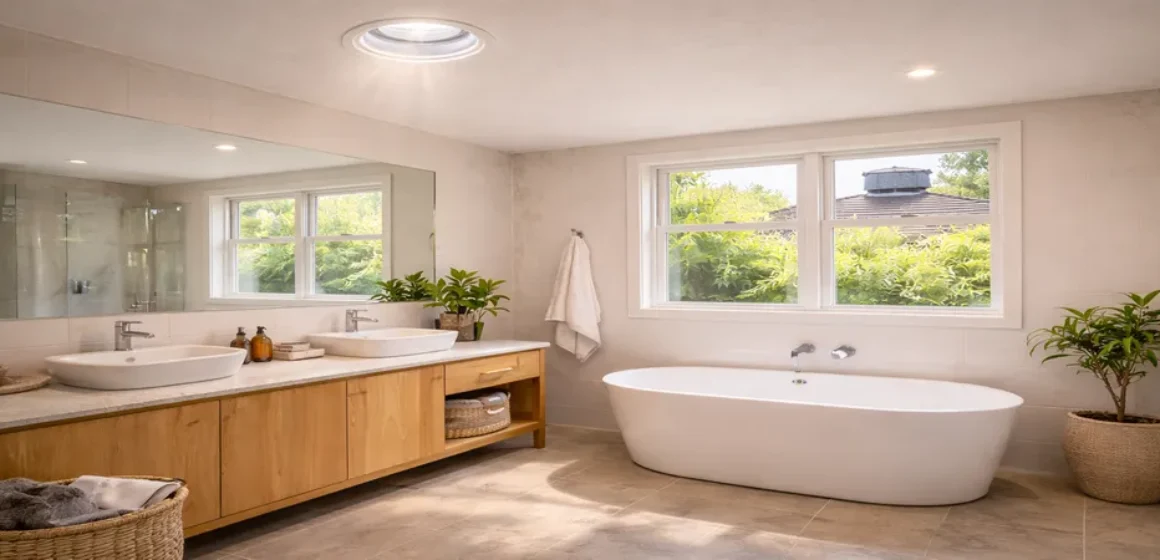
And when daylight comes from above, it often reaches the parts of the room that wall windows do not, especially in compact bathrooms.
Where roof ventilation fits (and why it can matter more than another fan)
Roof-level ventilation is powerful because it releases air where moisture naturally collects.
A vented skylight, in the right bathroom, can act as a high-level escape point. Think of it like opening the top of a bottle.
- With no high exit, humid air swirls and settles back.
- With a high exit, the room clears more quickly, especially after hot showers.
This is not about replacing a fan. In many cases, it is about improving the whole air exchange pathway.
If you want to learn more about vented skylights
A practical “mould cycle check” you can do this week
Instead of focusing on the mould spot itself, look at how the room dries.
After a normal shower day:
- Does the room smell damp in the evening?
- Are towels still damp the next morning?
- Do corners stay wet longer than the rest of the room?
- Does condensation cling to the ceiling or upper walls?
If yes, the room is not clearing moisture efficiently between use.
That is the cycle.
The comfort-first strategy to break the cycle
The goal is not to chase mould endlessly. The goal is to change the conditions that keep inviting it back.
Step 1: Confirm your extraction is doing real work
- Ensure the fan ducts outdoors (not into a roof space)
- Run it long enough to clear humidity (not just until the mirror clears)
Step 2: Make sure fresh air can enter the bathroom
If air cannot enter, air cannot leave effectively. Simple changes can help:
- allow a modest under-door gap
- avoid sealing the room too tightly during the dry-out window
Step 3: Add a high-level release point if humidity lingers
If the bathroom remains heavy and damp hours after showers, high-level venting may be the missing piece.
This is where a vented skylight can change behaviour, especially in:
- windowless bathrooms
- ensuites with limited opening windows
- bathrooms used frequently through the day
Step 4: Introduce daylight that reaches the “problem zones”
If your bathroom is consistently shaded, a skylight can help create a drier-feeling room by improving how surfaces warm and dry.
In smaller bathrooms, that “above light” can be more useful than adding another wall window, simply because it reaches deeper.
Illustrative example only: a realistic NZ scenario
A homeowner in Wellington kept seeing mould return around the shower ceiling line, even after regular cleaning. The extractor fan worked, but the room still felt damp late in the day.
A simple review highlighted a pattern:
- showers were frequent
- the room had limited fresh-air entry
- humidity lingered near the ceiling
Once the airflow pathway was improved and roof-level venting and daylight were introduced as part of a comfort-first plan, the bathroom began drying faster between use.
The outcome was not a promise of “no mould ever again”. It was a change in the room’s daily behaviour. Less lingering damp, less repetition, and fewer conditions for mould to re-establish.
What not to expect (and what to expect instead)
It is worth being realistic.
A skylight or vented skylight is not a magic switch that eliminates mould on its own. Bathrooms still need sensible habits.
But when daylight and airflow are improved together, homeowners typically notice:
- the room feels fresher after use
- surfaces dry faster
- the “damp smell” becomes less common
- mould takes longer to return, or returns less aggressively
That is often the difference between constant maintenance and manageable upkeep.
A sensible next step if mould keeps returning
If bathroom mould is repeating despite cleaning, it is usually worth stepping back and looking at airflow and drying, not just the visible spot.
If you share a few photos and tell us whether the bathroom has windows, how often it is used, and when the room feels damp, we can help you work out whether a skylight, a vented skylight, or a simpler airflow adjustment is the best next move.
Start here: https://inquiry.skylights.co.nz/inquiry