Building it in from day one: skylights in new builds and group homes across NZ
When you build from scratch, you get a rare opportunity: to decide how light will move through your home before any walls go up.
Plans for new homes often include:
- generous glazing to outdoor areas
- open-plan living and kitchen spaces
- media rooms, studies and extra bedrooms.
What can be less obvious on paper is how the middle of those spaces will feel at 10am on a winter morning or 4pm on a cloudy day.
Skylights and roof windows, when designed in from day one, can:
- bring daylight into the centre of the plan
- support energy and comfort goals
- reduce the need for future retrofits.
Illustrative Example Only: “We built a new home on the outskirts of Tauranga with a long open-plan living area. Our designer suggested skylights over the central zone, not near the sliders. Now the whole room feels balanced throughout the day, and we rarely turn lights on before evening.”
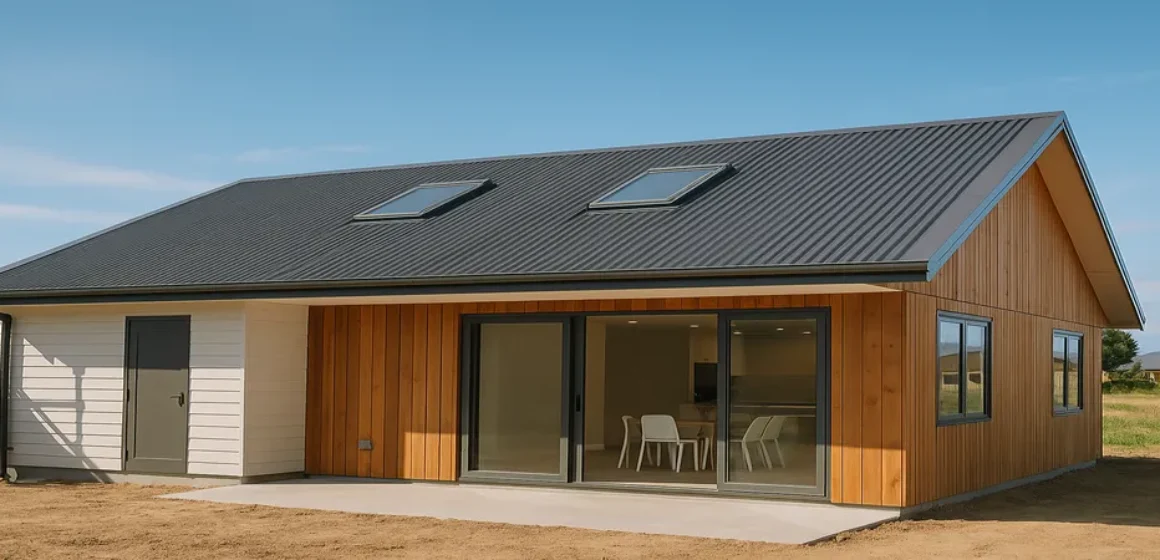
This article focuses on skylights in NZ new builds and group homes – how to plan them early, what to discuss with your builder, and the difference between treating skylights as a feature and treating them as part of the home’s daylight strategy.
1. Why new builds are the easiest place to get skylights right
You can add skylights later, but starting with a blank page has clear advantages.
Structure and services designed around them
In a new build, designers and builders can:
- align skylights with rafters, trusses and beams
- plan shafts to avoid key services
- integrate openings into the roof layout from the outset.
This reduces the need to work around unknown framing or older construction.
Roof, insulation and ventilation all considered together
Because everything is being built at once, skylights can be part of a coordinated approach to:
- insulation levels
- heating and cooling strategies
- mechanical and natural ventilation.
This can make it easier to meet modern performance expectations without compromise.
No existing rooms to work around
You are not constrained by:
- existing window positions
- ad-hoc lean-tos
- inherited dark corridors.
Instead, you can decide where you want light from above, then let that influence the final layout.
2. New build patterns where skylights add the most value
Skylights do not have to appear in every room. In many NZ new builds, a few strategic locations make the biggest difference.
Long open-plan living / kitchen / dining spaces
In many designs, these spaces stretch from front to back with large sliders at each end.
Skylights can:
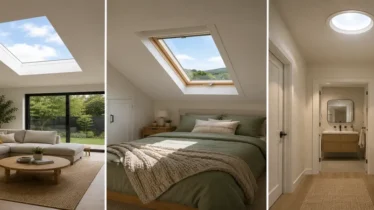
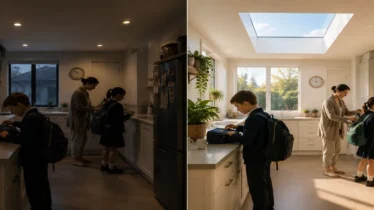
- bring balanced light into the central zone
- reduce contrast between bright doors and darker internal walls
- make dining tables, islands and sofas feel more welcoming.
Internal bathrooms, ensuites and toilets
In compact or grouped plans, some wet areas sit away from external walls.
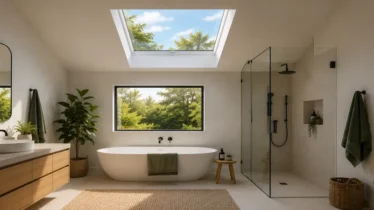
Here, skylights or tubular units can:
- provide natural light in rooms that would otherwise rely fully on artificial lighting
- support a sense of space and comfort
- work alongside ducted extraction for moisture control.
Central halls, stairs and internal studies
Even in new homes, some circulation spaces and study nooks sit away from windows.
Skylights in these areas can:
- make daily routes through the home feel more pleasant
- support focused daytime work in small, central study spots
- reduce the need for day-long artificial lighting.
3. Working with group home and volume builders
Many New Zealanders build through group home companies or volume builders using standard plans.
Understanding the base plans
Standard plans are typically optimised for:
- efficient construction
- affordability
- broad appeal.
They may or may not include skylights by default.
It helps to:
- ask for daylight-oriented views in the design stage (where is light coming from at different times?)
- identify internal zones that feel distant from external glazing
- note any windowless wet areas or long internal corridors.
Asking the right questions
When discussing skylights with your builder, useful questions include:
- Which of your standard plans already include skylights, and why?
- In this plan, where do you see opportunities for light from above?
- Are there any roof or truss constraints we should be aware of if we add skylights?
You are not asking the builder to redesign the house, but inviting them to explain how skylights fit into their existing systems.
Customising without overcomplicating
Some group builders offer accessory packs or upgrade options.
If skylights are not formally listed, it may still be possible to:
- add tubular skylights to long halls or internal toilets
- incorporate a small number of larger units in key living areas
- coordinate installation with the roofing contractor.
The aim is to choose a small number of well-considered skylights, rather than scattering them everywhere.
4. Design first: mapping daylight in a plan
Before choosing specific skylights, it helps to read your plan through a daylight lens.
Following the sun for your site
Ask your designer or builder to walk you through:
- where north is on your site
- how the main living spaces are oriented
- what shading is likely from neighbouring homes or landscape.
Skylights can then be:
- positioned to complement, not duplicate, existing glazing
- used to bring light into areas currently far from any external wall.
Thinking in sections, not just plans
Daylight travels vertically as well as horizontally.
Looking at cross-section views helps you understand:
- ceiling heights and roof slopes
- how light might fall from a skylight onto walls and surfaces
- where shafts can be run without clashing with structure.
A small adjustment in ceiling shape or room position on paper can save much larger compromises later.
5. Comfort, performance and future-proofing
New homes are generally built to higher insulation and glazing standards than older housing. Skylights should match that level.
Energy and thermal considerations
To keep performance consistent:
- choose skylights with appropriate double glazing
- consider Low-E glass where climate and design justify it
- ensure shafts are insulated to a similar standard as ceilings.
Light control in media rooms and bedrooms
In new builds, dedicated media rooms and multi-use living spaces are common.
Skylights can work here if:
- blinds or shades are included from the start
- skylight positions are planned around screen locations
- sleep habits and shift work are considered in bedroom design.
Ventilation and indoor air quality
In higher-performing homes, ventilation strategies matter.
Vented skylights or roof windows can support:
- purging warm air from upper-level spaces in the evening
- providing extra fresh-air options in studies or living rooms
- working alongside mechanical systems, not replacing them.
6. Budget, value and what to prioritise
Every new build budget has limits. Skylights sit alongside many other decisions.
Choosing high-impact locations first
If budget allows only a few skylights, prioritise:
- the central part of your main living space
- any internal bathrooms or ensuites
- long internal corridors or stairs.
These are the areas where better daylight often has the greatest everyday impact.
Comparing against other upgrades
Skylights are not a substitute for:
- sufficient heating
- good insulation
- quality windows and doors.
If those fundamentals are not yet at a solid level, it can be wise to:
- secure them first
- then use skylights as a way to refine comfort and light, not to fix underlying issues.
Thinking about long-term liveability
Consider how you are likely to use the home over time:
- will there be children, guests, home-based work?
- could an internal room or nook become a future study or bedroom?
- is there a risk you will later wish you had added skylights to certain areas?
A small investment in a couple of skylights can sometimes prevent a more expensive retrofit later.
7. Planning path – bringing skylights into your new build conversation
To make skylights part of your new build from the beginning, this planning path can help.
Step 1 – Gather your initial plans and sun path information
Ask your designer or builder for plans that clearly show orientation and any shading assumptions.
Step 2 – Mark where you expect to spend most of your daytime hours
Highlight living, kitchen, dining, home office and play areas.
Step 3 – Identify internal zones far from external walls
Note bathrooms, corridors, stairs and any windowless rooms.
Step 4 – Sketch possible skylight zones with your designer
Treat skylights as part of the daylight strategy, not a separate add-on. Mark zones rather than exact sizes at first.
Step 5 – Share plans with a skylight installer
An installer can confirm feasibility, suggest product types and talk through any structural or roofing implications before details are finalised.
8. Next steps – designing daylight, not just floor area
A well-designed new build feels good to live in not only because of its floor plan, but because light, temperature and air are all considered from the start.
Skylights and roof windows can be an integral part of that, especially when they:
- are planned alongside windows, heating and ventilation
- focus on the internal parts of rooms that would otherwise miss out on daylight
- support both everyday comfort and long-term flexibility.
If you are in the design stage of a new build or group home:
- ask your designer or builder to walk you through how natural light will behave in key spaces
- highlight any zones that still feel like they might rely heavily on artificial lighting
- gather your plans and a short note about how you hope the home will feel during the day.
Skylights.co.nz can help connect you with installers across New Zealand who understand the realities of new builds, group plans and modern performance expectations.
Make an enquiry via Skylights.co.nz
If you share your region, a copy of your plans and a few comments on how you picture living in the home, an installer can usually outline one or two skylight strategies that fit your design rather than fight it.
FAQs – skylights for new builds and group homes in NZ
Q1. Is it cheaper to include skylights during a new build than to retrofit later?
Often yes. When roofs, ceilings and scaffolding are already part of the build, integrating skylights can be more efficient than returning later to open up finished work.
Q2. Do group home builders allow skylights in standard plans?
Many do, either as listed options or by agreement. It depends on the builder and plan. Discuss skylights early so they can be factored into design, pricing and roof layouts.
Q3. Will skylights affect the energy efficiency of my new home?
With suitable glazing and insulated shafts, skylights can support comfort and reduce daytime lighting needs. They should be considered alongside other envelope decisions so performance remains consistent.
Q4. Should I choose skylight products before signing the build contract?
You do not always need to select exact models early, but it helps to agree on locations, functions and approximate sizes so structure and roof layouts can be designed accordingly.
Q5. Can skylights work in single-level new builds as well as two-storey homes?
Yes. In single-level homes they are often used to bring light into central living zones, internal bathrooms and long corridors. In two-storey designs they can also support stairwells and upper-level retreats.
Q6. Who is responsible for coordinating skylight installation on a new build?
Typically your main builder or project manager will coordinate between the roofer and skylight installer. Sharing a clear brief and drawings with everyone early helps the process run smoothly.