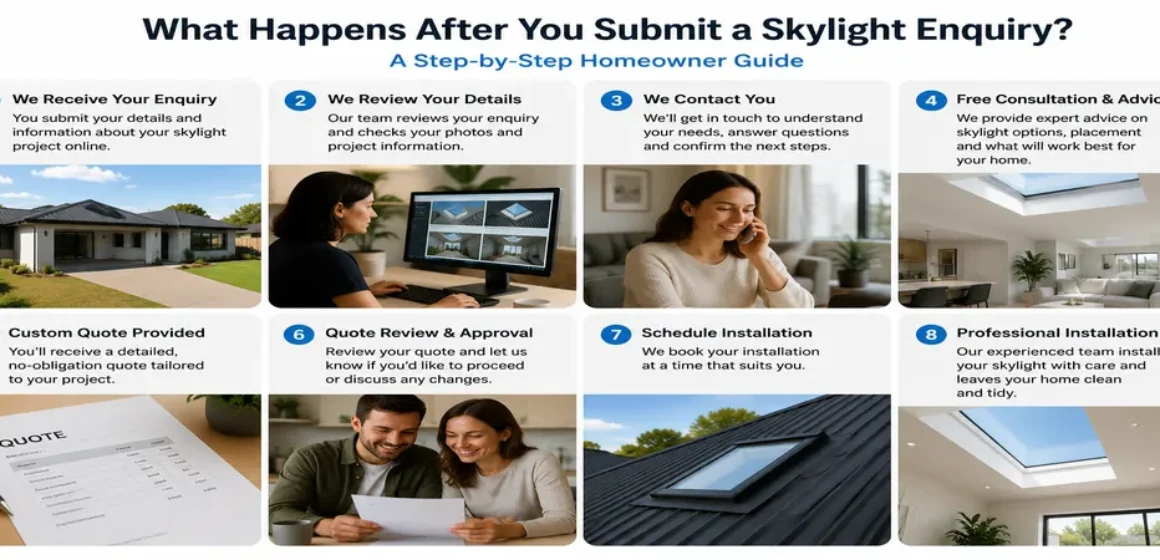
What happens after you submit a skylight enquiry? A step-by-step homeowner guide
Submitting a skylight enquiry can feel like a small step, but for many homeowners it comes with a lot of uncertainty.
Will someone call straight away? What information will they need? Do you need to know your roof type? Can a quote be prepared from photos? Will a site visit be required? How do you know whether you need a fixed skylight, vented skylight, tubular skylight or Sky tube?
These are normal questions.
Most homeowners do not enquire because they already know the technical answer. They enquire because one room in the home is not working as well as it should. A kitchen feels dark. A hallway needs lights during the day. A bathroom feels enclosed. A laundry feels dull. A bedroom or office feels flat through winter.
The skylight enquiry process is designed to turn that room problem into a clearer daylight recommendation.
This guide explains what usually happens after you submit a skylight enquiry, what information helps, and how the process can move from initial details to assessment, quote, booking and installation planning.
Step 1: Your enquiry is reviewed
After you submit your enquiry, the first step is understanding what you are trying to improve.
The team will usually look at details such as:
- Your location
- The room or rooms involved
- The type of daylight issue
- Any photos you have provided
- Whether ventilation is also a concern
- Whether the project is a new installation, retrofit or replacement
- Whether roof or renovation work is already planned
- Any notes about roof type, access or timing
The goal is not to force a product recommendation immediately.
The goal is to understand the room, the problem and the likely next step.
A homeowner may ask for a skylight, but the room may be better suited to a tubular skylight. Another homeowner may ask about a tubular skylight, but the room may need a fixed skylight if it is larger or visually important. A bathroom may need a daylight discussion and a ventilation discussion.
This is why the enquiry review matters.
Step 2: The room problem is clarified
A good skylight conversation starts with the room.
You may be asked about:
- When the room feels darkest
- Whether lights are used during the day
- How often the room is used
- Where you want the daylight to land
- Whether privacy is a concern
- Whether glare or summer heat matters
- Whether moisture, steam or stuffiness is present
- Whether the room is being renovated or repainted
- Whether you prefer a subtle daylight source or a larger skylight feature
These questions help identify the real brief.
For example, “a dark bathroom” could mean several different things:
- The bathroom needs more daylight
- The bathroom has steam and condensation
- The bathroom has a small frosted window
- The bathroom is being renovated
- The bathroom needs privacy-friendly overhead light
- The bathroom needs better extraction as well as daylight
Each situation may lead to a different recommendation.
The clearer the room problem, the better the advice.
Step 3: Photos may be requested or reviewed
Photos are one of the most helpful parts of the enquiry process.
They help the team understand the room, ceiling, roof and practical constraints before making assumptions.
Useful photos include:
- A wide photo of the room
- A photo of the ceiling area
- A photo of the darkest part of the room
- A photo of the window and what it faces, if relevant
- A ground-level photo of the roof above or near the room
- A photo of any existing skylight, vent, extractor fan or roof feature
- A photo of any ceiling stain, mould mark or moisture concern
- Access photos if the roof may be difficult to reach
You do not need professional photos.
Clear phone photos are usually enough to begin.
You should not climb onto the roof to take photos. Ground-level roof photos are safer and can still be useful. If more detail is needed, that can be assessed properly.
Step 4: The likely product direction is considered
Once the room and photos are reviewed, the next step is considering which daylight option may suit.
This may include:
- Fixed skylight
- Vented skylight
- Tubular skylight
- Sky tube
- Roof window, where relevant
- Replacement unit, if an existing skylight is involved
The product direction depends on the room’s purpose.
Fixed skylight
Often considered for kitchens, living rooms, bedrooms, home offices and larger bathrooms where stronger daylight and a visible skylight feature are wanted.
Vented skylight
Often considered for bathrooms, kitchens, upper-level rooms or raked-ceiling spaces where daylight and airflow may both be useful.
Tubular skylight or Sky tube
Often considered for hallways, laundries, toilets, wardrobes, pantries, compact bathrooms and internal rooms where practical daylight is needed without a large skylight feature.
The product recommendation should not be treated as one-size-fits-all.
The right answer depends on the room below and the roof above.
Step 5: Roof details are checked as far as possible
A skylight becomes part of the roof, so roof details matter.
During the enquiry process, the team may try to understand:
- Roof type
- Roof pitch
- Roof condition
- Roof profile
- Flashing requirements
- Nearby valleys, gutters, ridges or roof penetrations
- Solar panels or other obstructions
- Roof access
- Weather exposure
- Whether the room sits directly below roof space
Some of this can be estimated from photos. Some may need a site visit or installer assessment.
This is normal.
A skylight quote should not be based on unsafe assumptions about the roof. Roof pitch, flashing, access and weatherproofing are important parts of the project.
If further assessment is needed, that is usually a sign the project is being handled properly.
Step 6: A site visit may be recommended
Some enquiries can move forward from photos and details. Others need a site visit.
A site visit may be recommended if:
- The roof type or pitch is unclear
- The room has a complex ceiling or roofline
- The home is two-storey or difficult to access
- The project involves a bathroom, kitchen or larger skylight
- There are signs of moisture, staining or existing roof issues
- The preferred placement needs confirmation
- The roof has solar panels, vents, valleys or other constraints
- The homeowner is unsure which room should come first
- The installation may require internal finishing or coordination with other trades
A site visit is not just about measuring.
It helps confirm what is practical, safe and suitable.
For roof work, that matters.
Step 7: Placement is discussed
Placement is one of the most important parts of the process.
The question is not only where a skylight can physically fit.
The better question is:
Where should the daylight land?
In a kitchen, the answer may be the bench or island. In a hallway, it may be the darkest central section. In a bathroom, it may be the vanity or centre of the room. In a home office, it may be a location that improves daylight without causing screen glare. In a bedroom, it may be near the wardrobe or desk rather than directly above the bed.
Placement may be influenced by:
- Room use
- Ceiling layout
- Roof structure
- Rafters or trusses
- Wiring, plumbing or ducting
- Existing lights, vents or fans
- Glare
- Privacy
- Blinds
- Summer comfort
- Roof pitch and flashing
A good skylight recommendation should balance room benefit with roof practicality.
Step 8: Ventilation is separated from daylight
Many skylight enquiries involve rooms that are not only dark, but also steamy, stale or enclosed.
This is especially common in bathrooms, laundries and kitchens.
It is important to separate daylight from ventilation.
A fixed skylight can improve natural light, but it does not open. A tubular skylight or Sky tube can provide practical daylight, but it does not provide ventilation by itself. A vented skylight may support airflow in suitable rooms, but it should not automatically replace proper extraction.
For example:
- A bathroom may need daylight and a better extractor fan
- A kitchen may need daylight over the bench and still need a rangehood
- A laundry may need daylight plus separate moisture management
- A bedroom may feel stuffy but also need heating, ventilation or window-use habits reviewed
The right enquiry process should clarify whether the room needs light, airflow or both.
That prevents the wrong product from being chosen for the wrong reason.
Step 9: A quote or proposal is prepared
Once the room, roof, product direction and placement are understood well enough, a quote or proposal can be prepared.
A good quote should make the scope clear.
Depending on the project, it may outline:
- Product type
- Product size
- Quantity
- Room or location
- Supply and installation scope
- Flashings
- External weatherproofing
- Internal finishing if included
- Exclusions
- Payment terms
- Quote validity
- Estimated timing or next steps
Not every quote includes every finishing item.
For example, plastering, painting, electrical work, blinds, access equipment or roof repairs may need to be listed separately or excluded depending on the project.
The important thing is clarity.
A homeowner should understand what is included, what is not included and what needs to happen next.
Step 10: You review the quote and ask questions
After receiving the quote, take time to review it properly.
Useful questions include:
- Does the quote match the room I want improved?
- Is the product type clear?
- Is the placement clear?
- Are flashings included?
- Is internal finishing included or excluded?
- Is electrical work required?
- Are blinds or accessories included or optional?
- Is ventilation being handled properly?
- Are any roof repairs or access requirements excluded?
- What is the expected timeline?
- What deposit or payment terms apply?
It is better to ask questions before approval than to assume.
A clear quote protects both the homeowner and the installer.
Step 11: Approval and booking
If you decide to proceed, the next step is usually approval and booking.
This may involve:
- Written confirmation
- Acceptance of the quote
- Deposit payment, if required
- Confirmation of product availability
- Installation scheduling
- Final placement confirmation
- Any site visit or pre-installation checks still required
- Coordination with other trades if relevant
Installation timing may depend on product availability, region, weather, roof access and scheduling.
For roof work, weather matters. A responsible installation should not be forced through unsafe or unsuitable conditions just to meet a preferred date.
The best outcome is a properly planned installation, not simply the earliest possible installation.
Step 12: Installation planning
Before installation, the team may confirm practical details such as:
- Access to the property
- Access to the room
- Roof access
- Weather window
- Product and flashing details
- Interior protection
- Any furniture or items that need moving
- Whether anyone needs to be home
- Approximate installation sequence
- Any internal finishing or follow-up work
For some projects, installation may be straightforward. For others, especially larger skylights, bathrooms, roof windows or more complex rooflines, planning may involve more steps.
The goal is to protect the home and complete the work properly.
Step 13: After installation
After installation, the focus should be on confirming the finish and ensuring the homeowner understands the result.
Depending on the scope, this may include:
- Final weatherproofing checks
- Internal finish review
- Operation demonstration for vented units
- Care or maintenance guidance
- Discussion of any remaining plastering, painting or electrical work if excluded
- Confirmation that the installed product matches the agreed scope
A skylight is part of the home, so the handover should be clear.
For vented skylights, homeowners should understand how to operate them properly. For tubular skylights and Sky tubes, the diffuser and daylight effect should be reviewed. For fixed skylights, glazing, blinds if included and internal finish should be checked.
What can slow down the process?
Some skylight enquiries take longer because details need to be confirmed properly.
Common reasons include:
- Missing photos
- Unclear room location
- Complex roofline
- Unknown roof type or pitch
- Hard-to-access roof
- Moisture or ceiling staining
- Existing roof damage
- Multiple rooms being considered
- Renovation timing
- Product availability
- Weather delays
- Need for a site visit
- Internal finishing questions
- Electrical or ventilation requirements
These delays can be frustrating, but they are often there to prevent poor assumptions.
A skylight is not just a decorative item. It affects the roof, weatherproofing, ceiling and room performance.
Good planning is part of the service.
How to make the process smoother
You can make your enquiry easier to assess by providing clear information upfront.
Send useful photos
Include room, ceiling, darkest area and roof photos where possible.
Describe the room problem clearly
Say what feels wrong with the room, not just what product you think you want.
Mention ventilation or moisture
If the room is steamy, damp or stuffy, include that information early.
Be clear about timing
Mention whether the work is urgent, part of a renovation or being planned for a future season.
Share known roof details
If you know your roof type, roof age or recent roof work, include it.
Ask questions early
If you are unsure about product type, placement or scope, ask before approval.
A clear enquiry helps the team provide clearer advice.
What you do not need to know before enquiring
You do not need to know everything before submitting an enquiry.
You do not need to know:
- The exact skylight size
- The roof pitch
- The technical flashing type
- Whether the answer is fixed, vented or tubular
- The final placement
- Whether a site visit will be required
- Every roof or ceiling detail
It is enough to know which room is not working and what outcome you want.
For example:
“Our hallway needs lights on during the day, and we want a subtle daylight option if possible.”
“Our bathroom feels dark and steamy, and we want to understand whether daylight and ventilation can be improved.”
“Our kitchen bench is dark in the morning, and we want to know whether a skylight could help.”
That is a strong starting point.
Illustrative example only
A homeowner submits an enquiry for a dark hallway. They include photos looking down the hallway, the ceiling area, the darkest section and the roof from outside. They mention that the light is used during the day and that they prefer a subtle finish.
From this, the team can begin assessing whether a tubular skylight or Sky tube may be suitable. They may still need to confirm roof pitch, tube path, framing and placement, but the first conversation is already much clearer.
Another homeowner submits an enquiry for a bathroom. They include photos of the bathroom, ceiling fan, frosted window, roof area and some peeling paint near the ceiling.
This helps identify that the bathroom may need both daylight and ventilation review. The recommendation may involve a fixed skylight, vented skylight, tubular skylight or separate ventilation discussion depending on what the assessment shows.
In both cases, good information leads to better advice.
The enquiry is not a commitment
Submitting an enquiry does not mean you need to know the answer already.
It starts the process.
A good skylight enquiry should help you understand:
- What product may suit the room
- Whether the roof and ceiling need assessment
- What photos or details are needed
- Whether a site visit is recommended
- What the likely scope may include
- What questions need answering before a quote is finalised
The goal is clarity.
Once you understand the room, roof, product and scope, you can decide whether to proceed.
Planning your next step
If you have a room that feels dark, enclosed, flat or overly dependent on artificial lighting, submitting an enquiry can help clarify what is possible.
Skylights.co.nz can help you consider whether a fixed skylight, vented skylight, tubular skylight or Sky tube may suit your home, roof type and desired outcome.
To start the process, use the Skylights.co.nz enquiry form:
https://inquiry.skylights.co.nz/inquiry
You may also find these useful:
FAQs
What happens after I submit a skylight enquiry?
Your enquiry is reviewed to understand the room, daylight issue, location, photos, roof details and whether ventilation or a site visit may be needed. The next step may be a follow-up question, product recommendation, site assessment or quote.
Do I need to know what type of skylight I want before enquiring?
No. You do not need to know whether you need a fixed skylight, vented skylight, tubular skylight or Sky tube before enquiring. It is more useful to explain the room problem and desired outcome.
Can I get a skylight quote from photos?
Photos can help start the quote process and may be enough for some initial guidance. However, roof pitch, roof condition, framing, access and placement may still need further assessment before a final recommendation is confirmed.
Will I need a site visit for a skylight quote?
Some skylight enquiries may need a site visit, especially if the roof, ceiling, access, product type or placement is unclear. A site visit helps confirm what is practical, safe and suitable.
What information should I include in a skylight enquiry?
Include photos of the room, ceiling, darkest area and roof if possible. Also explain which room needs daylight, when it feels darkest, whether ventilation or moisture is a concern, and whether renovation work is planned.
What happens after I approve a skylight quote?
After approval, the next steps usually include quote acceptance, deposit if required, product confirmation, installation scheduling, weather-window planning and any final placement or site checks needed before installation.