Stairwell Skylights in Taupō and Waikato Homes: Safety, Light and Placement
A stairwell can shape how a home feels more than people expect.
It may connect bedrooms to living areas, link a lower-level garage to the main floor, sit beside an entryway, or lead to a mezzanine, loft, split-level space or upper hallway. It is not always treated like a room, but it is used every day. When it feels dark, the movement through the home can feel less comfortable.
This becomes especially noticeable in winter.
A stairwell that feels acceptable in summer may feel dull from June onwards. The landing may sit in shadow. The lower section may rely on artificial lighting during the day. A narrow stairwell may feel closed in. A split-level home may have daylight in the living room but poor light on the stairs. The space may be safe enough, but not as clear, welcoming or connected as it should be.
For homeowners considering a stairwell skylight Taupō or wider stairwell skylight Waikato solution, the goal is not simply to add brightness.
The better goal is:
Bring daylight into the stairwell in a way that improves visibility, comfort and movement without creating glare, harsh contrast or installation issues.
A fixed skylight may suit some stairwells where stronger overhead daylight is wanted. A tubular skylight or Sky tube may suit compact landings, stair transitions or upper hallway areas where practical daylight is enough. A vented skylight may be worth considering in some high or warm stairwell spaces where airflow is also part of the issue.
This guide explains how to think clearly about stairwell skylights in Taupō and Waikato homes before making an enquiry.
Why stairwells are different from standard rooms
A stairwell is not used like a bedroom, kitchen or living room.
It is a movement space. People pass through it many times a day, often while carrying laundry, groceries, bags, children’s items, tools or household gear. A stairwell may also be used early in the morning, late in the evening, during winter afternoons and in low-light conditions.
That means daylight has a practical role.
It can help:
- Improve visibility on steps and landings
- Make movement through the home feel clearer
- Reduce the sense of enclosure
- Connect upper and lower levels
- Make an entry or hallway feel more welcoming
- Help a split-level layout feel less disconnected
- Reduce daytime reliance on artificial lighting in suitable spaces
- Make the stairwell feel like part of the home, not just a passage
A stairwell skylight needs careful planning because light behaves differently on stairs.
Poor placement can create glare, bright patches, deep shadows or uneven contrast on steps. Good placement can make the space feel naturally clearer.
The goal is not maximum brightness.
The goal is usable daylight.
Why Taupō and Waikato stairwells can feel dark
Taupō and Waikato homes include many different layouts.
Some homes have split levels, sloping sites, internal access garages, upper bedrooms, loft-style spaces, lake or rural outlooks, compact townhouses, older homes with central staircases, or newer homes with stairwells tucked into the floor plan.
A stairwell may feel dark because:
- It has no window of its own
- It relies on borrowed light from landings
- It sits in the centre of the home
- It connects to an internal garage
- It is shaded by a roof overhang or covered entry
- It has a narrow layout
- The upper landing blocks daylight from reaching lower steps
- The walls or flooring are dark
- It is beside a closed hallway
- It sits under a complex roof section
- The existing lighting is functional but flat
In winter, these issues can become more obvious. The stairwell may need artificial lighting even during the day, especially if the connected hallway, entry or landing is also dark.
A skylight may be worth considering where the stairwell lacks useful daylight and the roof or ceiling layout can support a suitable option.
Safety is about visibility, not just brightness
When people think about stairwell safety, they often think about handrails, step height, surface grip and lighting.
Daylight also has a role, but it must be planned properly.
A stairwell does not need harsh light. It needs clear, balanced visibility.
Good daylight can help people see:
- Step edges
- Landings
- Turns
- Handrails
- Wall changes
- Floor transitions
- Low ceiling areas
- Objects left on stairs
- Changes in surface colour or material
But poorly placed daylight can create problems.
A skylight that produces a bright patch at the top of the stairs may make lower steps look darker by contrast. Strong light from the wrong angle may create glare on polished timber, tiles, glass balustrades or painted walls. Light that falls unevenly may make the stairwell feel visually confusing.
This is why stairwell skylight placement needs more care than some other areas.
The purpose is not to make the stairwell dramatic.
The purpose is to make movement through the home feel clearer and more comfortable.
Start with the stairwell type
Before choosing a skylight, identify the type of stairwell.
Different layouts need different thinking.
Straight stairwell
A straight stairwell may need daylight along the length of the stairs or at the landing. Placement should avoid creating too much brightness at one end while leaving the other end dull.
Stairwell with a landing
A landing can be a useful daylight target. If the landing is brightened well, it may help both the upper and lower sections feel clearer.
Split-level stairwell
Split-level homes often have short runs of stairs between living areas, entries or bedrooms. These may need subtle daylight that helps the transition feel more natural.
Internal garage stairwell
A stairwell from an internal garage can feel especially dark. A tubular skylight or Sky tube near the upper landing or transition area may be worth considering if the roof path allows it.
Stairwell beside an entry
If the stairs are near the front door, the entry and stairwell should be assessed together. A skylight may need to support both arrival and movement.
High stairwell or void
A taller stairwell may suit a fixed skylight, depending on roof and ceiling structure, but glare and access need careful planning.
The stairwell type should guide the skylight option.
Where should daylight land in a stairwell?
Placement is the most important decision.
Daylight should land where it helps people move through the stairwell safely and comfortably.
This may be:
- Over the landing
- Near the upper stair opening
- Along the centre of the stairwell
- Near the bottom transition
- Above a turn in the stair
- Near the entry-stair connection
- At the top of an internal garage stairwell
- In the upper hallway connected to the stairwell
The best position is not always directly above the stairs.
Sometimes daylight works better near a landing, where it can spread into both directions. Sometimes the top of the stairwell is the right location because it brightens the transition into an upper hallway. In compact spaces, a tubular skylight or Sky tube may provide enough daylight near the landing without needing a large opening.
Ask:
- Which part of the stairwell feels darkest?
- Are the steps clearly visible during the day?
- Does the landing feel dull?
- Is the lower section darker than the upper section?
- Does the stairwell connect to a dark hallway or entry?
- Is glare already an issue?
- Would daylight improve movement, or only appearance?
A stairwell skylight should be planned from the way the space is used.
Fixed skylights for stairwells
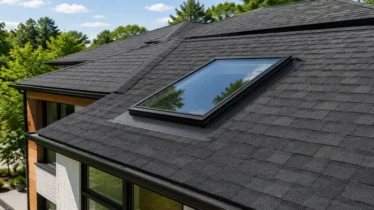
A fixed skylight may suit some stairwells where stronger overhead daylight is wanted and the roof and ceiling layout support a larger opening.
It may be worth considering when:
- The stairwell has a high ceiling or void
- The landing needs stronger daylight
- The stairwell feels enclosed during the day
- The space connects to an entry or hallway
- A visible skylight would suit the architecture
- Ventilation is not the main concern
- Glare and contrast can be managed
- The roof and ceiling structure are suitable
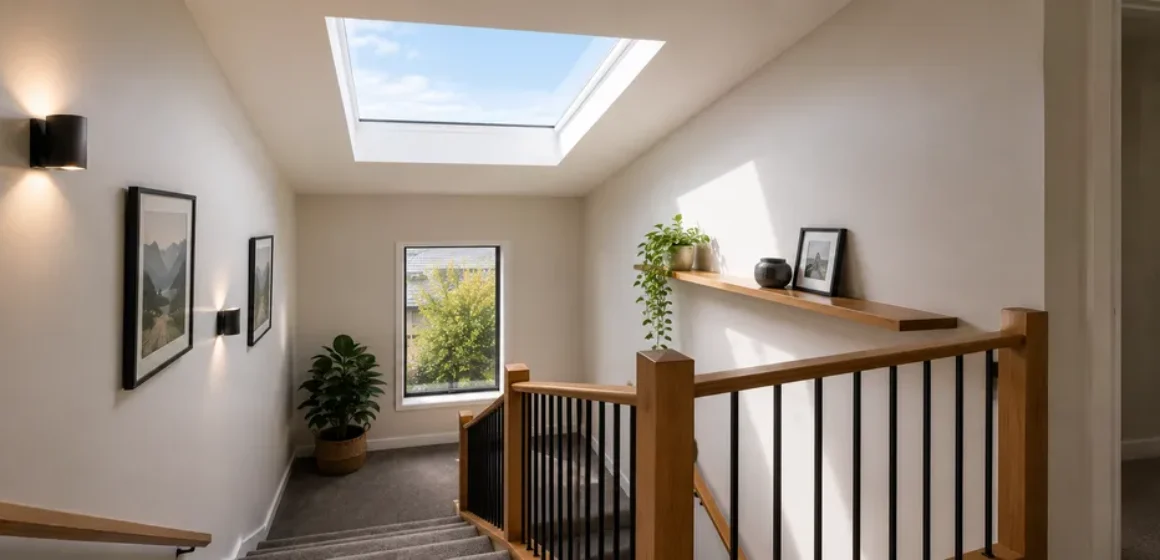
A fixed skylight can help make a stairwell feel more open and naturally connected to daylight. It may be especially effective in taller stairwells, split-level entries or spaces where the stairs form a visible part of the home.
However, stairwells require careful size and placement decisions.
Too much light in one location can create strong contrast. Placement near glossy surfaces, glass balustrades or polished stairs needs attention. If the skylight is high, cleaning and maintenance considerations should also be discussed.
A fixed skylight can be a strong option, but it must serve the stairwell’s movement and visibility needs.
Tubular skylights and Sky tubes for stairwell landings
A tubular skylight or Sky tube may suit stairwells where practical daylight is needed without a large visible skylight.
This may apply to:
- Small stair landings
- Upper hallway transitions
- Internal garage stairs
- Compact split-level stair areas
- Narrow stairwells
- Stairwells where a full skylight would feel too large
- Areas where subtle daylight is enough
- Homes where roof-to-ceiling tube path is suitable
A tubular skylight brings daylight from the roof through a reflective tube and delivers it through a ceiling diffuser. In a stairwell, this can help brighten the landing or transition area without overwhelming the space.
This can be particularly useful where the stairwell itself is compact, but the upper landing or hallway feels dark during the day.
A tubular skylight or Sky tube does not provide ventilation by itself. If airflow is also a concern, that needs separate discussion.
Tube path, roof type, roof pitch, bends, ceiling position and obstructions all need assessment.
Vented skylights in stairwell spaces
A vented skylight may be worth considering in some stairwells, but it should be chosen for a clear reason.
Stairwells can sometimes collect warm air, especially in taller homes, loft-style spaces, homes with high ceilings or areas where warm air rises from lower levels. In those situations, a vented skylight may support airflow when used appropriately.
It may be worth discussing when:
- The stairwell is tall or open
- Warm air gathers near the top
- The upper landing feels stuffy
- The stairwell connects to bedrooms or a loft
- Natural airflow is part of the wider home improvement plan
- The skylight can be operated conveniently
- The roof and ceiling layout are suitable
However, a vented skylight is not automatically better than a fixed skylight.
It may involve more cost, operation planning, controls and maintenance considerations. If the main issue is daylight, a fixed skylight or tubular skylight may be enough.
A vented skylight should solve a real airflow need.
Otherwise, it may add complexity without enough benefit.
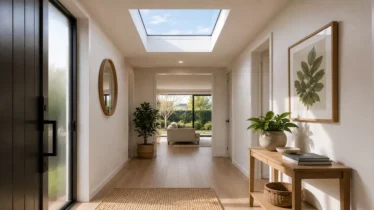
Stairwells near entries
Many stairwells sit near the entrance of the home.
This creates an opportunity and a risk.
If planned well, a skylight can improve both the entryway and the stairwell, making the home feel brighter from the moment someone walks in. If planned poorly, it may brighten the wrong spot and leave the stairwell or hallway still feeling dull.
When the stairwell is near an entry, consider:
- Does the front entry feel dark?
- Does the stairwell feel dark?
- Is the landing the main problem?
- Would one daylight point help both areas?
- Does the front porch reduce light into the entry?
- Is the hallway also dark?
- Would a fixed skylight or tubular skylight be more suitable?
- Is glare likely on the stairs or entry flooring?
The entry, stairs and hallway should be assessed together.
A stairwell skylight may be part of a broader daylight improvement for the first part of the home.
Stairwells from internal access garages
Internal garage stairwells can feel especially disconnected from natural daylight.
This is common where the garage sits below or beside the main living area, and the stairwell becomes a practical route into the home. The space may be used every day, but it may feel dim, narrow or purely functional.
A skylight, tubular skylight or Sky tube may be worth considering if:
- The stairwell has no useful natural light
- The garage entry feels dark during the day
- The upper landing lacks daylight
- The stairwell connects to a hallway or laundry
- The room needs practical brightness rather than a feature
- The roof path allows a suitable solution
In many cases, a tubular skylight or Sky tube near the upper landing may be more practical than a full fixed skylight over the stairs.
However, every layout is different.
The stairwell, garage entry, hallway and roof path should be reviewed together.
Split-level homes
Taupō and wider Waikato homes may include split-level layouts, especially on sloped sections or homes designed around views, garages or living zones.
Split-level stairs may be short, but they can still feel dark or awkward if they sit between rooms with different light levels.
A skylight may help where:
- The split-level transition feels dull
- The stairs sit between darker zones
- The landing lacks natural light
- A lower level feels disconnected from the upper level
- The stairwell relies on artificial lighting during the day
- A fixed skylight, tubular skylight or Sky tube can be placed effectively
Split-level stairwells need careful contrast control.
If the living room is bright but the stairs are dark, daylight may help the transition. If the stairs become much brighter than the connected rooms, the result may feel uneven.
The aim is to make movement through the levels feel natural.
Glare on stairs
Glare matters in stairwells.
Strong light can reflect off:
- Polished timber treads
- Tiles
- Glass balustrades
- Painted walls
- Metal handrails
- Gloss finishes
- Windows near the stairwell
- Framed artwork
- Mirrors or decorative features
Glare may make steps harder to read, especially where bright and dark areas sit close together.
Before choosing placement, consider:
- Where the daylight will fall
- Whether step edges remain clear
- Whether the light source faces people moving up or down
- Whether reflective surfaces are present
- Whether blinds or diffused daylight may be useful
- Whether a tubular skylight may provide a softer result
- Whether the stairwell is used heavily during the day
A stairwell skylight should improve visibility.
It should not create harsh reflections or visual confusion.
Shadows and contrast
Stairwells are sensitive to contrast.
If one part of the stairwell becomes very bright and another part remains dark, the steps may feel less visually clear. A bright upper landing and dark lower run can sometimes make the transition feel awkward.
This is why balanced daylight is important.
A good skylight plan should consider:
- How light spreads through the stairwell
- Whether the landing or steps receive the main daylight
- Whether lower sections remain too dark
- Whether artificial lighting still supports the space
- Whether wall colour affects brightness
- Whether multiple smaller daylight points are better than one strong opening
- Whether a diffuser-style option creates softer light
The goal is not to eliminate every shadow. That is unrealistic.
The goal is to avoid harsh contrast that makes the stairwell less comfortable to use.
Artificial lighting still matters
A stairwell skylight does not replace artificial lighting.
Stairs must remain safe and usable at night, early morning, during dark weather and whenever daylight is low. Artificial lighting is still essential.
A good stairwell lighting plan may include:
- Natural daylight from a skylight, tubular skylight or Sky tube
- Step lighting, where appropriate
- Wall lights
- Ceiling lights
- Landing lights
- Two-way switching
- Sensor lighting, where suitable
- Good handrail visibility
- Lighting that avoids harsh glare
The skylight should support daytime use. It should not be the only lighting solution.
Stairwells need layered visibility.
Daylight can improve the feel of the space, but safe artificial lighting remains important.
Roof and ceiling considerations
A stairwell skylight must work with the roof and ceiling structure.
Important considerations include:
- Roof type
- Roof pitch
- Roof profile
- Flashing requirements
- Roof condition
- Water flow direction
- Valleys, ridges and gutters
- Existing roof penetrations
- Solar panels
- Ceiling height
- Ceiling cavity depth
- Rafters or trusses
- Wiring
- Plumbing
- Ducting
- Insulation
- Existing lights or sensors
- Smoke alarms
- Internal finishing requirements
- Access for installation and future maintenance
Stairwells may have high ceilings or difficult access, which can affect installation planning. If the skylight is placed high above stairs, maintenance, cleaning and operation should be considered.
For tubular skylights and Sky tubes, tube path matters. For fixed and vented skylights, framing, flashing and internal finishing are key.
The roof and ceiling may determine whether the ideal daylight position is practical.
Cleaning and access
Stairwell skylights can be harder to access than skylights in some other rooms.
This matters for:
- Cleaning
- Maintenance
- Blind operation
- Opening mechanisms
- Internal finishing
- Future inspections
- Reaching manual controls
- Safely accessing the ceiling area
If the skylight is high above stairs, a homeowner should consider whether manual operation is realistic, whether a powered or solar option is more practical, and how future cleaning or maintenance will be handled.
A fixed skylight may be simpler than a vented skylight in some high stairwell spaces if airflow is not needed.
A tubular skylight or Sky tube may also be worth considering where the aim is daylight without a large high-level feature.
The best product is one the homeowner can live with comfortably, not just admire from below.
Stairwell skylight size
Size should be handled carefully.
A stairwell may not need a large skylight. In some cases, a smaller fixed skylight or tubular skylight may provide enough daylight. In a tall or open stairwell, a larger skylight may suit the scale of the space.
Size should consider:
- Stairwell width
- Ceiling height
- Landing size
- Wall colour
- Step material
- Existing windows
- Roof orientation
- Desired daylight level
- Glare risk
- Whether the skylight is fixed, vented or tubular
- Whether the skylight is intended as a feature
- Whether one daylight point is enough
A skylight that is too small may not improve the stairwell enough. A skylight that is too large may create glare, contrast or visual dominance.
The right size is the one that improves visibility and comfort without overwhelming the space.
Stairwell skylights during renovation
Renovation is a good time to consider stairwell daylight.
Homeowners may be repainting, replacing flooring, updating handrails, improving the entry, changing lighting, finishing a garage conversion or renovating upper-level rooms. These projects can be a good opportunity to assess whether the stairwell needs better daylight.
Early planning can help coordinate:
- Skylight placement
- Ceiling lights
- Smoke alarms
- Sensors
- Wall colours
- Handrail visibility
- Stair finishes
- Electrical work
- Roofing work
- Internal finishing
- Scaffolding or access requirements
If skylight planning is left too late, placement may be limited by finished surfaces, lighting layouts or access constraints.
For Taupō and Waikato homeowners planning winter or spring improvements, assessing stairwell daylight early can prevent missed opportunities.
When a stairwell skylight may not be the first answer
A skylight may not be the right first step in every stairwell.
Other improvements may be more suitable if:
- The stairwell already has useful daylight
- The main issue is poor artificial lighting
- Step edges are unclear because of flooring or finish choices
- Handrails need better contrast
- The roof above is unsuitable
- Glare would be difficult to control
- The stairwell is too difficult to access safely
- The hallway or entry is the real problem
- The home layout is about to change
- Ventilation is the main issue, not daylight
Sometimes the first improvement should be better lighting, lighter paint, clearer step nosings, handrail updates or hallway daylight.
Other times, overhead daylight may be a strong addition.
The right answer depends on the cause of the problem.
Common mistakes with stairwell skylights
Choosing brightness over visibility
Stairs need clear, balanced light, not harsh brightness.
Ignoring glare
Polished stairs, glass balustrades and bright walls can reflect light.
Placing the skylight too high without considering access
Cleaning, maintenance and operation should be considered early.
Forgetting the landing
The landing may be the best daylight target.
Treating the stairwell separately from the entry or hallway
These spaces often work together.
Choosing a vented skylight without a real airflow need
Extra function should solve a real problem.
Assuming one skylight will light everything
Long or complex stairwells may need more careful planning.
Forgetting night lighting
A skylight supports daytime use only.
Avoiding these mistakes helps create a stairwell that feels clearer and more comfortable, not just brighter.
The Taupō stairwell daylight test
Before asking for a quote, assess the stairwell during the day with the lights off.
Ask:
- Are the steps clearly visible?
- Does the landing feel dark?
- Does the stairwell need artificial light during the day?
- Is the lower section darker than the upper section?
- Does the stairwell connect to a dark entry, hallway or garage?
- Are there reflective surfaces that could create glare?
- Is the stairwell narrow, tall, open or split-level?
- Would daylight near the landing improve the whole space?
- Is airflow also a concern?
- Would a fixed skylight, tubular skylight or Sky tube be more suitable?
- Is the roof above accessible and suitable?
- Would cleaning or operation be difficult?
This test helps identify whether the stairwell genuinely needs daylight and where that daylight should land.
It also helps prepare a better enquiry.
Illustrative example only
A Taupō homeowner has a split-level home where the stairwell connects the internal garage to the main living area. The upper living room has reasonable daylight, but the stairwell and landing feel dull during winter afternoons. The light is often used during the day, especially when carrying items from the garage.
The homeowner asks whether a skylight could help.
A tubular skylight or Sky tube near the upper landing may be worth considering if the goal is practical daylight and the roof path allows it. If the stairwell has a higher ceiling or open void, a fixed skylight may also be assessed. If warm air collects near the top of the stairwell, a vented skylight may be discussed, but only if airflow is a genuine need and operation is practical.
The best solution depends on the landing, the roof above, glare risk and how people move through the space.
The aim is not to make the stairwell a feature.
The aim is to make it clearer, safer-feeling and more naturally connected to the home.
What to send when asking for a stairwell skylight quote
Good information helps shape a better recommendation.
For a stairwell skylight enquiry, send:
- Photos of the stairwell from the bottom
- Photos from the top landing
- A photo of the landing
- A photo of the ceiling above the stairwell
- A photo showing the darkest section
- A photo showing the entry, hallway or garage connection
- A photo showing any windows near the stairwell
- Roof photos above or near the stairwell, if possible
- Approximate stairwell dimensions
- Whether the stairwell is straight, split-level, narrow, open or high
- Whether glare is already a concern
- Whether airflow is also an issue
- Whether the home is in Taupō or elsewhere in Waikato
- Whether renovation or painting work is planned
- Whether you prefer a fixed, vented, tubular skylight or Sky tube option
- The roof type, if known
These details help determine whether a skylight is suitable, which product type may make sense, and where daylight should land.
The best stairwell skylight outcome
The best result is not simply a bright staircase.
It is a stairwell that feels clearer, safer-feeling and more connected to the rest of the home.
A good outcome may mean:
- The landing feels less dull
- Step visibility is improved during the day
- The entry or hallway transition feels more natural
- The stairwell feels less enclosed
- Artificial lighting is needed less during daylight hours
- Glare and contrast are managed
- The skylight suits the roof and ceiling structure
- Cleaning and access have been considered
- Airflow is addressed separately where relevant
- The stairwell feels like part of the home, not just a passage
A stairwell may not be a room, but it still deserves careful daylight planning.
If it is used every day, it should feel clear and comfortable to move through.
Planning your next step
If your Taupō or Waikato stairwell feels dark, enclosed or overly dependent on artificial lighting during the day, it may be worth exploring whether overhead daylight could help.
A fixed skylight may suit taller stairwells, landings, entries and open stair spaces where stronger daylight is wanted. A tubular skylight or Sky tube may suit compact landings, internal garage stairwells, upper hallways and split-level transitions where practical daylight is enough. A vented skylight may suit some stairwells where airflow is also a genuine concern.
Skylights NZ can help you review which option may suit your stairwell, roof type, ceiling layout and desired outcome.
To start planning your options, use the Skylights NZ enquiry form:
https://inquiry.skylights.co.nz/inquiry
You may also find these useful:
- Skylight installation services
- Request a skylight quote
- Skylight options for NZ homes
- Entryway Skylights in Hamilton and Cambridge Homes: Making the First Space Feel Brighter
- Dark Hamilton Hallways: Why Winter Shows the Problem Clearly
- Tubular Skylights for Waikato Hallways, Toilets and Walk-in Wardrobes
- The 3pm Winter Test: Is Your Waikato Room Asking for Better Daylight?
FAQs
Is a skylight a good idea for a stairwell?
A skylight may be a good idea for a stairwell if the space lacks useful daylight and has a suitable roof and ceiling layout. Placement should improve visibility on steps and landings without creating glare, harsh contrast or access problems.
What type of skylight is best for a stairwell?
A fixed skylight may suit taller or more open stairwells where stronger daylight is wanted. A tubular skylight or Sky tube may suit compact landings, upper hallways or internal garage stairwells. A vented skylight may suit some stairwells where airflow is also needed.
Where should a stairwell skylight be placed?
A stairwell skylight should be placed where daylight improves movement and visibility. This may be over a landing, near the upper stair opening, in an adjacent hallway or above a split-level transition. Placement should avoid glare and harsh shadows on steps.
Can a skylight make stairs safer?
A skylight may improve daytime visibility in a stairwell where natural light is poor, but it should not replace proper artificial lighting, handrails, safe surfaces or clear step edges. It should be part of a wider visibility and safety approach.
Is a tubular skylight suitable for a stairwell landing?
Yes, a tubular skylight or Sky tube may suit some stairwell landings, especially where practical daylight is needed without a large visible skylight. Suitability depends on roof type, tube path, ceiling position and the shape of the stairwell.
What should I send for a stairwell skylight quote?
Send photos from the bottom and top of the stairs, the landing, ceiling, darkest section, connected hallway or entry, and roof above the stairwell if possible. Include roof type if known, whether glare or airflow is a concern, and whether renovation work is planned.