When a circular skylight becomes the hero: designing 2 m+ feature domes in NZ
1. The moment a skylight stops being “just practical”
Most skylights begin as problem-solvers: a dark hallway, a gloomy kitchen, an internal bathroom.
Every so often, the brief sounds different:
“We’re thinking about a 2.4 metre circular skylight over the main living space. We want it to be a masterpiece.”
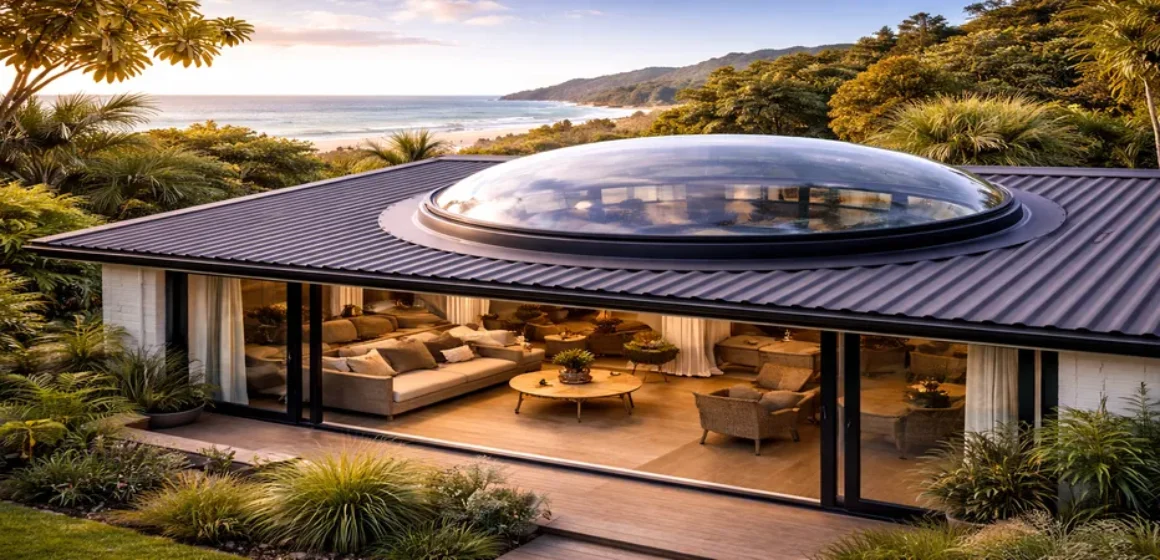
At that size, it is no longer simply a way to bring in light. It is a large circular skylight that will define the room, shape the roofline, and change how the space feels in every season.
In New Zealand, where homes sit in coastal, alpine and windy landscapes, these feature domes need to balance:
- visual impact and proportion
- shaft shape and ceiling design
- structural and roof integration
- climate, comfort and maintenance.
This article is a design-led guide to large circular skylight NZ projects. It is written to help you understand what makes a circular skylight truly heroic – and how to decide whether a 2 m+ dome belongs in your home.
All examples are Illustrative Only and kept at a high level. This is not a DIY guide.
2. What “hero” actually means – more than just “big”
It is tempting to equate “hero skylight” with “largest possible diameter”. In practice, hero status comes from how the skylight interacts with the room and the architecture.
A circular skylight becomes a hero when it:
- anchors the composition of the room
- shapes the way people move and gather
- defines the mood at different times of day
- is supported by thoughtful detailing so it feels intentional, not oversized.
Three common hero roles
In New Zealand homes, large circular domes often play one of three roles:
- Centred gathering point
- A big circle of light over a dining table, living cluster or entry.
- The room organises itself around that pool of daylight.
- Vertical connection
- A feature dome above a stair, double-height void or internal courtyard.
- Light drops through the volume, making the home feel more connected.
- Framing the sky
- A large opening in a simple roof plane that brings in sky, cloud and occasional stars.
- Often seen in modern coastal or rural homes where the sky is a key part of the experience.
If a proposed large circular skylight does not clearly fall into one of these roles, it is worth asking whether you are chasing size for its own sake – or whether a smaller, better-placed dome would serve the home more effectively.
3. Proportion, not just diameter – matching the room
A 2.4 m dome in one home might feel magnificent. In another, it could overpower the space.
Reading the room size and shape
Ask simple, non-technical questions:
- How wide is the space where people actually sit and gather?
- What is the ceiling height – standard, raised, or double-height?
- Does the room lend itself to a central focal point, or is it more of a long, flowing space?
As a rough guide:
- In a modest suburban living room, a 2 m+ dome may be too dominant unless the entire room is designed around it.
- In a large open-plan living/dining/kitchen, a big dome can feel balanced when it sits over a well-defined zone (e.g. main seating or dining area).
- In a double-height entry or stair void, a large circle can match the scale of the volume and the view of the sky.
The relationship to furniture and circulation
Large circular skylights work best when the furniture layout supports them:
- A table, rug or seating cluster that sits comfortably inside the circle of light.
- Circulation paths that pass through or alongside the lit zone without feeling exposed or harsh.
Illustrative Example Only: A Kapiti Coast home considered a 2.4 m dome in a long open-plan room. Rather than centring it on the whole space, the designer aligned the skylight over a defined living area anchored by a round rug and sofa cluster. The dome now reads as a deliberate gathering point, not a random bright spot in a long room.
4. Shaft and ceiling shape – how the hero is delivered
With a large dome, the shaft and ceiling design become just as important as the opening in the roof.
Straight-sided vs flared shafts
For 2 m+ skylights, you will often see two broad shaft approaches:
- Straight-sided shafts
- Strong, architectural expression – a clean cylinder or prism of light.
- Can feel dramatic and precise.
- May require careful planning for insulation and finishes.
- Flared or chamfered shafts
- Sides open out as they meet the ceiling.
- Light spreads more widely, softening the edge of the pool.
- Can feel more relaxed and “gathering” in living spaces.
Neither is automatically better. The decision should reflect the room’s character and the overall architecture.
Ceiling finishes – quiet or emphasised
A large circular skylight interacts strongly with the ceiling finish:
- Smooth, plasterboard ceilings with subtle paint create a calm, gallery-like feel.
- Timber linings can bring warmth and texture, especially in alpine and rural homes.
- Subtle curves or stepped details around the opening can frame the circle and help it feel intentional.
The key is consistency. If the dome is the hero, the surrounding ceiling should support it, not compete with it.
5. Structure and roof integration – what changes at 2 m+
From a homeowner’s perspective, it helps to understand that large circular skylights move into a different category structurally.
A bigger opening in the roof
Cutting a 2 m+ circle in the roof:
- removes more framing than a standard skylight
- may require beams or trimmers to re-direct loads
- often triggers a more detailed structural review.
Your design and build team will look at:
- how existing rafters or trusses are affected
- whether additional support is needed
- how to maintain or improve the roof’s performance.
Heavier dome, more substantial base
Larger domes and their bases:
- weigh more
- present more surface area to wind
- may require specific anchoring or fixings.
In coastal or high-wind parts of New Zealand, this is particularly important.
Flashings with more to do
As diameter grows, the area of roof disrupted by the opening increases. Flashings around a large circular skylight must:
- handle higher volumes of water
- cope with more complex wind patterns
- be designed as part of the overall roof solution, not as an afterthought.
You do not need to know the technical details. What matters is recognising that large circular skylight NZ projects are structural and roofing exercises as well as design gestures.
6. Climate and comfort – big light, all year round
A large circular skylight changes how a room feels not only visually, but thermally.
Coastal light – bright and shifting
In coastal regions such as Northland, Bay of Plenty, Kapiti and coastal Canterbury:
- light can be intense, with reflections from sea and sand
- wind and salt exposure are significant.
For large domes here, design teams consider:
- how to moderate glare through dome choice and shaft design
- ventilation (or pairing with other ventilation strategies) in warm months
- material and thickness choices that cope with exposure.
Alpine and inland – low winter sun and clear skies
In alpine and inland regions like Queenstown, Wanaka and Central Otago:
- sun angles shift noticeably across seasons
- winter light is precious but can be sharp when it arrives.
Large circular skylights in these climates often aim to:
- bring winter light deeper into living spaces
- avoid over-heating or glare during the long, clear days of summer
- work with good shaft insulation and overall thermal design.
Windy and exposed hill suburbs
In Wellington and exposed hill suburbs around the country:
- uplift forces and wind-driven rain demand careful detailing
- access to the roof for ongoing inspection may be more challenging.
This feeds into decisions about:
- dome thickness or material
- base system
- how the feature dome is maintained safely over time.
7. Everyday life under a hero dome – not just a photo moment
It is easy to fall in love with a single image of a huge circular skylight. To test whether it belongs in your home, imagine ordinary days beneath it.
Ask yourself:
- What does the space feel like at 7 am on a winter morning?
- How does the light fall during a summer afternoon when you might want to rest or read?
- Where will you sit for a quiet cup of tea – and does the dome support that, or work against it?
Consider:
- Whether you need a way to control light or heat, such as internal blinds or pairing with other shading strategies.
- How TV, screens and reflective surfaces will behave in the pool of light.
- Whether the dome supports calm, everyday use as well as “wow” factor.
Illustrative Example Only: A family in suburban Christchurch considered a very large dome over their living room. During the design process, they walked the space at different times of day and imagined daily routines under the skylight. They decided to slightly reduce the diameter and adjust the shaft shape to create a softer, more adaptable light pattern that worked for both quiet evenings and daytime gatherings.
8. Decision checkpoints before you commit to a large circular skylight
Before signing off on a 2 m+ dome, it can help to pause at a few checkpoints.
Checkpoint 1 – Role and proportion
- Can you clearly state the skylight’s role (gathering point, vertical connector, sky frame)?
- Does the diameter feel balanced with the room and furniture plan?
Checkpoint 2 – Roof and structure
- Have your designer and builder confirmed how the roof structure will adapt?
- Is there a clear plan for flashings and base integration on your specific roof type?
Checkpoint 3 – Climate and comfort
- Have you talked through how the dome will behave in your region’s climate across seasons?
- Is there a plan for managing heat, glare and ventilation where relevant?
Checkpoint 4 – Access and maintenance
- How will the dome be inspected or cleaned over time?
- Are there safe access routes or professional maintenance plans in place?
Checkpoint 5 – Budget focus
- What are you trading off to fund this feature?
- Would a slightly smaller dome, or a refined shaft and ceiling treatment, achieve a similar impact while freeing budget for other improvements?
Skylights New Zealand regularly helps homeowners work through these checkpoints so that large circular skylight NZ projects become enduring assets, not impulsive gestures.
Make an enquiry via Skylights New Zealand
Share your plans, room photos and a simple note about what you want the skylight to do for the space. A skylight professional can help you test whether a hero-scale circular skylight is the right move – or whether a more modest, carefully designed dome will serve you better.
FAQs – large circular skylights in NZ homes
Q1. How big is “large” for a circular skylight in NZ?
There is no strict rule, but once domes reach around 2 metres or more in diameter, they usually move into “feature” territory, with greater structural, flashing and design implications.
Q2. Can any NZ roof support a 2 m+ circular skylight?
Not automatically. The existing roof structure, pitch, profile and overall design all need to be assessed. In many cases, additional framing and detailing are required.
Q3. Are large circular skylights only suitable for new builds?
They are easier to integrate into new builds, where structure and roof layout can be planned with the dome in mind. Some renovations can accommodate large domes, but they require careful design and coordination.
Q4. Will a large circular skylight overheat my living room?
It depends on your region, dome material, shaft design and the room’s overall thermal performance. Good planning can help manage heat and glare, but they must be part of the conversation from the outset.
Q5. Are large circular skylights much more expensive than standard domes?
Yes, they typically sit in a different budget band once structure, flashing, access and installation are considered. A skylight professional can help you compare feature and non-feature options.
Q6. How do I know if a large circular skylight is right for my home?
Clarify the skylight’s role, test proportion against the room, review roof and climate considerations, and ensure maintenance is realistic. If it still feels compelling after that, it may be the right feature.