Clearer days at your desk: skylights for home offices and WFH spaces in NZ
Across New Zealand, many home offices were never designed as offices.
A desk appears in the corner of a spare room.
The dining table becomes a part‑time workstation.
A landing, hallway or mezzanine turns into a semi‑permanent study space.
On bright days, side windows can create glare on screens. On dull days, rooms start to feel like caves. Desk lamps and overhead lighting help, but the quality of light often feels tiring after hours online.
Somewhere in the mix, skylights enter the conversation:
“If we bring more natural light in from above, will it make working here feel better – or just increase glare?”
This article focuses on skylights for home offices in NZ homes – how to plan light that supports focus, comfort and long hours at a desk, rather than simply making a room brighter.
1. What good work light actually feels like
Before thinking about products, it helps to define what “good light” means for work at home.
Even, indirect and stable
For desk‑based tasks, comfortable light is usually:
- bright enough to read and write easily
- soft enough to avoid eye strain
- consistent across the day without dramatic shifts.
Harsh downlights, strong shafts of sunlight and patches of deep shadow can all make long working sessions more tiring than they need to be.
Screens, paper and faces
In a typical home office, you are often looking at:
- one or more monitors
- a laptop and notebook
- other people’s faces on video calls.
Lighting that works well for paper alone may not be comfortable for screens and calls. A skylight needs to support all three.
2. Common home office setups and their light problems
Not all work‑from‑home spaces are the same. A few common patterns show up across NZ houses.
The spare bedroom office
Often found in:
- mid‑level light conditions with one wall window
- south‑facing or side‑facing rooms with limited outlook
- spaces that feel flat on overcast days.
Issues can include:
- needing lights on most of the day
- feeling disconnected from the outside world
- one side of the room being much brighter than the other.
The open‑plan corner
In many homes, a desk sits:
- against a wall near the kitchen or dining area
- near large sliders or ranch doors
- inside a space designed for living, not focused work.
Light problems here often include:
- strong sideways glare from glazed doors
- reflections on screens in the afternoon
- a sense of distraction from changing outdoor light.
The internal nook or landing
Some homes carve offices out of:
- hallways and landings
- under‑stairs zones
- internal areas with no direct window.
These spaces may feel cave‑like. They often rely heavily on artificial light, which can start to feel oppressive over long periods.
Skylights and tubular units can respond differently in each scenario, which is why location and layout matter more than a one‑size‑fits‑all solution.
3. How skylights can support focused work
When placed and controlled well, skylights can improve the overall quality of light in a work space.
Softening contrast in mixed‑light rooms
In rooms with one strong side window, a skylight positioned over the central part of the space can:
- reduce contrast between the bright window wall and darker internal wall
- create a more even background for video calls
- make the area around the desk feel less “tunnel‑like”.
Bringing daylight into internal work zones
In internal nooks, tubular skylights or small conventional units can:
- make it easier to read documents without harsh artificial light
- help reduce the sense of working in a cupboard
- support better awareness of time passing during the day.
Offering a view of the sky without distraction
In some cases, placing a skylight slightly away from the desk itself allows:
- a sense of openness and connection to changing weather
- daylight to fall on nearby walls, brightening the room indirectly
- screens to stay free of strong overhead reflections.
4. Managing glare: the key to pairing skylights with screens
Screens and bare overhead light do not always cooperate; this is where careful planning matters most.
Positioning in relation to the desk
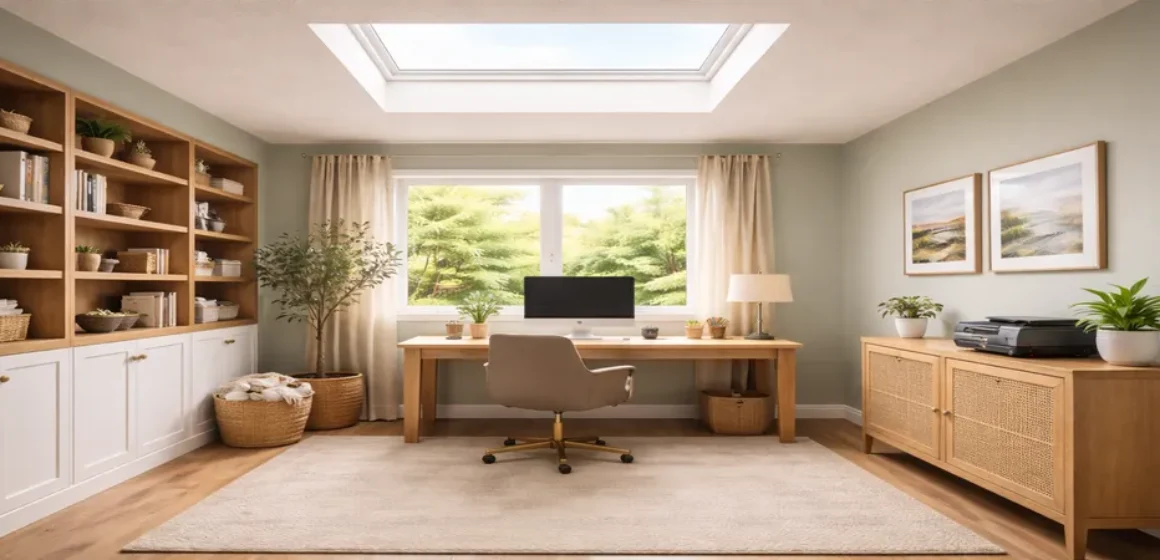
As a general guide, skylights tend to work best for home offices when:
- they are positioned slightly in front of or beside the desk, not directly above screens
- light falls onto the work surface and walls rather than the monitor face
- the main shaft of light is outside your direct line of sight when seated.
This reduces reflections and harsh contrast between screen and surroundings.
Using blinds and diffusers
For work spaces, consider skylight options with:
- built‑in blinds or shades for adjustable brightness
- diffusing elements that soften hard sunlight
- simple controls that let you adjust light for different tasks.
This is especially helpful in:
- north‑ or west‑facing roof planes with strong summer sun
- regions with bright, high‑contrast winter days.
Combining with task and ambient lighting
Even with skylights, you will still use artificial lighting, especially in early mornings and evenings. A comfortable mix often includes:
- general ambient lighting (ceiling or wall lights)
- a desk or floor lamp for focused tasks
- skylight daylight as the base layer during the day.
The goal is a flexible lighting environment that can adapt as the day and tasks change.
5. Comfort, energy and climate for all‑day work
A home office that feels good to sit in for eight hours needs more than just visual comfort.
Temperature and drafts
Longer periods at a desk can make you more aware of:
- cold downdrafts near poorly insulated glazing
- hot, stuffy air near the ceiling
- uneven temperatures between different parts of the room.
To keep conditions stable:
- match skylight performance (double glazing, Low‑E options) to your region
- ensure shafts are insulated to the same standard as surrounding ceilings
- consider vented units where warm air build‑up is likely.
Ventilation and air quality
Good air quality is essential for concentration.
Vented skylights, used alongside opening windows and mechanical systems, can help:
- flush out warm air in upper‑level offices
- provide fresh air without having to open side windows directly onto noisy streets
- support moisture control in combined bedroom‑office spaces.
The aim is to create a space where you can work with the window or skylight slightly open when conditions allow, without compromising comfort.
6. Choosing between tubular skylights and conventional units for WFH
Not every home office needs a large, dramatic skylight. In many cases, a smaller solution will do the job.
When tubular skylights work well
They are often a good fit for:
- compact internal nooks and studies
- landing offices where wall space is limited
- secondary workspaces used for part of the day.
Tubular skylights can bring a surprising amount of soft, diffuse light through a small roof opening, and are often easier to route around structure.
When to consider a larger skylight or roof window
Conventional skylights or roof windows may suit:
- dedicated home offices used all week
- larger multipurpose rooms where you want a sense of space as well as light
- attic or loft offices with sloping ceilings.
Here, the combination of sky view and increased daylight can make a room feel like a true workspace rather than an improvised corner.
Thinking about future flexibility
If your home office may later become a bedroom or secondary living space, planning skylights with that future use in mind – including blinds and thermal performance – can be helpful.
7. Planning path – preparing a clear brief for your home office skylight
A simple, organised approach will make conversations with installers more productive.
Step 1 – Observe your current workday light
Note how the room feels at 9am, midday and 3pm. When do you rely most on artificial light? When does glare appear on screens?
Step 2 – Map the room layout
Sketch your desk, chair, main storage, and any bed or sofa. Mark where screens face and where your eyes naturally look when you sit.
Step 3 – Identify the roof area above
Note whether your office sits under a simple roof plane, an eave, or a more complex junction. Take photos of the roof from outside if possible.
Step 4 – Decide your priorities
Rank what matters most: less glare, more natural light, ventilation, a sense of openness, or a mix of several.
Step 5 – Gather photos and notes for an installer
Include room photos, roof shots, your sketch and a short description of how often you work from home and at what times of day.
Skylights New Zealand can help connect you with installers across New Zealand who understand the demands of real, full‑time home offices and occasional WFH corners.
Make an enquiry via Skylights.co.nz
If you share your region, photos and a brief summary of your work pattern, an installer can usually suggest one or two skylight options that support both focus and comfort.
FAQs – skylights for home offices and WFH in NZ
Q1. Will a skylight make screen glare worse in my home office?
It can if placed directly above screens without control. With careful positioning and effective blinds or diffusers, skylights can actually reduce contrast and make glare easier to manage.
Q2. Is a skylight worth it if I only work from home a few days a week?
If your workspace is noticeably dark or cave‑like, a skylight or tubular unit can improve how the room feels on both workdays and non‑workdays. Consider how the room is used at other times as well.
Q3. Should I choose a vented skylight for my home office?
Vented units are useful in upper‑level spaces, warmer regions or combined bedroom‑offices where airflow is important. In cooler, single‑level homes, a fixed skylight paired with opening windows and mechanical ventilation may be sufficient.
Q4. Can a tubular skylight provide enough light for office work?
In small internal rooms or nooks, yes. Tubular skylights can deliver a surprising amount of diffuse light. In larger or more heavily used offices, a conventional skylight may be more appropriate.
Q5. Will a skylight make my home office too hot in summer?
Appropriate glazing, sizing, roof orientation and the use of blinds all influence heat gain. A well‑specified skylight, matched to your region and roof, is designed to support comfort rather than compromise it.
Q6. Is it better to add a skylight to my office now or wait for a renovation?
If a renovation or re‑roof is planned soon, it can be efficient to combine projects. If not, a focused retrofit in a single office or study space can still make a substantial difference to daily work comfort.