Designing calm spaces: skylights for reading corners, retreats and quiet zones in NZ homes
When people talk about renovating or building, they often start with the big spaces: the kitchen, the open-plan living area, maybe a new deck.
Yet in many New Zealand homes, the places that truly feel calm are much smaller.
A chair tucked beside a bookcase. A bench on a landing. A corner of the bedroom where the light falls just right for half an hour in the afternoon.
These are the reading corners, retreats and quiet zones that carry more of our day than we realise. They do not need to be large, but they do benefit from thoughtful light. Too dim and they become storage. Too glary and they fall out of use.
This article explores skylights for reading nooks and calm spaces in NZ homes. Rather than focusing on whole rooms, we will look at micro-spaces – small, intentional pockets of light – and how skylights can:
- create retreat spaces within existing layouts
- provide enough light to read or think without harsh glare
- add intimacy and focus, even in busy households.
We will walk through 3–4 design-led scenarios and finish with practical planning notes for both new builds and retrofits.
1. Why small, calm spaces matter in a home
A home can feel full and busy, yet still lack places to pause.
Calm spaces are often:
- slightly away from main circulation routes
- comfortable for one or two people
- defined more by light, view and sound than by size.
Daylight plays a quiet role here. A good calm space usually has:
- light that feels steady rather than harsh
- enough brightness to read, write or think without straining
- a sense of enclosure or focus that makes it easy to stay, even for a few minutes.
Skylights are not the only way to achieve this, but they can be powerful where wall windows are limited or where you want a pocket of light within a larger, more flexible room.
2. Design principles for a light-filled retreat
Before we jump into scenarios, a few simple principles help keep calm spaces comfortable.
Even, gentle light rather than a spotlight
For reading and quiet activities, the aim is usually:
- soft light falling onto pages, tablets or notebooks
- reduced contrast between the lit area and surrounding space
- no direct brightness in your line of sight when you look up.
Skylights can support this by:
- using diffused glazing or light shafts to spread light
- sitting slightly in front of or behind a seat, rather than directly overhead
- combining with pale surfaces that help bounce light around.
Intimacy in larger rooms
A small retreat within a big room needs some definition.
Skylights can help by:
- picking out a localised area – a corner, bench or window seat
- creating a “pool” of gentle light that makes the space feel special
- working with joinery, rugs or furniture to signal that this is a place to pause.
Control for different times of day
Even in calm spaces, light needs to change.
Planning for blinds or simple shading is important where:
- the sun can be strong at certain times of day
- the nook is used in the evening for screens
- the space sits next to a bedroom that needs darkness.
3. Scenario one – a reading nook in the living room
In many NZ homes, the living room does double or triple duty: family space, TV room, occasional study, and sometimes the only place to relax.
The challenge
A reading chair or daybed in the corner often competes with:
- overhead lighting aimed at the whole room
- glare from large windows or doors
- noise and activity from the rest of the household.
How a skylight can help
A carefully positioned skylight can:
- bring soft, focused light onto a specific corner
- help that corner feel distinct from the main TV or conversation zone
- keep daylight available even when curtains or blinds are partly closed on large windows.
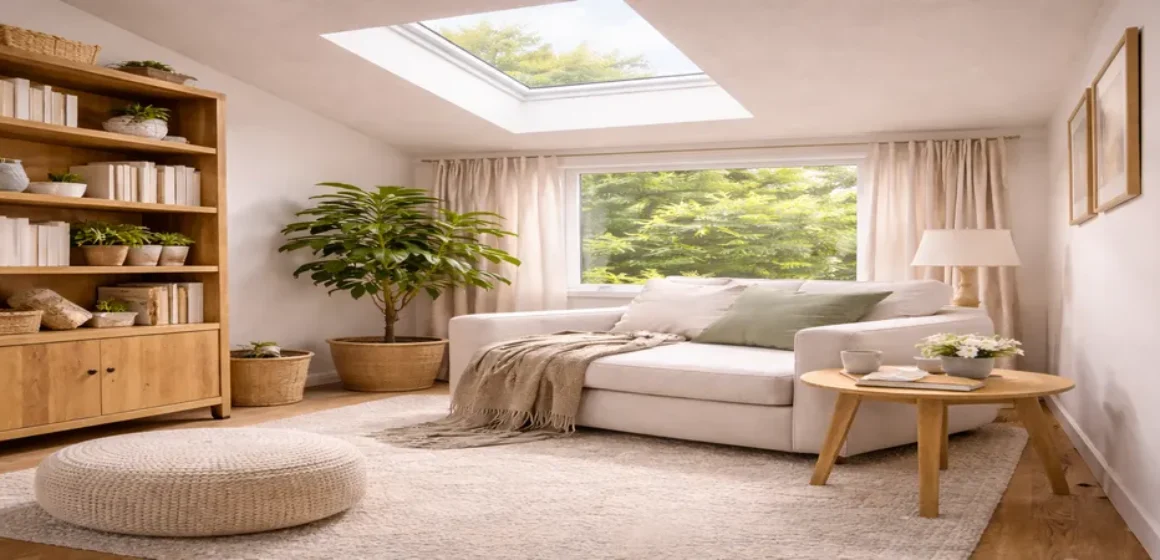
Illustrative Example Only: In an Auckland villa, a small reading nook was created beside an existing chimney breast. A compact skylight was placed so light fell across the back of the chair and wall, not straight onto readers’ faces. A low bookcase and a rug completed the space, which now feels separate from the television area without adding walls.
Design notes
When planning this kind of nook:
- avoid placing the skylight directly over where heads will rest
- check how light will fall at different times of day, especially if the home has strong afternoon sun
- coordinate artificial lighting (such as a floor lamp) so the nook works after dark.
4. Scenario two – a quiet landing or upper-level retreat
Upper landings and circulation spaces can become valuable calm zones with the right light and furniture.
The opportunity
A landing might currently be:
- a pass-through space with minimal natural light
- a place where laundry or storage tends to gather
- underused because it feels dim or purely functional.
How a skylight can help
Skylights over landings can:
- brighten circulation during the day
- create a natural place for a bench, chair or built-in desk
- connect upper-level spaces more gently with the sky and weather.
For calm use, the emphasis is on even light and safety:
- stairs and edges must remain clearly visible
- glare should not be introduced in stair users’ direct line of sight
- the space should remain comfortable, not overly hot at the top of the house.
Design notes
When turning a landing into a retreat:
- position the skylight to wash light down a wall or onto a built-in seat, rather than directly over the stair opening
- consider vented skylights where heat tends to collect
- keep furniture low-profile so circulation and safety remain clear.
5. Scenario three – a bedroom corner for reflection and pause
Bedrooms are not only for sleep. A small chair, ottoman or window seat can become a place to read, journal or simply take a moment.
The challenge
Bedrooms often have:
- one main window focused on outlook and ventilation
- heavier curtains or blinds for night-time darkness
- corners that remain underused because light does not quite reach them.
How a skylight can help
A skylight in a bedroom can:
- bring daylight into a corner without adding another wall window
- support daytime use for reading or quiet work
- create a sense of height above a seat or bench.
Managing rest and privacy
Because bedrooms need darkness and privacy, details matter:
- blinds or shutters are important for flexible control
- diffused or patterned glass can soften the feeling of openness to the sky
- placement should respect where beds are located and how people feel about light in early mornings.
Illustrative Example Only: In a Dunedin home, a small bedroom with a single south-facing window felt flat. A skylight was added above a corner chair and low bookcase, bringing in soft overhead light without changing the main window. Blackout blinds ensured the room could still be darkened completely at night.
6. Scenario four – a compact studio or “light retreat” in an existing plan
Sometimes, a calm space is not an extra corner at all – it is a small studio, study or converted area that needs light to become truly usable.
The opportunity in existing layouts
Common candidates include:
- a former storage room or box room
- a section of a garage conversion
- a small room between larger spaces with limited wall windows.
How skylights can turn it into a retreat
In these cases, skylights can:
- transform a previously dim room into a focused, single-person workspace
- reduce the need for artificial light during the day
- support activities like drawing, reading, music or craft.
Retrofitting needs careful thought around roof type, structure and access, but even one well-positioned skylight can change how such a room feels.
7. Practical planning tips – creating your own light retreat
Whether you are sketching ideas or working with a designer, a few questions can help frame the conversation.
- Where do you naturally pause today?
Look for places where you already sit, lean or put down a cup of tea – even if the space is not perfect yet. - What do you want to do in your quiet space?
Reading, writing, phone calls, stretching, listening to music, or simply thinking. - When will you use it most?
Morning, afternoon, early evening, or a mix. This influences orientation and control. - How sensitive are you to brightness and heat?
If you prefer soft, diffused light, mention this early. It affects glazing, blinds and positioning. - What can the roof above that area support?
Roof type, pitch, access and any existing structure may shape what is practical. A skylight installer can help assess this.
Skylights New Zealand works with installers and partners who understand how skylights for reading nooks and calm spaces in NZ can be woven into both new designs and existing homes.
Make an enquiry via Skylights New Zealand
If you share photos, a short description of your ideal retreat and when you hope to use it, a professional can help you explore skylight options that support calm, comfortable micro-spaces.
FAQs – skylights for reading nooks and calm spaces in NZ homes
Q1. Are skylights a good idea for reading nooks in NZ homes?
They can be, provided they are planned to give soft, even light without harsh glare. Positioning, glazing and blinds all contribute to how comfortable a reading nook feels in real use.
Q2. Will a skylight make a calm space too bright or hot?
Not if brightness and heat are considered from the start. In many cases, diffused glazing, insulated shafts and blinds are used to keep light comfortable through different seasons.
Q3. Do calm spaces always need large skylights?
No. Many successful reading corners and retreats use modest-sized skylights or tubular units. The goal is quality of light in a small area, not maximum glass.
Q4. Can I retrofit a skylight into an existing reading corner?
Often yes, depending on roof type, structure and access. An installer can advise what is practical and how to integrate a skylight with existing finishes and furniture.
Q5. How do I avoid glare on pages or screens in a reading nook?
Position the skylight so light falls slightly in front of or behind the seating, not directly overhead. Consider diffused glazing or blinds to soften direct sun at certain times of day.
Q6. Should calm spaces be fully separate from main rooms?
Not necessarily. Many effective retreats are pockets within larger rooms – defined by light, furniture and sound rather than walls. Skylights can help quietly signal those pockets without closing spaces off.