Circular skylights as centrepieces in living rooms, entries and stair voids
1. When the skylight becomes the focal point of the room
Not every skylight wants to disappear into the ceiling.
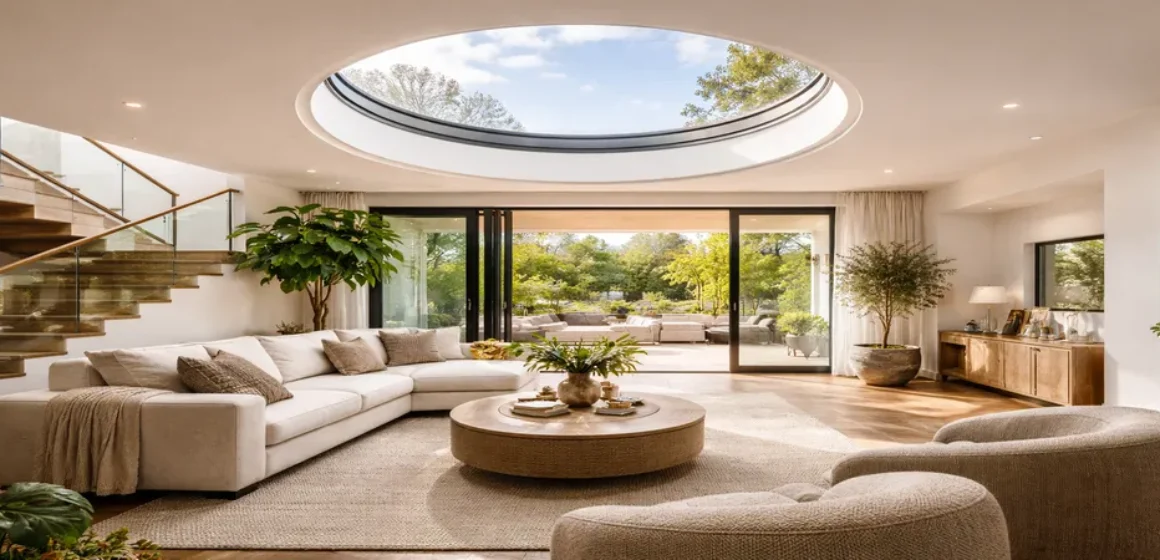
In many New Zealand homes, a circular feature skylight is treated like a pendant light, artwork or piece of furniture – something the room is quietly organised around.
- In a living room, it might draw people towards a cosy seating area.
- In an entry, it can turn a simple hall into a memorable arrival space.
- Above a stair, it can help a circulation zone feel generous and uplifting.
This article looks at circular feature skylight NZ homes through three lenses:
- Living rooms and family spaces.
- Entries and thresholds.
- Stairs and vertical connections.
Instead of chasing maximum size, we focus on how circular skylights behave in each type of space – visually, practically and in New Zealand’s varied climates.
All scenarios are Illustrative Only. They are there to help you picture possibilities before you talk with a designer or installer.
2. Living rooms – shaping how people gather
Living rooms carry a lot of jobs in NZ homes. They are where families:
- relax together after work
- host friends and extended family
- read, watch TV, play music or simply sit.
A circular feature skylight here needs to support all of that, not just look good in a photo.
Choosing the zone
Rather than centring the skylight on the entire room, start by choosing a specific zone:
- the main seating cluster
- a reading corner
- a dining table within an open-plan living space.
Positioning the circle over a clear function helps:
- keep the light where people actually spend time
- avoid glare on screens or in circulation paths
- anchor the furniture layout.
Illustrative Example Only: In a Tauranga family home, the architect located a mid-sized circular skylight over a defined conversation area – a sofa, two chairs and a coffee table on a rug. The TV wall sat off to one side, outside the most intense pool of light. The skylight reads as a gentle spotlight on gathering, not on screens.
Working with NZ light and views
- On coastal sites (e.g. Kapiti, Coromandel, Nelson), circular skylights can complement sea or hill views, adding a vertical slice of sky to horizontal views through windows.
- In inland and alpine areas (e.g. Wanaka, Central Otago), a circular skylight can bring in crisp winter light while windows frame landforms and trees.
The key is balance:
- let the skylight and windows share the work
- avoid aligning the skylight directly over high-glare surfaces such as polished benches or equipment.
Ceiling and shaft choices in living spaces
In living rooms, many homeowners favour:
- softly flared shafts that spread light more evenly across seating areas
- neutral, matte ceiling finishes that avoid harsh reflections
- subtle framing details around the circle, rather than heavy trims.
3. Entries and hallways – making arrival feel intentional
Entries do important, quiet work. They set the tone for the home before anyone reaches the main living areas.
A circular feature skylight in an entry can:
- bring natural light into an otherwise internal space
- create a sense of height and generosity, even on a compact footprint
- make everyday arrivals – school bags, groceries, guests – feel calmer.
Round light in a rectangular space
Most entries are rectangular, with doors, side lights and storage competing for space. A circular skylight offers a contrasting, soft geometry.
Design considerations include:
- Aligning the circle with the centre of the entry or a key element such as a console table or bench.
- Ensuring light falls onto surfaces people touch and see: floor finishes, hooks, artwork.
- Avoiding glare directly through the front door glass (especially in strong afternoon sun).
Illustrative Example Only: A Wellington townhouse with no front windows used a circular skylight over the entry bench and hooks. Morning light now drops onto the coat area and floor tiles, making the space feel brighter and more welcoming without changing the façade.
Ceiling height and proportion
- In standard-height entries, a moderate-diameter circle can make the ceiling feel higher without overwhelming the space.
- In double-height entries, a circular skylight can become the focal point of the void, with light filtering down to the front door area below.
Even in compact Auckland or Christchurch townhouses, a well-placed circular skylight can turn a purely functional entry into a small event.
4. Stair voids – light that connects levels
Stairs are more than a way to move between floors. When handled well, they can become one of the most memorable parts of a home.
Circular feature skylights above stairs and voids can:
- pull natural light deep into the centre of a plan
- help treads and landings feel safer and more inviting
- emphasise vertical movement in a gentle, uplifting way.
Positioning over the stair
Installers and designers pay attention to:
- where people’s eyes are as they move up and down
- how close the light is to landings and turns
- where handrails sit relative to the pool of light.
The goal is to:
- avoid harsh light directly in people’s eyes on the stair
- brighten treads and landings for better visibility
- keep shadows soft and predictable.
Void shape and skylight size
In stair voids:
- A taller, narrower void may suit a smaller circle that acts as a clear vertical beacon.
- A wider, open stair with an adjacent living space can accommodate a larger circle that lights both the stair and part of the room.
Illustrative Example Only: In a Hamilton two-storey home, a circular skylight sits above the turn in the stair. It is sized so that the main light falls on the intermediate landing and upper balustrade, making both levels feel linked without creating glare on the lower treads.
5. Comfort, not just drama – managing light throughout the day
Feature skylights still need to be comfortable over the full day and year.
Light quality morning to evening
Ask:
- What direction does the roof face?
- When will the skylight receive direct sun, and when will it provide softer ambient light?
- How does this align with how you use the room (morning coffee, working from home, evening TV)?
In practice:
- Living rooms that get strong afternoon sun may benefit from diffusing domes or shaft shapes that soften glare.
- Entries and stair voids can often handle more direct sun, as people pass through rather than sit for long periods.
Heat and ventilation considerations
In New Zealand’s varied climate, feature skylights are often designed alongside:
- insulation and shaft detailing
- cross-ventilation and, in some cases, vented skylight options
- shading approaches (particularly in sunny coastal areas).
A feature skylight that makes a room uncomfortably hot or bright in summer will not feel like a gift. Early, honest conversations about comfort are essential.
6. Roof types and what they mean for centrepiece skylights
While this article is room-focused, the roof still sets important boundaries.
Pitched longrun roofs
Common across regional and suburban NZ, pitched longrun roofs:
- work well with circular domes on square bases
- allow feature skylights to sit in line with other roof elements
- need thoughtful flashing to handle increased water flow around a feature.
Tiled roofs
On tiled villas and bungalows:
- entries and living rooms often sit under complex hips and valleys
- a circular skylight may need careful placement to avoid these junctions
- experienced installers can help find positions where the skylight feels centred in the room and rational on the roof.
Flat and low-slope roofs
In some modern coastal and city homes with membrane roofs:
- circular feature skylights can feel like deliberate, sculptural objects on a clean roof plane
- upstands, drainage and access become critical parts of the design conversation.
7. Everyday details that make feature skylights feel finished
Small decisions can heavily influence how a circular feature skylight reads in daily life.
Consider:
- Flooring under the skylight – timber, tiles or a rug can all respond differently to the pool of light.
- Furniture heights – tall shelving or cabinetry beneath a skylight can block or distort the intended effect.
- Wall colours – darker tones will deepen the contrast, lighter tones will spread the light more gently.
Illustrative Example Only: In a Nelson home, a circular skylight over the entry originally fell onto a dark mat and coat cupboard. After a simple refresh with pale floor tiles and a slim bench, the same skylight now feels brighter and more intentional.
Feature skylights are not only about the dome. They are about how the whole composition – floor, walls, furniture and light – works together.
8. Questions to ask when planning a circular feature skylight
Whether you are planning for a living room, entry or stair, a simple question set can help keep decisions grounded.
- What role will this skylight play in the room?
- Focal point, gentle background light, wayfinding cue, or all three?
- Where do people actually spend time in this space?
- Can the skylight support those areas rather than random corners?
- How does the local climate behave?
- Coastal, alpine, urban or windy hill conditions will shape comfort and detailing.
- What does the roof allow?
- Roof type, pitch and existing features may favour certain locations and sizes.
- How will this feel on an ordinary day?
- Visualise a weekday morning, a winter evening, and a quiet Sunday under the skylight.
Skylights New Zealand helps homeowners map these questions to real products and roof details so a circular feature skylight supports both the architecture and daily life.
Make an enquiry via Skylights New Zealand
Share photos of your living room, entry or stair, along with a sentence about how you’d like the space to feel. A skylight professional can then suggest circular feature options that fit your home, climate and roof.
FAQs – circular feature skylights in NZ homes
Q1. Do circular feature skylights need to be very large to work?
No. Many effective feature skylights are modest in size but carefully placed over a key zone such as a seating area, entry bench or stair landing.
Q2. Will a feature skylight make my living room too bright for TV?
Not if it is planned thoughtfully. Position, shaft design and dome choice all affect glare. Often the TV zone can sit just outside the strongest pool of light.
Q3. Are entries and stairs good places for circular skylights?
Yes. People pass through these spaces often, and natural light can make them feel safer and more welcoming. They also tend to cope well with varied light levels.
Q4. Can I retrofit a circular feature skylight into an existing home?
In many cases, yes. The feasibility depends on roof type, structure, access and room layout. A skylight professional can assess options based on site photos and plans.
Q5. Do feature skylights need blinds or shading?
Sometimes. In strong sun or very light-sensitive rooms, integrated shading or pairing with other design strategies may help. This should be part of the early design conversation.
Q6. How do I choose between a circular and rectangular feature skylight?
It comes down to the architecture and the room. Circles can soften rectilinear spaces and create strong focal points. Rectangles can align with structural grids and window layouts. Both can work well when thoughtfully integrated.