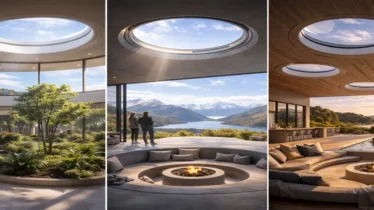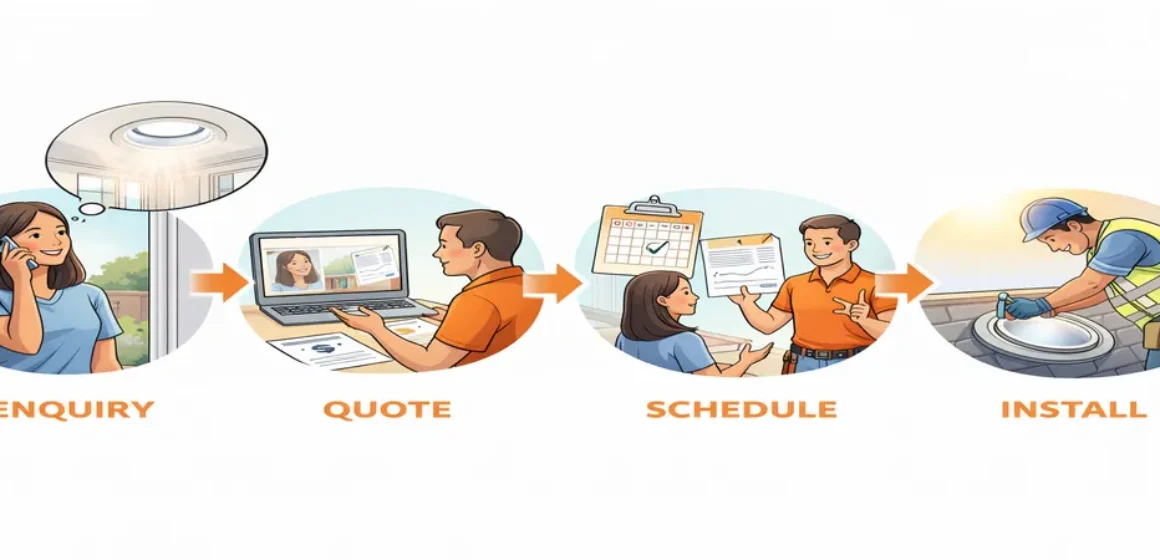
From enquiry to install: a circular skylight journey in plain English (Illustrative Only)
1. The email that starts the journey
Many circular skylight projects begin with a simple message that sounds something like this:
“Hi, we’re looking at a large circular skylight for our living area. We were quoted a glass option that seems to be about three times the price of acrylic. We’re unsure what we actually need. Can you help us understand the options?”
Behind that email are familiar concerns:
- not wanting to overpay
- not wanting to make a mistake in a key room
- not wanting to get lost in technical terms.
This article follows a fictional, Illustrative Only circular skylight installation journey NZ – from first enquiry to living with the finished skylight.
It shows, in plain English, how Skylights New Zealand typically helps homeowners work through:
- materials (acrylic, polycarbonate, glass)
- thickness (for example, 3 mm vs 4.5 mm)
- base type (circular dome on square base vs circular base)
- climate, exposure and region
- budget, comfort and maintenance.
2. Stage 1 – Clarifying the idea and the room
The first response does not start with products. It starts with the room.
The skylight professional asks for:
- a short description of the space (living, kitchen, stair, entry)
- when the room is used (day, evening, weekends)
- how it feels now (dim, flat, bright on one side, etc.)
- a few photos from different angles.
In our Illustrative example:
- The room is an open-plan living/dining space in a coastal Bay of Plenty home.
- It feels bright near the sliders, but the centre of the room is dull.
- The owners want a circular hero piece over the sitting area.
At this stage, the focus is on lifestyle and comfort, not yet on diameter or material.
3. Stage 2 – Understanding the roof, ceiling and climate
Next, the conversation shifts gently to the roof and structure.
The homeowner is asked to share:
- what kind of roof they have (longrun, tile, membrane)
- a rough sense of the roof pitch (flat, gentle, steeper)
- whether they are coastal, inland or more alpine in climate
- ceiling height and type in the room (flat, raked, double-height).
In the example:
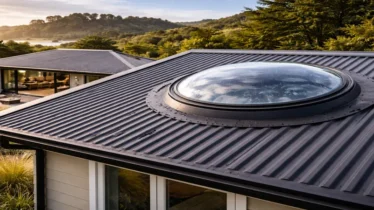
- The roof is longrun metal, with a gentle pitch and nearby ridgeline.
- The home sits within a few hundred metres of the coast.
- The ceiling is flat at standard height.
This is enough for the skylight professional to start considering:
- base type (square base vs circular base) in relation to the roof profile
- likely material and thickness needs in a coastal environment
- shaft options that will suit a flat ceiling.
4. Stage 3 – Materials and thickness in plain English
Only when the room, roof and climate are understood does the material discussion begin.
The skylight professional explains, in simple terms:
- how acrylic, polycarbonate and glass differ in weight, impact resistance and appearance
- why glass often carries higher costs (support structure, glazing, installation complexity)
- where thicker domes (such as 4.5 mm acrylic) may be considered, especially for larger diameters or exposed sites.
In this fictional journey, the homeowners learn that:
- a well-specified acrylic or polycarbonate dome can be entirely appropriate for their coastal home
- glass, while beautiful in some contexts, may be an unnecessary cost step for this particular project
- choosing thickness is about span, exposure and use, not just upgrading everything “to be safe”.
They are invited to think about what they want the skylight to do for the room, and how that aligns with each material choice.
5. Stage 4 – Size, base and shaft: sketching the experience
With a material direction forming, attention returns to the experience inside the room.
The homeowners are guided through questions such as:
- Where will people usually sit or stand?
- What do they want the circle of light to land on?
- Are they drawn to a strong “spot” of light or a softer, spread effect?
Rough diameter ranges are discussed (for example, 1.5 m vs 2.0 m). The skylight professional explains how:
- the dome diameter will shape the visible sky and light area
- the internal throat size and shaft profile will influence how that light feels.
At the same time, roof details are checked to see whether:
- a circular dome on a square base will sit best with the longrun roof
- a circular base suits the particular profile
- there is room to position the base away from ridges or valleys.
A simple overhead sketch and a few cross-sections (prepared by the design team, not the homeowner) help everyone see the proposed relationship between:
- circular opening
- furniture layout
- daylight path.
6. Stage 5 – Budget bands and quote options
Once a preferred direction emerges, the discussion becomes more concrete.
The skylight professional outlines:
- key components (dome, base, shaft, flashing, installation scope)
- any variations tied to material or thickness
- how site access and climate might influence installation complexity.
Instead of a single number, the homeowners may receive two or three banded options, such as:
- a calm, well-performing entry option
- a mid-range hero piece
- a premium, fully integrated architectural solution.
Each comes with clear, plain-English notes on what changes between them.
The earlier question – “why is glass so much more expensive?” – is now anchored in real comparisons, not just percentages. The homeowners can see how cost relates to structure, materials and labour.
7. Stage 6 – Installation planning and communication
After a direction is confirmed, the focus shifts to how the work will actually happen.
Key points are clarified:
- the installer’s experience with circular domes and bases
- how roof and interior works will be sequenced
- what access is needed (scaffolding, roof access, internal protection)
- how weather windows will be chosen.
The homeowners receive a simple outline of:
- expected duration on site
- how the room will be protected and cleaned
- who they can speak to if questions arise during the work.
In our Illustrative journey, installation is scheduled for a settled period, with contingency planning for coastal rain and wind.
8. Stage 7 – Living with the completed skylight
The journey does not end on the day of installation.
In the weeks after completion, the homeowners notice that:
- the sitting area is now naturally the first place people choose in the morning
- lights are used less during the day
- the circular opening has become part of the home’s identity.
They are also given:
- simple guidance on cleaning and maintenance
- realistic expectations for how the skylight will age
- a reminder of who to contact if they notice changes they are unsure about.
Illustrative Example Only: On the first winter weekend, the family comment that the room feels “alive” even on an overcast day, and that they are glad they did not choose the most expensive option purely on price.
The whole experience – from first email to everyday life – has been grounded in plain language, clear steps and honest trade-offs.
9. How Skylights New Zealand supports calm circular skylight journeys
The specifics of each project vary, but the underlying approach remains consistent:
- start with the room and the people
- understand roof, climate and context
- explain materials and thickness in everyday terms
- align base type and detailing with the roof
- explore budget bands honestly
- plan installation and care as part of the conversation.
For homeowners, this means the process feels like a guided journey, not a series of disconnected quotes.
Make an enquiry via Skylights New Zealand
Share a short description of your space, a few photos and your region. From there, a skylight professional can help you map your own circular skylight installation journey NZ – step by step, in plain English.
FAQs – circular skylight journeys in NZ homes
Q1. Do I need detailed plans before I make a circular skylight enquiry?
No. Photos, a simple room description and your location are usually enough to start a useful conversation.
Q2. Will I be pushed towards the most expensive option?
The aim is to align the skylight with your goals and context, not to default to the highest price band. Clear comparisons help you make an informed choice.
Q3. How long does a circular skylight installation usually take?
It depends on size, access and scope. Many residential installs are completed within days rather than weeks, but this is always discussed as part of planning.
Q4. What if I change my mind about size or material after the first quote?
In many cases it is possible to adjust the design before final orders and structural decisions are locked in. Early, open discussion helps.
Q5. How much of the process can be handled remotely?
Initial stages – sharing photos, discussing goals, reviewing options – are often handled remotely, with on-site visits arranged when needed for accurate detailing.
Q6. Will I receive guidance on maintenance and future checks?
Yes. Responsible skylight journeys include clear information about care, expected ageing and who to contact if something changes.