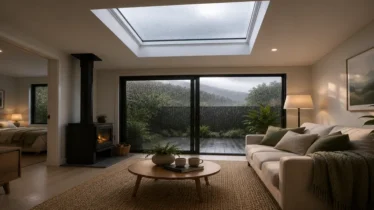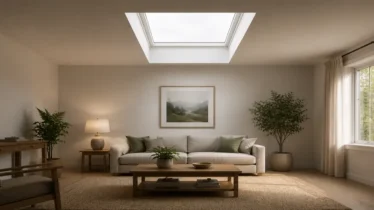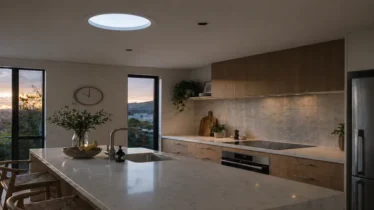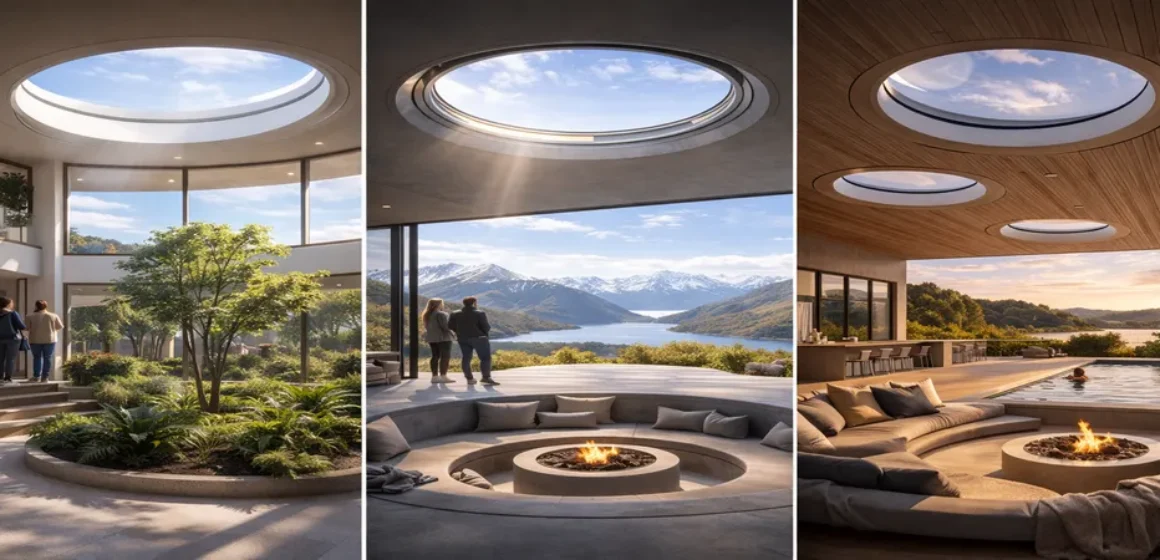
Three circular skylight “hero piece” concepts for NZ architects (Illustrative Only)
1. Why circular skylight “hero pieces” matter in NZ projects
Circular skylights behave differently when they become hero elements rather than background daylighting.
They can:
- anchor a room around a clear focal point
- express structure and volume without extra ornament
- turn transitional spaces into places people want to occupy.
For architects, a circular skylight case study NZ is rarely about the dome alone. It is about how:
- light lands on surfaces
- ceiling geometries are shaped
- climate and maintenance are folded into the design.
Below are three Illustrative Only concepts that show how circular hero pieces can work in very different New Zealand homes:
- A coastal courtyard house in Northland.
- A reworked villa in Wellington.
- A compact new build in outer Auckland.
Each focuses on design thinking, not catalogue choices.
2. Concept 1 – Coastal courtyard house, Northland
Setting: A single-level, U-shaped home on a Northland coastal site, wrapped around a sheltered courtyard. Longrun roof, pale render, timber detailing.
Brief and problem
The clients want:
- a central, sheltered outdoor room
- strong daylight in the open-plan kitchen–dining space
- protection from onshore wind and glare off the water.
The courtyard is protected, but the kitchen–dining area in the base of the “U” feels flat and dull for much of the day.
Circular skylight response
The design introduces a 1.8 m circular dome over the dining table, centred on the courtyard axis.
Key moves:
- The dome reads as a soft oculus in an otherwise simple ceiling.
- A gently flared shaft spreads light across the table surface and onto surrounding walls.
- The circular form echoes a round courtyard planter below, tying inside and outside together.
Climate and comfort
Northland’s coastal climate brings:
- salt air
- summer heat
- occasional heavy rain.
The concept assumes:
- a diffused or partially diffused dome finish to reduce glare
- detailing and materials chosen for coastal resilience
- coordination with eaves and courtyard planting to avoid “hot spots” on the table.
Why it works as a hero piece
The hero is not the skylight alone; it is the **relationship between:
- table
- circular light pool
- courtyard planting and sky.**
For architects, the concept shows how a single circular skylight can:
- resolve a central axis
- control views of the sky
- support everyday rituals (meals, conversations) with calm, consistent light.
3. Concept 2 – Villa and character home in Wellington
Setting: A weatherboard villa in a Wellington hill suburb, with typical lean-to additions and a dark central corridor.
Brief and problem
The clients want to:
- retain the villa’s character
- avoid opening up every wall
- make the central hall and stair landing feel safe and welcoming.
Wind, driven rain and heritage form a tight set of constraints.
Circular skylight response
Instead of a full roof lantern or long run of new windows, the design introduces a 1.2 m circular skylight above the meeting point of:
- the central hall
- a compact stair
- the threshold to a new living/kitchen addition.
The shaft is:
- lined in a soft, matt finish that respects the villa palette
- slightly elongated to reduce direct views of mechanical roof elements
- proportioned so the circle feels deliberate, not cut-in.
Climate and detailing
In windy Wellington conditions, the circular skylight is detailed with:
- a base and flashing strategy tuned to the existing roof profile
- careful attention to acoustic behaviour in heavy rain
- an emphasis on airtightness around the ceiling opening.
The goal is not to create drama on stormy days, but a stable, reassuring light source for the centre of the home.
Why it works as a hero piece
The hero effect here is quiet.
The circular skylight:
- reveals ceiling height at a single key junction
- creates a gentle “pause” point in the circulation route
- marks the transition between old and new parts of the house.
For architects, the concept demonstrates how a circular dome can sit comfortably in a character context without feeling imported or overly contemporary.
4. Concept 3 – Compact new build, outer Auckland
Setting: A compact, two-storey new build on a narrow Auckland site. Townhouse format, efficient floor plates, limited external walls.
Brief and problem
The owners want:
- a sense of generosity in the central stair and upper landing
- a small work-from-home nook on the landing
- light without losing privacy to neighbouring windows.
Conventional windows would face directly into neighbouring properties.
Circular skylight response
The design introduces a 1.4 m circular skylight over the upper landing, with a shaft shaped to:
- wash light down the stair treads
- create a calm, focused area for a small desk
- avoid direct glare on screens.
The stair void becomes a vertical “light well”. The circular opening reads as an intentional architectural move rather than an afterthought.
Comfort, privacy and everyday use
The compact plan means this space is used throughout the day:
- children moving between bedrooms and living areas
- adults working from the landing desk
- quick trips to storage and laundry.
The circular skylight supports this by:
- bringing in daylight from above, not from side boundaries
- allowing careful tuning of brightness and shaft finish
- keeping lines of sight private while still feeling connected to the sky.
Why it works as a hero piece
Here, the hero is about making a small plan feel generous.
The circular skylight:
- signals the landing as a “place” rather than a thoroughfare
- supports flexible use (study, reading, quiet sitting)
- maintains the clean lines of a compact, contemporary interior.
For architects, the concept shows how circular hero pieces can unlock value in tight, privacy-sensitive plans.
5. Translating hero concepts into real project briefs
These three Illustrative Only scenarios point to a practical pattern.
When circular skylights are intended as hero elements, project briefs are strongest when they:
- Name the moment
- family meals under a central pool of light
- the transition between old and new spaces
- a small landing that becomes a favourite spot.
- Describe the climate honestly
- coastal glare and salt
- Wellington wind and rain
- cool southern winters or humid northern summers.
- Show how the ceiling will respond
- flared shafts, oculus-style openings, or quiet circular cut-outs.
- Connect to circulation and furniture
- table positions, stair lines, work nooks and soft seating.
- Flag maintenance and access
- especially in exposed or tight sites.
For architects and designers, involving Skylights New Zealand early can support:
- product and material selection in line with design intent
- realistic conversations about diameter, thickness and base types
- alignment between hero gestures and long-term performance.
Make an enquiry via Skylights New Zealand
Share drawings, climate notes and a brief description of the moment you want the skylight to create. Together, you can test whether a circular hero piece is the right move, or whether a quieter approach will better serve the project.
FAQs – circular skylight hero concepts in NZ homes
Q1. Are large circular skylights only suitable for high-end homes?
Not necessarily. The key is matching size, detailing and budget to what the skylight is doing for the space, rather than treating all hero pieces as the same.
Q2. Can hero circular skylights work in character homes?
Yes, when proportion, ceiling treatment and detailing respect existing forms. The aim is to feel intentional and calm, not disruptive.
Q3. How early should circular skylights be considered in the design process?
Ideally at concept stage, so structure, services and ceiling geometry can develop around them.
Q4. Do hero skylights always need to be very large?
No. In some projects, a modest diameter used in the right place can feel more powerful than an oversized dome.
Q5. How do I balance hero skylights with energy and maintenance concerns?
By integrating climate, material choice, shaft design and access planning into early design, rather than treating the skylight as a late addition.
Q6. Can circular skylights be combined with other daylighting strategies?
Yes. They often work best as part of a wider daylight plan, alongside windows, clerestories and internal openings.