Planning a custom circular skylight: what to know before you ask for a quote
1. Why a little preparation makes custom skylights calmer
Custom circular skylights sit in a different category to standard, off-the-shelf domes.
You might be:
- planning a 2.4 m feature dome over a living space
- upgrading a small tubular skylight to a larger circular statement
- matching a new skylight to an existing architectural idea.
In each case, a custom circular skylight NZ quote needs more than just a diameter. The installer or supplier will still do detailed checks, but the conversation becomes much easier when you arrive with a few essentials ready.
This article is a calm, straightforward playbook. It outlines:
- The room and experience you are aiming for.
- What matters about your roof and structure.
- How to think about size, throat and light behaviour in plain English.
- Why climate, exposure and usage patterns belong in the brief.
- The key information that makes quote requests far more productive.
All examples are Illustrative Only, based on patterns seen across many homes rather than any single project.
2. Start with the room, not the roof
It is tempting to begin with diameter. A better starting point is the room itself.
What happens in the space?
Ask simple questions:
- Is this a living area, kitchen, entry, stair, bathroom or multipurpose space?
- How many people usually occupy it at once?
- Is it mainly used during the day, evening, or both?
The role of the room guides whether you are looking for:
- soft, even background light
- a dramatic pool of light that becomes a feature
- task-friendly light for cooking, circulation or working.
How does the room feel now?
Note what is already true:
- where it feels darkest
- where glare currently appears (for example, from existing windows)
- which corners you naturally gravitate towards.
You do not need technical language. A short description such as:
“The middle of the lounge is quite dark during the day, even when the curtains are open, and we sit with our backs to the existing window.”
is often more helpful than a long discussion of lux levels.
3. A simple snapshot of your roof and structure
Next, give a basic picture of what the skylight must pass through.
Roof type and pitch
Note, in plain language:
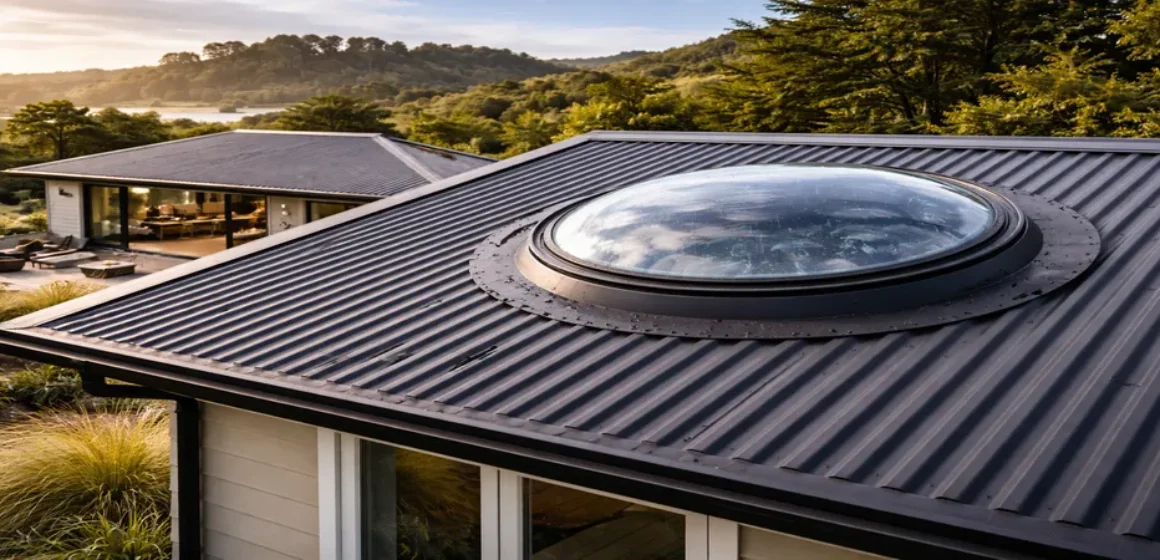
- whether the roof is longrun metal, tile, membrane or a combination
- roughly how steep it is – flat, gentle pitch, or clearly steep
- whether there are obvious ridges, valleys or changes in height nearby.
A few photos from the ground or a safe vantage point help the skylight professional understand how a custom dome and base might sit.
Ceiling type and height
Inside, note:
- whether the ceiling is flat, raked or part of a double-height space
- approximate ceiling height in the area you are considering
- any beams, bulkheads or features that could interact with a circular opening.
This information allows early thinking about the shaft or throat that will connect dome to ceiling.
4. Size, throat and light behaviour – in plain English
Custom projects often involve non-standard diameters. Two terms matter here:
- the dome diameter (the circular size on top)
- the internal throat size (the opening that delivers light into the room).
You do not need to specify exact numbers, but it helps to understand what is being discussed.
Diameter – how wide the skylight is
A larger diameter generally means:
- a wider area of light on the floor or surfaces
- more sky visible from beneath
- greater impact on heat and brightness.
When you hear options like 1.2 m, 1.8 m or 2.4 m, think about:
- where people will stand, sit and lie
- what they will be looking at
- how much of the room you actually want strongly lit.
Throat size and shape – how light is delivered
The throat is the internal opening and shaft that connects dome to ceiling. Decisions here influence:
- how focused or spread the light feels
- whether you see a circle of sky, a soft glow, or a mix
- how the skylight reads as part of the ceiling design.
Plain-English ways to talk about this include:
- “We want the light to spread across the dining table, not just the middle of it.”
- “We would like the shaft to feel integrated with the ceiling, not like a sharp tunnel.”
- “The opening needs to be clear of the fan and pendant light.”
5. Climate, exposure and region – why they belong in the brief
Two circular skylights of the same size can behave differently in different parts of New Zealand.
Wind, salt and snow
Briefly note if your home sits in a:
- coastal area with salt-laden air
- wind-exposed position, such as Wellington hill suburbs or open plains
- alpine or inland climate with frost, occasional snow or large temperature swings.
These factors can influence:
- dome thickness and material recommendations
- base and flashing choices
- expectations around maintenance.
Sun path and interior comfort
Mention:
- which direction the roof plane faces, if you know it
- whether the room currently feels cold, warm or changeable
- any particular comfort concerns (for example, “we do not want to overheat the room in summer”).
You are not expected to solve these issues yourself. Including them simply gives the skylight professional a clearer starting point.
6. Budget bands and priorities – without needing exact numbers
Custom circular skylights involve more variables than smaller, standard domes. It helps to signal budget bands and priorities, even if you do not know final costs.
Budget bands in principle
You might describe your position in broad terms:
- entry-level custom – “we are open to a custom size, but cost control matters”
- mid-range – “we want a strong feature with good performance”
- premium – “this is a key architectural element and we are prepared to invest accordingly”.
This does not lock you in. It simply helps align options with expectations.
Priorities when choices need to be made
Be clear about what matters most if trade-offs arise:
- visual impact vs simplicity
- performance and comfort vs maximum size
- ease of maintenance vs harder-to-reach positions.
A short note such as:
“If we have to choose, we would rather have a slightly smaller dome that is more comfortable and easier to maintain.”
is valuable guidance during quote preparation.
7. Two illustrative journeys – from idea to informed brief
The following scenarios are Illustrative Only. They show how early information can shape a custom skylight conversation.
Journey 1 – The 2.4 m feature dome over a living space
A family in a coastal North Island home is considering a 2.4 m circular dome over their main living area.
They share:
- photos of the existing longrun roof and the internal ceiling
- a sketch showing where sofas, dining table and TV sit
- a note that summer afternoons can already feel warm.
During the conversation, the skylight professional:
- confirms suitable roof zones for a dome of that size
- discusses shaft options to spread light across the room rather than focus it on one spot
- suggests material and thickness options that reflect coastal conditions.
The final brief balances impact with comfort. The dome stays large, but shaft design, placement and material choice are tuned to the site.
Journey 2 – Upgrading from a tubular skylight to a circular statement
In a central-city townhouse, an existing tubular skylight provides useful light but feels underwhelming. The owners would like a larger circular feature over their stair.
They provide:
- photos of the current tube from inside and outside
- a rough floor plan showing stair position across two levels
- a description of when the stair feels most used and most dim.
The skylight professional:
- reviews whether the current location can accommodate a wider throat and dome
- checks roof structure, base options and fire/egress considerations where relevant
- outlines scenarios where a new position might produce a better result than simply enlarging the existing opening.
The quote request becomes a conversation about options, not just a size swap.
8. What to gather before you ask for a custom circular skylight quote
You do not need architectural drawings to start the process. A small, focused set of details is enough.
Before you request a quote, try to have:
- Room description
- type of room, how you use it, and how it feels now.
- Basic dimensions
- approximate room size and ceiling height.
- Roof information
- roof type (metal, tile, membrane), approximate pitch and photos.
- Location and climate notes
- suburb and any obvious exposure factors (coastal, hilltop, alpine, sheltered valley).
- Initial size thoughts
- a sense of whether you are thinking in the 1 m range, 1.5 m range, 2 m+ range, or open to advice.
- Budget and priority signals
- broad budget band and whether impact, comfort or practicality leads.
If you are unsure about any of these, simply say so. Clarity about what you do not yet know is just as helpful.
Make an enquiry via Skylights New Zealand
Attach a few photos of your room and roof, along with short notes based on the list above. A skylight professional can then start your custom circular skylight NZ conversation from a well-informed place, rather than from guesswork.
FAQs – planning a custom circular skylight in NZ
Q1. Do I need exact measurements before I ask for a custom skylight quote?
No. Approximate room sizes, ceiling heights and photos are usually enough to begin. Exact dimensions are confirmed later as part of detailed design.
Q2. How early in my project should I start talking about a custom circular skylight?
Earlier is better. Including skylights at concept stage makes it easier to coordinate structure, roof design and interior layout.
Q3. What if I do not know my roof type or pitch?
Clear photos and a basic description (for example, “steel roof, looks fairly steep”) can be a starting point. Your skylight professional can guide you on what else is needed.
Q4. Will sharing a budget band lock me into a fixed price?
No. It simply helps align initial options and avoid proposals that are far from what you have in mind.
Q5. Can I change my mind about size after I see initial options?
In most cases, yes – especially if you are still at the planning stage. Decisions become more fixed once structural and roof work is finalised.
Q6. Is a custom circular skylight always significantly more expensive than standard options?
Custom solutions do carry additional cost, but the difference varies. The aim is to match complexity and specification to what you are trying to achieve, rather than assuming all custom skylights sit in the same price band.