My living room is bright but uncomfortable: the glare problem nobody names
A lot of New Zealand living rooms have the same strange contradiction.
They are bright.
And yet they are not always comfortable.
You might notice it in small behaviours:
- you avoid one seat in the afternoon
- you keep adjusting the curtains even though you wanted the light
- the TV feels harder to watch at certain times
- you squint without realising you’re doing it
Most people describe this as “the sun is annoying” or “the light is too harsh”.
But the real issue is usually one word we don’t use enough:
glare.
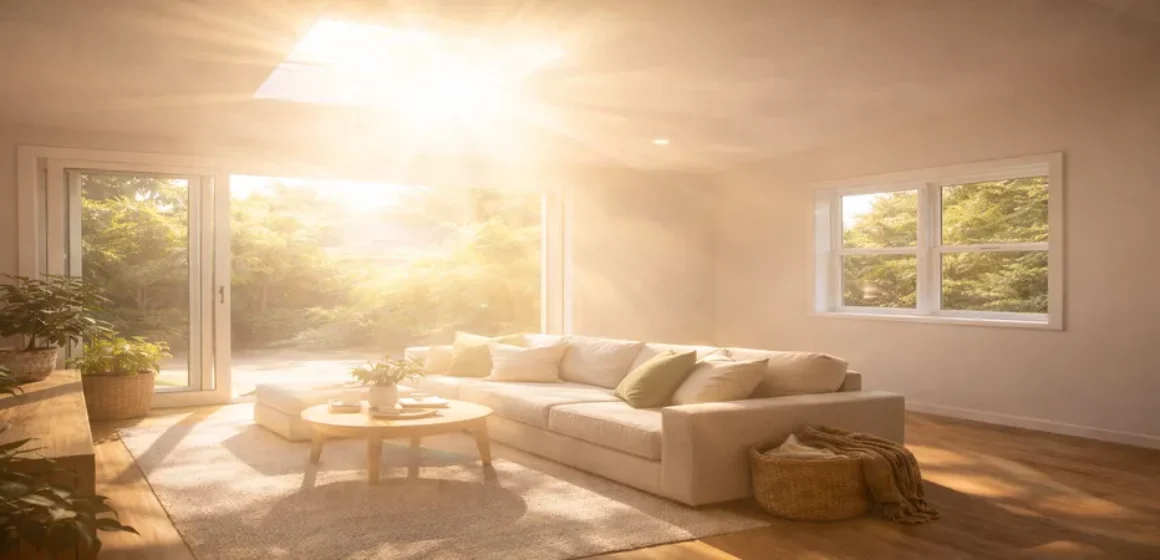
Glare is not about having too much light. It is about having the wrong kind of light in the wrong place.
In 2026, as NZ homes continue to chase better daylight and better comfort, glare is one of the most important problems to understand — because it is also one of the easiest to prevent.
What glare actually is (in plain English)
Glare happens when a bright source dominates your field of view, or when bright light reflects off surfaces in a way your eyes can’t relax into.
A simple way to picture it:
Your eyes want an even scene. Glare creates an uneven scene.
Instead of the room feeling calm and open, it feels sharp.
And the sharper it feels, the more tiring the room becomes.
The two types of glare NZ homeowners experience
1) Direct glare
This is when sunlight or a bright sky view hits your eyes directly.
It can happen from:
- a roof window or skylight in the wrong position
- a window where the sun drops into view late in the day
- a bright patch landing exactly where you look up
2) Reflected glare
This is more subtle and more common.
It happens when sunlight hits reflective surfaces such as:
- polished timber floors
- glossy tiles
- stone benchtops
- high-gloss cabinetry
- TV screens
The light is not necessarily “too strong”. It is just landing in a way that creates visual tension.
Why glare feels worse in some NZ living rooms
Glare isn’t random. It tends to show up where three things overlap.
1) A strong afternoon sun pattern
Summer afternoons in NZ can be intense, especially when sunlight comes in at an angle that hits the room’s main seating zone.
2) A room that is light on the edges but uneven in the centre
In open-plan homes, the brightest areas might be near windows, while the centre stays dim.
When you introduce a strong light source from above without diffusion, the contrast can become uncomfortable.
3) Reflective finishes (modern homes are full of them)
Many modern interiors look beautiful in soft daylight.
But reflective materials amplify glare when direct sun is introduced.
This is why a “bright room” can still feel hard to sit in.
The skylight connection (without blame)
It is tempting to say “the skylight caused it”.
But glare is rarely caused by skylights alone.
More often, it comes from the combination of:
- skylight placement
- roof direction
- glazing choice
- and how the light lands in the space
A well planned skylight can reduce reliance on curtains and lights.
A poorly planned skylight can create a room you keep managing.
That difference is why skylight glare NZ homeowners report is almost always preventable.
The ‘3pm test’: a simple way to diagnose glare
If you want a practical check, do this:
On a clear day, look at your living room around 3pm.
Ask:
- Where are the brightest patches?
- Do they land on the floor near seating?
- Do they hit the TV wall or screen?
- Are your eyes pulled toward one harsh spot?
If the answer is yes, you are not imagining it. The room has a glare pattern.
The good news: glare patterns can be softened.
The comfort-first fixes (in the right order)
Glare solutions work best when you start with the highest-impact, lowest-regret options.
Fix 1: Adjust placement (for new skylights or major changes)
If you are still planning, placement is the biggest lever.
A skylight positioned to deliver even light to the darker centre of the room can feel calm.
A skylight positioned where it captures direct late-day sun can feel sharp.
If you have a placement guide, link it here: [ADD LINK]
Fix 2: Choose calmer light (diffusion and glazing)
If your goal is comfort, the room often wants even daylight rather than raw sun.
This is where diffusion and glazing choices matter.
If you have a glazing guide, link it here: [ADD LINK]
Fix 3: Add control where it is predictable
Blinds or glare control are not a failure. They are a comfort tool.
In some living rooms, they are what keeps the space usable during peak summer hours.
If you have a glare-control or blinds page, link it here: [ADD LINK]
Fix 4: Reduce reflective hit zones
Sometimes small changes help:
- a softer rug placement to break up a floor hotspot
- repositioning seating so glare isn’t in your primary line of sight
You do not need to redesign the home. You just need to stop feeding the glare pattern.
What not to do (the fixes that often disappoint)
Avoid chasing darkness
The goal is not to remove daylight.
It is to make daylight comfortable.
Heavy tint or blocking light entirely can make the room feel flat in winter.
Avoid “bigger skylight = better light” thinking
Bigger can create stronger hotspots.
Better outcomes usually come from:
- placement,
- diffusion,
- and control.
Illustrative example only: the seat nobody used
A homeowner in Auckland had a living room that looked bright, but one seat near the centre was avoided every summer afternoon.
They assumed it was just “the afternoon sun”.
But the pattern was consistent: a bright patch landed on the floor and bounced off a polished surface into the seating zone.
The fix was not removing daylight. It was reshaping it:
- calming the light behaviour
- reducing the intensity of that hotspot
- and adding sensible control for peak hours
The room still felt bright. It just stopped feeling sharp.
A calm next step
If your living room is bright but uncomfortable, you do not need to accept it as normal.
Glare can usually be improved with comfort-led choices that keep the good daylight and remove the sharpness.
If you share a few photos, the times of day the room feels worst, and whether the glare shows up on floors, the TV, or seating zones, we can recommend a practical path forward.
Start here: https://inquiry.skylights.co.nz/inquiry