The 3pm test: how to predict if a skylight will overheat a room
Every summer, the same hesitation comes up.
“I love the idea of a skylight, but I don’t want the room to get too hot.”
In New Zealand, that is a sensible concern.
Our summer afternoons can be bright and intense, and many homes already have at least one room that runs warmer than the rest — especially open-plan living areas, rooms with large west-facing windows, or spaces with limited airflow.
The good news is you do not have to guess.
There is a simple, homeowner-friendly way to predict whether a skylight will improve comfort or create overheating problems.
We call it the 3pm test.
It is not a technical calculation. It is a lived-experience check.
What the 3pm test is really checking
Overheating is rarely about one feature.
It is usually about how sun and heat behave in your specific room.
At around 3pm in summer:
- the day’s heat has built up
- the sun can start hitting at angles that create hotspots
- many rooms shift from “pleasant” to “a bit much”
So the 3pm test checks three things:
- Where does strong sun land?
- Where does warm air collect?
- Does the room have a realistic way to release heat?
If you understand those, you can plan a skylight that adds daylight without adding discomfort.
Step-by-step: how to do the 3pm test in your home
You only need a clear day and ten minutes.
Step 1: Pick the room you want to improve
Living room, kitchen, stairwell, hallway — wherever you are considering roof glazing.
Step 2: Check the room around 3pm on a clear day
If you can, do it on two different summer days. One calm day and one breezy day.
Step 3: Look for three signals
Signal A: Hotspots
- bright patches on floors, sofas, or benches
- one area that feels noticeably warmer
Signal B: Air heaviness
- the room feels stuffy
- you want to open a door or window for relief
Signal C: The “fan threshold”
- the point where you instinctively turn on a fan or cooling earlier than you’d like
Write down where these happen.
That map tells you more than any brochure.
What your 3pm results usually mean
If the room is already warm at 3pm
Your skylight plan must be comfort-led.
That does not mean “no skylight”.
It means:
- avoid introducing direct sun into seating and work zones
- prioritise even daylight over raw brightness
- plan ventilation pathways
- consider controls where predictable
If the room is bright but still feels stuffy
This is often an airflow issue.
Warm air rises. If your room has no clear pathway to release it, heat lingers.
In some spaces, a vented skylight can help, but the right approach depends on the room and roof.
If the room is comfortable at 3pm but dim in the centre
This is one of the best cases for a skylight.
A comfort-first skylight can:
- bring daylight to the centre
- reduce reliance on lights
- maintain a calm room feel
Why skylights get blamed (when the real issue is the room)
A skylight is a window to the sky.
It does not create heat. It changes how heat and light enter the room.
Most overheating complaints come from:
- skylights placed in a high-intensity sun zone
- glazing and light quality not matched to the space
- a room with limited airflow pathways
- a “more light is better” approach that overshoots
The 3pm test helps you see those risks early.
The comfort-first design moves that prevent overheating
These are the levers that typically matter most.
Move 1: Placement that targets the dark zone, not the sun zone
Skylight placement should brighten where the room is dim.
It should not amplify a sun patch that already exists.
If you have a placement guide, link it here: [ADD LINK]
Move 2: Calm light over direct sun
For many living rooms, even daylight feels better than direct sunlight.
Diffusion and glazing choices can help keep the room usable in summer.
If you have a glazing guide, link it here: [ADD LINK]
Move 3: Controls where the pattern is predictable
If the room shows a strong 3pm glare or heat pattern, controls are not an afterthought.
They are how you keep the benefit without the penalty.
Move 4: Plan the heat exit
Ask a simple question:
Where does warm air go in this room?
If the answer is “it doesn’t”, you will feel it in summer.
Ventilation strategies and vented skylights can help in the right spaces.
The three mistakes that make overheating more likely
Mistake 1: Choosing skylight size before placement
Size should follow placement.
A large skylight in a high-intensity zone can create a summer hotspot.
A smaller unit placed well can feel better.
Mistake 2: Expecting one change to fix a whole thermal pattern
If a room has large unshaded glazing and limited airflow, the skylight is only one part of the story.
Comfort is a system.
Mistake 3: Solving summer with darkness
Over-correcting by blocking daylight can make the room flat in winter.
The goal is not “less light”. It is better light.
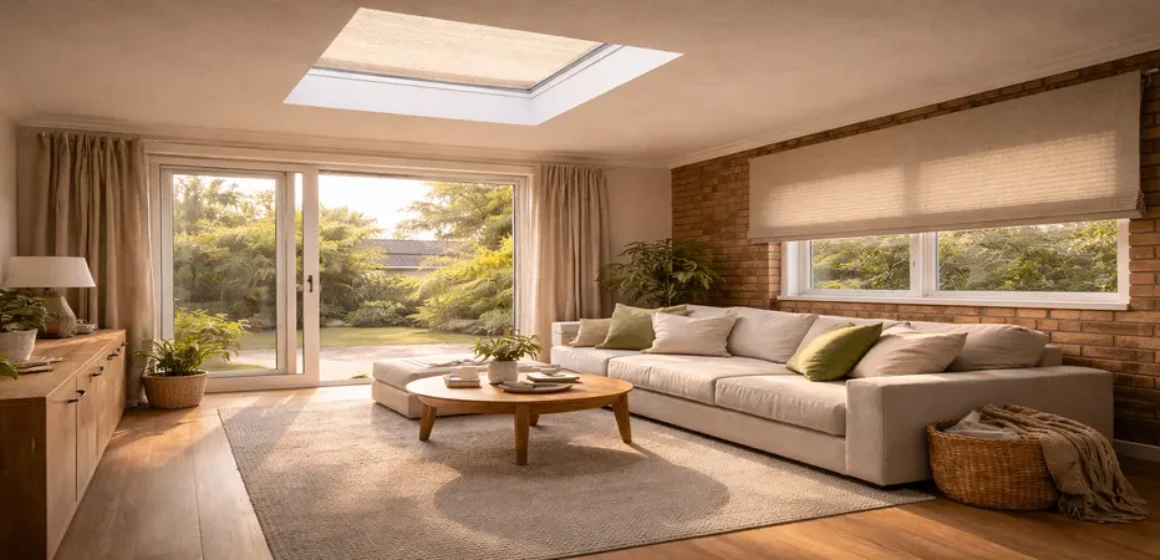
Illustrative example only: a 3pm pattern that changed the plan
A homeowner in Hamilton wanted a skylight in their open-plan living area because the centre stayed dim.
Their 3pm test showed something important: the room was already warm in summer, and one corner near the seating zone developed a bright hotspot.
That result changed the plan.
Instead of aiming for maximum skylight size, the approach focused on:
- placement that brightened the darker centre without amplifying the hotspot
- calmer light quality
- and comfort control for peak summer days
The living area became brighter, but also easier to sit in.
A quick 3pm checklist you can save
Before installing a skylight, check:
- Is the room already warm at 3pm?
- Where are the bright patches?
- Do they land on seating, TV walls, or benches?
- Does the room feel stuffy or heavy?
- How does it behave on still days versus breezy days?
- If you added roof glazing, would it calm the room or intensify it?
If you can answer those, you can avoid most overheating outcomes.
A calm next step
If you’re considering a skylight and want to avoid overheating, the 3pm test is the smartest starting point.
If you share a few photos, what you observed at 3pm, and when the room feels dim or uncomfortable, we can recommend a skylight approach that suits NZ summer behaviour and keeps the daylight benefit.
Start here: https://inquiry.skylights.co.nz/inquiry