Can skylights be installed in winter? What NZ homeowners should know before booking
The question usually arrives on the first run of wet, cold mornings.
A homeowner notices the hallway is darker than expected. The bathroom feels flat and steamy. The kitchen needs lights on before breakfast. Then comes the hesitation: “Have we missed the right time to do this?”
In many New Zealand homes, winter is exactly when the need for better daylight becomes obvious. It is also the season when people become more cautious about roof work, rain, wind, water tightness and timing.
So, can skylights be installed in winter?
In many cases, yes. A winter skylight installation can be possible when the roof type, weather conditions, access and installation method are suitable. But winter does change the planning. It demands more care, better scheduling, and a clear understanding of how the roof will be protected during the work.
This guide explains what homeowners should know before booking a skylight or sky tube installation during the colder months.
The practical answer: yes, but the conditions matter
Skylights are installed in New Zealand across different seasons. Winter does not automatically rule out installation.
However, it does make these factors more important:
- Weather windows
- Roof pitch and roof material
- Site access and safety
- Product type
- Flashing method
- Ceiling access
- Interior finishing requirements
- Installer availability
- Regional climate conditions
A simple sky tube installation on a straightforward metal roof may be easier to schedule than a large skylight requiring more roof and ceiling work. A low-pitch roof, steep roof, tile roof, multi-level home or exposed coastal location may require more planning.
The real question is not only “Can it be done in winter?”
It is:
Can it be done safely, cleanly and weathertight in the right weather window?
That is the standard homeowners should expect.
Why winter often makes homeowners take action
Winter has a way of revealing the rooms people tolerated during warmer months.
A hallway that felt acceptable in summer can feel like a passageway with no warmth or life. A bathroom that seemed fine with the window open can feel damp and closed in. A kitchen that worked well during long summer evenings may need artificial lighting for much of the morning.
This is not only about brightness. It is about how the home feels when people are actually living inside it more often.
During winter, many households:
- Keep windows closed for longer
- Use artificial lighting earlier in the day
- Notice condensation more often
- Spend more time indoors
- Become more aware of dark internal rooms
- Start thinking about comfort, airflow and home improvement planning
A homeowner might put it simply:
“We did not think the room was a problem until winter made it obvious.”
That is why winter enquiries are common. The season exposes the weakness in the home’s daylight pattern.
What installers consider before winter roof work
A proper skylight discussion should begin with the home, not the product.
Before recommending an installation approach, an installer or skylight specialist will usually consider several practical details.
Roof type
Metal roofing, long-run roofing, tile roofing, concrete tile, asphalt shingle and other roof types all require different flashing considerations.
The flashing is the system that helps transition the skylight into the roof so water is directed properly around the opening. In winter, flashing detail matters even more because rain patterns can be less forgiving.
Roof pitch
Roof pitch affects how water moves across the roof.
A steeper roof generally sheds water more quickly. A lower-pitch roof requires more careful product and flashing selection. Not every skylight suits every roof pitch, and this should be checked before the quote is finalised.
Weather exposure
Homes in exposed coastal, hillside or high-wind areas may need more careful scheduling than sheltered suburban homes.
In places such as Wellington, coastal Auckland, Kapiti, parts of Northland, Otago and the lower South Island, local conditions can affect timing and installation planning. This does not mean skylights cannot be installed. It means the work needs to be planned with the site in mind.
Roof access
Safe access matters in every season. In winter, wet surfaces, wind and shorter daylight hours can make access planning more important.
Some homes may require additional access equipment, edge protection or careful scheduling to complete the job safely.
Interior scope
A skylight installation may involve more than the roof opening.
Depending on the product and room, there may be internal ceiling work, a light well, plastering, painting, diffuser fitting or trim finishing. Some work can be completed as part of the installation, while other finishing may need to be staged.
Understanding this early prevents surprises.
Product choice can affect winter timing
Different daylighting products involve different levels of work.
Tubular skylights and sky tubes
A tubular skylight, often called a sky tube, may be suitable for smaller or internal spaces such as hallways, laundries, wardrobes, toilets and compact bathrooms.
Because the internal ceiling finish is usually more contained, some sky tube installations can be more straightforward than larger skylight projects. The roof still needs proper flashing and weather care, but the overall disruption can be lower in suitable homes.
This makes sky tubes a strong winter option when the goal is practical daylight in a targeted area.
Fixed skylights
A fixed skylight can bring stronger daylight and visual impact to kitchens, living areas, bedrooms and other larger rooms.
The installation may involve a larger roof opening and, depending on the ceiling design, a light well or internal finish. This can still be suitable in winter, but timing, weather protection and internal scope should be clearly understood.
Vented skylights
A vented skylight may be suitable for rooms where airflow matters, such as bathrooms, kitchens or upper-level spaces.
In winter, homeowners often ask about vented skylights because steam, condensation and closed windows become more noticeable. A vented skylight can support airflow in the right setting, but it should be considered alongside extraction, heating, insulation and moisture control. It is not a standalone cure for condensation.
Larger or custom skylights
Larger skylights or custom work may require longer planning, product lead times, more roof preparation and more detailed finishing.
These projects can still be planned in winter, but they may need more flexibility around weather and scheduling.
The winter installation process homeowners should expect
A well-managed winter skylight installation should feel structured, not rushed.
The process usually includes the following stages.
1. Room and outcome review
This begins with the reason for the skylight.
Is the room dark all day? Is it mainly a morning issue? Does the room need airflow? Is privacy important? Is the goal subtle daylight or a larger architectural feature?
The product choice should follow the room’s purpose.
2. Roof and ceiling assessment
The roof material, roof pitch, ceiling type, roof cavity and access are checked. Photos can often help at the early enquiry stage, but some situations need a site visit or further assessment.
This stage is especially important in winter because the installation needs to be planned around real site conditions.
3. Product and flashing selection
The skylight or sky tube must suit the roof and room. Flashings need to be appropriate for the roof profile and pitch.
This is where experienced planning makes a visible difference. The goal is not only to bring in light, but to maintain the integrity of the roof.
4. Weather window scheduling
The installation is booked around suitable weather conditions. In winter, this may mean allowing flexibility rather than forcing the job into an unsuitable day.
A good installer should prioritise weather protection and safety over speed.
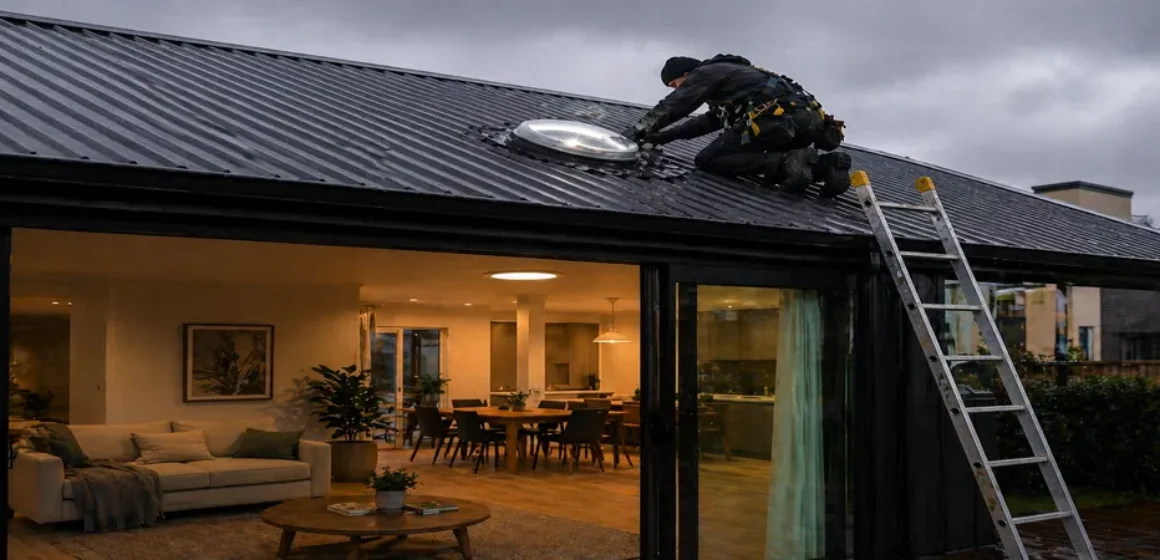
5. Roof work and weather protection
The roof opening, flashing and product installation are completed with care to maintain water tightness. The home should be protected during the work.
The exact method depends on the product and roof type.
6. Internal finish
Depending on the skylight type, internal work may include diffuser fitting, trims, ceiling lining, light well finishing or other detail work.
Homeowners should ask what is included in the quote and whether painting or plastering is part of the scope.
What winter changes compared with warmer months
Winter does not necessarily make skylight installation impossible. It simply changes the level of planning required.
Shorter working days
There is less daylight available for roof work. This may affect start times, staging and how much can be completed in a day.
More weather interruptions
Rain, wind and surface moisture can delay work. This is normal and should be treated as responsible scheduling, not poor service.
Higher importance of temporary protection
If work needs to be staged, weather protection becomes critical. Homeowners should ask how the roof and interior will be protected if conditions change.
More noticeable indoor disruption
In winter, households may be home more often and may be more sensitive to open ceilings, airflow and temporary disturbance. Clear communication helps set expectations.
Stronger urgency once the problem is noticed
When a room feels dark every morning, homeowners often want it fixed quickly. But winter is not the time for rushed roof decisions. A clear plan matters more than a fast promise.
When it may be better to wait
There are times when delaying installation may be the better decision.
It may be worth waiting if:
- The roof is due for replacement very soon
- Major renovation work is about to start
- Weather exposure is too high for safe installation in the current period
- The roof needs repair before a skylight can be added
- Access is unsafe without additional planning
- The product required has a longer lead time
- Internal finishing would be better coordinated with other trades
This does not mean the enquiry is wasted. Winter can still be the right time to assess the home, choose the product, confirm the scope and prepare for the next suitable installation window.
Sometimes the smartest winter decision is to plan now and install at the right moment.
Questions to ask before booking a winter installation
Before approving a quote, ask practical questions that protect both the home and the outcome.
Useful questions include:
- Is this product suitable for my roof type and pitch?
- What flashing system will be used?
- How will the installation be scheduled around weather?
- What happens if rain or wind arrives on the planned day?
- Is internal finishing included?
- Will plastering or painting be required separately?
- How long will the room be affected?
- Does the room need light, ventilation or both?
- Are there any access or safety requirements?
- What photos or measurements do you need from me?
These questions do not make the process more complicated. They make it clearer.
A confident skylight provider should be comfortable answering them.
Illustrative example only
A homeowner in a 1990s suburban home notices the internal hallway feels dark from early morning until late afternoon through winter. The home has a metal roof, accessible ceiling space and no major renovation planned.
In this case, a sky tube may be a practical winter daylight upgrade if the roof conditions, flashing requirements and weather window are suitable. The work is targeted, the room’s problem is clear, and the desired outcome is simple: bring natural light into a space that currently relies on artificial lighting.
Another homeowner may want a large fixed skylight above a kitchen with a more complex ceiling and an upcoming re-roof. In that case, it may be smarter to coordinate the skylight with the roofing project rather than install immediately.
Both homeowners may be making the right decision. The difference is the context.
How to prepare your home before making an enquiry
You can make the enquiry process smoother by gathering a few basic details.
Photos to take
- The room from several angles
- The ceiling area where daylight would be useful
- The outside roof area above or near the room
- Any existing roof features, vents or obstructions
- A wider exterior view if access may be relevant
Details to note
- Roof type if known
- Ceiling type
- Room dimensions if available
- Whether the room has an existing window
- Whether ventilation is also a concern
- Whether there is roof cavity access
- Any upcoming roofing, painting or renovation work
You do not need perfect technical information. Good photos and a clear room description are often enough to begin.
The most important winter rule
Do not choose a skylight simply because winter has made the problem feel urgent.
Choose it because the room, roof, product and installation approach make sense together.
A good winter skylight installation should feel considered. It should respect the roof, the weather, the interior finish and the homeowner’s real reason for wanting more daylight.
The aim is not just to brighten the room for one season. It is to improve how the home feels for years.
Planning your next step
If winter has made a dark room, steamy bathroom or dull kitchen harder to ignore, it may be worth exploring your options now.
Skylights.co.nz can help you understand whether a fixed skylight, vented skylight or tubular skylight may suit your home, roof type and preferred timing.
To start the process, use the Skylights.co.nz enquiry form:
https://inquiry.skylights.co.nz/inquiry
You may also find these useful:
FAQs
Can skylights be installed in winter in New Zealand?
Yes, skylights can often be installed in winter when the roof type, weather conditions, access and product choice are suitable. The work should be planned around safe weather windows and proper weather protection.
Is winter a bad time to install a skylight?
Winter is not automatically a bad time, but it does require careful scheduling. Rain, wind, shorter daylight hours and roof access conditions can affect timing. A well-planned installation should prioritise safety and water tightness.
Can a sky tube be installed in winter?
A sky tube can often be a practical winter option for hallways, laundries, toilets and other smaller spaces, provided the roof and ceiling conditions are suitable. Weather and access still need to be considered.
Will my roof be left open during installation?
A professional installation should be planned so the roof is protected during the work. The exact process depends on the product, roof type and installation scope. Homeowners should ask how the roof and interior will be protected if weather changes.
Should I wait until spring to install a skylight?
It may be worth waiting if the roof needs repair, a re-roof is planned, access is difficult, or the weather exposure is unsuitable. However, winter can still be a good time to assess the home, choose the right product and prepare for the next suitable installation window.
What information helps with a winter skylight enquiry?
Useful information includes photos of the room, ceiling and roof area, the roof type if known, the room’s main issue, whether ventilation is needed, and whether any roofing or renovation work is planned.