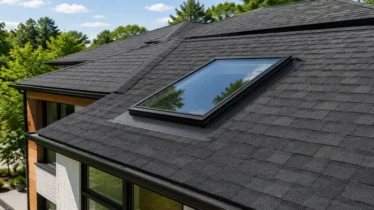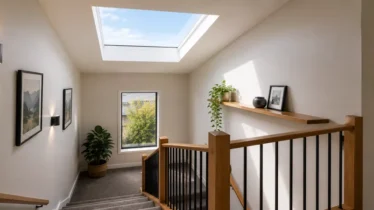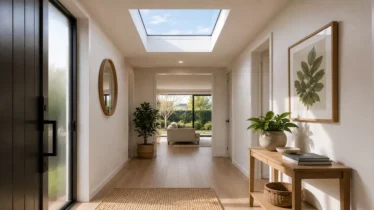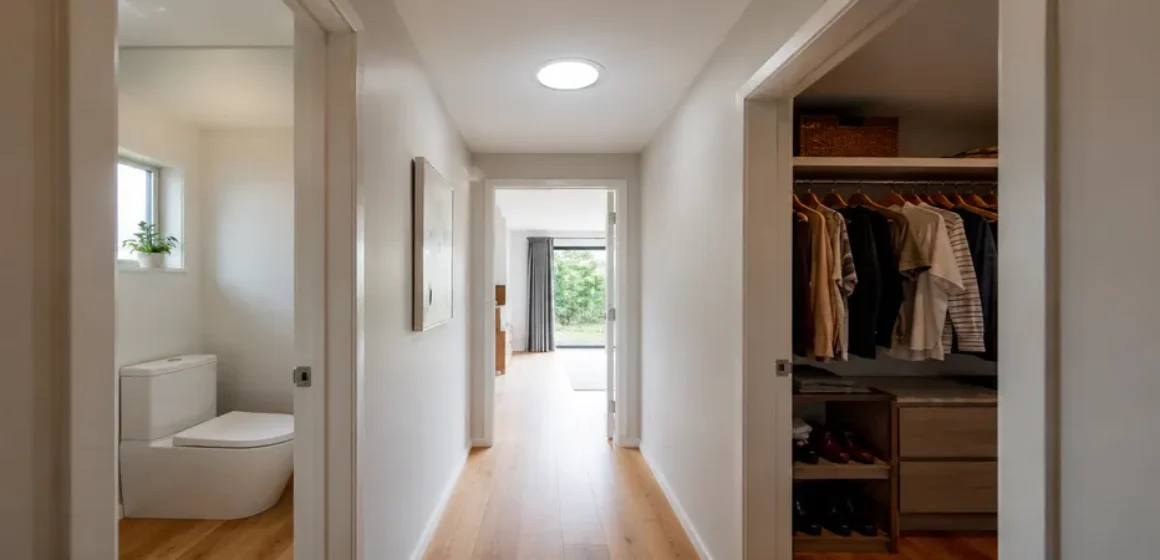
Tubular Skylights for Waikato Hallways, Toilets and Walk-in Wardrobes
Some of the darkest spaces in a Waikato home are not the biggest rooms.
They are the rooms and passages people pass through every day without thinking too much about them. The hallway that needs the light on at lunchtime. The separate toilet with no useful window. The walk-in wardrobe where colours are hard to see. The laundry cupboard that feels like an afterthought. The pantry or internal nook that depends entirely on artificial lighting.
These spaces may not justify a large skylight. They may not need a dramatic opening to the sky. They may not even have the ceiling proportions for a full fixed skylight to feel right.
But they may still need natural daylight.
That is where a tubular skylight Waikato solution can be worth considering.
A tubular skylight, or Sky tube, can bring daylight from the roof through a reflective tube and deliver it into the room through a ceiling diffuser. For compact internal spaces, this can provide useful daytime brightness without the visual scale or structural impact of a larger skylight.
This guide explains when tubular skylights may suit Waikato homes, which rooms are often the strongest candidates, what homeowners should consider before making an enquiry, and when another skylight option may be more appropriate.
Why compact spaces often feel darker in winter
In winter, the small spaces of a home often reveal daylight problems first.
A living room may still receive daylight from large windows. A kitchen may borrow light from an open-plan area. Bedrooms may have enough wall windows to feel usable. But internal hallways, separate toilets, walk-in wardrobes, pantries, laundries and storage-adjacent spaces often receive very little direct daylight.
They rely on borrowed light.
That borrowed light may come from:
- Open bedroom doors
- A nearby living room
- A small bathroom window
- A glazed entrance door
- A hallway end window
- A back door
- Light-coloured walls
- Artificial lighting
In summer, this may be enough. In winter, it often is not.
The days are shorter. The sun sits lower. Doors are closed more often. Curtains and blinds may stay drawn for warmth and privacy. External light may not reach deep into the floor plan. The result is a home where the small spaces feel dull even when the main rooms are acceptable.
A tubular skylight can sometimes help by bringing daylight directly into these overlooked zones.
What is a tubular skylight?
A tubular skylight is a daylighting system that captures light from the roof and carries it through a reflective tube to a ceiling diffuser inside the home.
It is different from a fixed skylight because it does not usually create a large roof-to-ceiling opening or a direct view of the sky. Instead, it delivers daylight through a smaller ceiling diffuser.
A typical tubular skylight includes:
- A roof dome or collector
- Roof flashing suited to the roof type
- A reflective tube
- Bends or angle adaptors where needed
- A ceiling diffuser inside the room
A Sky tube works on the same general daylighting principle.
The appeal is practical. In the right room, a tubular skylight can improve daytime brightness without overwhelming a small space.
It is especially relevant where the homeowner wants natural light, but does not need a full skylight feature.
Why tubular skylights suit small Waikato spaces
A full fixed skylight can be excellent in the right room, but it is not always the best match for compact areas.
A narrow hallway, separate toilet, small wardrobe or laundry cupboard may not need a large visible skylight. In some cases, a larger opening could feel visually too strong for the room. It may also be more complex than necessary.
A tubular skylight may suit these spaces because it can provide:
- Practical daytime brightness
- A smaller ceiling presence
- Softer diffused light
- Less visual dominance
- A useful option for internal rooms
- Flexibility where direct wall windows are limited
- A good fit for narrow or compact layouts
This does not mean tubular skylights are suitable everywhere.
Roof position, tube path, roof pitch, roof type, obstructions, ceiling location and room expectations all matter. But when the room mainly needs useful daylight rather than a sky view, a tubular skylight may be a sensible option to assess.
Hallways: one of the strongest use cases
Hallways are often one of the best candidates for a tubular skylight.
A hallway does not usually need a large skylight feature. It needs enough daylight to feel clear, safe and connected during the day.
Many Waikato hallways are internal or semi-internal. They may run between bedrooms, bathrooms, laundries and living spaces. Some receive light at each end but remain dark in the middle. Others rely almost entirely on electric lighting.
A tubular skylight may help where:
- The hallway light is on during the day
- The middle section feels darker than both ends
- Bedroom doors reduce borrowed light
- The hallway is narrow
- A fixed skylight would feel too large
- The passage has roof space above or nearby
- The goal is practical brightness rather than a design feature
Placement is critical.
For a short hallway, one well-positioned tubular skylight may be enough. For a longer hallway, more than one daylight point may be worth considering. If the hallway has a bend, the darker section may need separate attention.
The best result is not a hallway that feels artificially bright. It is a hallway that feels naturally usable.
Separate toilets: small rooms with strong daylight need
Separate toilets are often among the darkest rooms in a home.
They may have a tiny window, no window, a frosted pane, or a small opening facing a fence or side path. Many rely on the light switch every time they are used, even during the day.
A tubular skylight or Sky tube can be a practical option because the room does not usually need a full skylight. It simply needs enough daylight to feel cleaner, clearer and less enclosed.
A tubular skylight may suit a separate toilet where:
- There is no useful wall window
- Privacy limits window light
- The room is internal or beside a hallway
- The light is used during the day
- A full fixed skylight would feel excessive
- The ceiling and roof path are suitable
Ventilation should still be considered separately.
A tubular skylight improves daylight, but it does not provide airflow by itself. If the toilet room has odour, dampness or ventilation concerns, extraction or airflow may still need review.
The daylight need is simple. The room should not feel like a dark cupboard.
Walk-in wardrobes: daylight without overdoing it
Walk-in wardrobes are another strong candidate for tubular skylights.
They are often internal, windowless or located between a bedroom and bathroom. Artificial lighting may be enough to see, but the space can still feel closed in during the day.
Natural daylight can make a wardrobe feel more usable, especially when choosing clothing, checking colours or moving through the space as part of a morning routine.
A tubular skylight or Sky tube may suit a walk-in wardrobe where:
- There is no window
- The space feels dark during the day
- Artificial light is always needed
- Clothing colours are hard to judge
- The wardrobe sits under a suitable roof area
- A full skylight would feel too large
- The homeowner wants subtle daylight through a ceiling diffuser
However, care is needed.
A wardrobe does not usually need harsh brightness or direct sunlight. Strong light in the wrong place may be unnecessary. The goal is soft, practical daylight that makes the space easier to use without making it feel exposed or over-lit.
A tubular skylight can often provide that more restrained result.
Laundries and utility spaces
Small laundries, laundry cupboards and utility spaces can benefit from practical daylight.
These rooms may sit beside garages, back entrances, hallways or internal service areas. They may be used several times a day but still feel like secondary spaces.
A tubular skylight may be worth considering where:
- The laundry is compact
- The window is small or shaded
- The room sits beside a garage
- The laundry is inside a cupboard or recess
- The ceiling light is used during the day
- The space feels dull when sorting washing
- A fixed skylight would feel too large
Daylight can make the laundry feel more usable, but moisture needs separate assessment.
A tubular skylight does not ventilate the laundry. If drying clothes, dryer ducting, condensation or musty air are concerns, ventilation and moisture control should be reviewed alongside any daylight improvement.
In a utility space, daylight should support function without pretending to solve every problem.
Pantries, sculleries and storage-adjacent spaces
Modern homes often include pantries and sculleries, but these spaces are frequently located behind the main kitchen where window light is limited.
A pantry may be used many times a day, but still depend on artificial lighting. A scullery may be a practical work zone, yet feel dull because the main kitchen receives the natural light.
A tubular skylight or Sky tube may suit:
- Walk-in pantries
- Sculleries
- Internal storage rooms
- Compact preparation areas
- Kitchen support spaces
- Areas behind the main kitchen
- Small rooms where a full skylight would be unnecessary
These spaces usually need soft, useful brightness rather than a dramatic daylight statement.
A tubular skylight may help make the space feel better integrated with the rest of the home.
It can also be a practical consideration during kitchen renovations, especially if the pantry or scullery is being redesigned.
Internal bathrooms and ensuites
Not every bathroom needs a full skylight.
Some compact bathrooms or ensuites may be better suited to a tubular skylight, especially where the room mainly needs daylight and not a large roof window.
A tubular skylight may suit:
- Small ensuites
- Compact bathrooms
- Internal bathrooms
- Bathrooms with privacy-limited windows
- Rooms where a diffuser-style daylight source is enough
- Bathrooms where the roof-to-ceiling path is suitable
However, bathroom ventilation must be kept separate.
A tubular skylight brings daylight. It does not provide airflow by itself. If the bathroom has steam, condensation, mould or poor ventilation, extraction and airflow need separate attention.
For some bathrooms, a vented skylight may be worth discussing. For others, a tubular skylight plus appropriate extraction may be a more suitable combination.
The right answer depends on whether the room needs daylight, ventilation or both.
When a fixed skylight may be better
A tubular skylight is not always the best option.
A fixed skylight may be better when the room needs a stronger daylight effect, a visual connection to the sky, or a larger opening that changes how the room feels.
A fixed skylight may suit:
- Larger kitchens
- Living rooms
- Dining areas
- Wider entrances
- Larger bathrooms
- Home offices needing stronger daylight
- Rooms where the skylight is intended as a feature
- Spaces where the ceiling and roof layout support a larger opening
A tubular skylight is usually more functional and subtle. A fixed skylight is often more architectural and visually present.
Neither is automatically better.
The room decides.
For a compact hallway or toilet, a tubular skylight may be enough. For a kitchen island or living room, a fixed skylight may deliver a better result.
When a vented skylight may be better
A vented skylight may be better where the room needs both daylight and airflow.
This may apply to:
- Bathrooms
- Kitchens
- Upper-level rooms
- Loft-style rooms
- Stuffy bedrooms
- Rooms where warm air gathers near the ceiling
A tubular skylight does not open. It does not provide ventilation by itself.
If airflow is a major part of the problem, a vented skylight may be worth discussing, subject to roof suitability, room use and operation method.
However, a vented skylight should still not be treated as a complete moisture or extraction system. Bathrooms may still need extractor fans. Kitchens may still need rangehoods. Laundries may still need dryer ventilation.
The product should be matched to the room’s real problem.
The importance of tube path
For a tubular skylight, the path between the roof and ceiling matters.
The system needs to collect daylight from the roof and deliver it through a reflective tube to the internal diffuser. The more straightforward the path, the more predictable the planning tends to be.
Important considerations include:
- Roof position
- Ceiling position
- Tube length
- Number of bends
- Roof pitch
- Roof type
- Ceiling cavity depth
- Obstructions
- Trusses or rafters
- Wiring
- Plumbing
- Ducting
- Insulation
- Existing lights or vents
A short, straight tube path may be simpler. A longer path or one with bends may still be possible in some cases, but it needs assessment.
This is why photos and roof information are helpful.
The best ceiling location from inside the room may not always line up with the best roof position above. A good recommendation needs to consider both.
Diffuser placement inside the room
The diffuser is the visible part of a tubular skylight from inside the home.
Placement should be based on where daylight is needed most.
In a hallway, the diffuser may need to sit in the darkest section.
In a toilet, it may suit the central ceiling area.
In a wardrobe, it may need to support clothing visibility without creating harsh light.
In a laundry, it may be best near the working area.
In a pantry, it may need to brighten shelving or the entry zone.
Good diffuser placement helps the daylight feel intentional.
Poor placement can leave the problem area unchanged.
Before choosing a position, consider:
- Where the room feels darkest
- Where people stand or move
- Where tasks happen
- Whether existing lights are in the way
- Whether the diffuser should align with the ceiling layout
- Whether one daylight point is enough
- Whether multiple areas need light
A tubular skylight is often subtle, but placement still matters.
Daylight expectations: what homeowners should understand
A tubular skylight does not behave exactly like a window or full skylight.
It usually provides diffused daylight rather than a direct view to the sky. The result depends on roof position, weather, season, tube length, tube path, diffuser type and the room itself.
Homeowners should think of it as practical daylight, not a replacement for every light in every condition.
A tubular skylight may reduce reliance on artificial lighting during daylight hours in suitable rooms. It may make an internal space feel less closed in. It may improve visibility in small rooms. It may help the central parts of the home feel more natural.
But it will not:
- Provide night-time lighting
- Ventilate the room by itself
- Guarantee the same brightness every day
- Solve dampness or condensation
- Replace all artificial lighting
- Suit every roof or ceiling layout
- Automatically work better than a fixed skylight in every room
Clear expectations lead to better satisfaction.
Waikato winter use case
Waikato winter is when many homeowners notice the value of practical daylight.
From June to August, internal rooms can feel darker because the days are shorter and daylight is weaker. A hallway that felt acceptable in summer may need the light on through the day. A toilet or wardrobe may feel especially enclosed. A laundry near the garage may feel cold and shadowed.
A tubular skylight can be particularly relevant during this period because it targets the small spaces that winter exposes.
The question to ask is:
Which spaces feel unnecessarily dark during daylight hours?
If the answer is a hallway, toilet, wardrobe, pantry, compact laundry or internal nook, a tubular skylight or Sky tube may be worth assessing.
If the answer is a large kitchen, living room or main bedroom, a fixed or vented skylight may need to be considered instead.
Older Waikato homes and tubular skylights
Older Waikato homes often have layouts where internal passages and service rooms receive limited natural light.
Common examples include:
- Central hallways
- Separate toilets
- Small bathrooms
- Compact laundries
- Bedrooms off narrow passages
- Back entries
- Storage areas
- Additions that created darker internal zones
A tubular skylight may help some of these spaces without requiring the scale of a larger skylight. This can be useful where the homeowner wants the home to feel more usable, but does not want to dramatically alter the ceiling or room character.
However, older homes also need careful assessment.
There may be roof framing, older wiring, ceiling materials, insulation, roof condition or renovation history that affects suitability.
A tubular skylight may be practical, but it still needs professional planning.
Newer Waikato homes and compact layouts
Newer homes are not always naturally brighter in every space.
Modern floor plans can include internal corridors, garage access zones, walk-in wardrobes, pantries, ensuites and compact utility areas. These can be efficient, but they may rely heavily on artificial lighting.
A tubular skylight or Sky tube may suit newer homes where:
- Internal rooms lack windows
- Privacy limits side glazing
- The home has a deeper floor plan
- The garage access area feels dark
- The walk-in wardrobe or ensuite is internal
- The pantry or scullery has no natural light
- The homeowner wants subtle daylight without a large skylight
In these homes, the value is often practical rather than decorative.
The daylight makes the home feel better during ordinary use.
Roof type and installation considerations
Waikato homes may have metal roofs, tile roofs or other roof types. Roof suitability affects product choice, flashing requirements and installation planning.
For a tubular skylight, key considerations include:
- Roof type
- Roof pitch
- Roof profile
- Flashing suitability
- Roof condition
- Roof access
- Water flow direction
- Nearby valleys, ridges or gutters
- Solar panels or other roof features
- Ceiling cavity
- Tube path
- Obstructions
- Internal diffuser position
A tubular skylight is often viewed as a smaller daylight solution, but it still penetrates the roof. That means weathertightness, flashing and installation quality matter.
It should be treated as part of the roof system, not just an interior lighting upgrade.
Renovation timing: when to plan a tubular skylight
Tubular skylights are worth considering early if a homeowner is renovating.
This may include:
- Bathroom renovations
- Laundry upgrades
- Kitchen renovations
- Hallway repainting
- Wardrobe upgrades
- Roof replacement
- Ceiling work
- Lighting upgrades
- Garage-to-living conversions
- Internal layout changes
Early planning helps coordinate ceiling lights, extraction, insulation, ducting, electrical work, cabinetry and roof access.
For example, if a walk-in wardrobe is being redesigned, a diffuser location can be planned around shelving and hanging space. If a hallway is being painted, daylight placement can be considered before finishing work. If a laundry is being renovated, the skylight, lighting and ventilation can be assessed together.
The earlier the daylight problem is identified, the cleaner the planning can be.
Common mistakes with tubular skylights
Assuming every dark room needs a full skylight
Some rooms need practical daylight, not a large skylight feature.
Assuming tubular skylights work anywhere
Roof position, tube path, obstructions and ceiling layout all matter.
Ignoring ventilation
A tubular skylight does not provide airflow by itself.
Placing the diffuser in the wrong spot
The daylight should land where the room needs it most.
Expecting the same brightness every day
Daylight levels vary with weather, season, roof position and installation conditions.
Forgetting artificial lighting
Tubular skylights support daytime use. Rooms still need lights for night and low-light conditions.
Choosing by product before understanding the room
A hallway, toilet, wardrobe and pantry may each need different placement and expectations.
Avoiding these mistakes helps create a more useful result.
When a tubular skylight may not be the first answer
A tubular skylight may not be the best first step if:
- The room needs a strong visual skylight feature
- The homeowner wants a view of the sky
- The main issue is airflow or moisture
- The roof path is too obstructed
- The room is large and needs broader daylight
- The ceiling location cannot work with the roof position
- The space already receives enough natural light
- Better artificial lighting would solve the practical issue
- The homeowner expects it to replace night lighting
In these situations, a fixed skylight, vented skylight, lighting upgrade, ventilation improvement or broader renovation plan may be more appropriate.
The right solution should match the room’s actual need.
Illustrative example only
A Waikato homeowner has three dark areas: a central hallway, a separate toilet and a walk-in wardrobe.
The hallway needs the light on during the day, especially in winter. The separate toilet has a small frosted window facing a fence. The walk-in wardrobe has no window and always feels enclosed.
A fixed skylight could be considered for some rooms, but in this situation, tubular skylights or Sky tubes may be more practical. Each space needs useful daylight, not a large skylight feature or sky view.
The hallway may need one or more diffusers depending on length. The toilet may need a single well-placed diffuser. The wardrobe may need soft daylight positioned around how the storage is used.
The three spaces share the same complaint: “They feel dark.”
But each still needs its own placement decision.
What to send when asking for tubular skylight advice
Good photos and context help make the recommendation more accurate.
For a tubular skylight enquiry, send:
- Photos of the room or hallway from several angles
- A photo of the ceiling
- A photo of the darkest section
- Roof photos above or near the space, if possible
- Approximate room or hallway dimensions
- The roof type, if known
- Whether the space is internal or has a window
- Whether the goal is practical daylight or a stronger skylight feature
- Whether ventilation or moisture is also a concern
- Whether there are ceiling lights, vents or access panels nearby
- Whether renovation work is planned
- Whether the space is a hallway, toilet, wardrobe, laundry, pantry or bathroom
- The time of day the room feels darkest
These details help determine whether a tubular skylight, Sky tube, fixed skylight or vented skylight may be the better option.
The best tubular skylight outcome
The best outcome is not a small room that feels dramatically transformed.
It is a small room that feels easier to use.
A good tubular skylight result may mean:
- A hallway feels less gloomy during the day
- A separate toilet feels cleaner and less enclosed
- A walk-in wardrobe becomes easier to use
- A laundry feels more practical
- A pantry or scullery feels less like a dark service space
- Artificial lighting is needed less during daylight hours
- The ceiling diffuser looks natural within the room
- The roof and tube path have been properly considered
For many Waikato homes, the value of a tubular skylight is quiet but meaningful.
It improves the overlooked spaces that shape how the home feels every day.
Planning your next step
If your Waikato home has a dark hallway, separate toilet, walk-in wardrobe, laundry, pantry or compact internal room, a tubular skylight or Sky tube may be worth considering.
A tubular skylight may suit spaces where practical daylight is the main goal and a full skylight is not necessary. A fixed skylight may be better where stronger daylight or a visible sky connection is wanted. A vented skylight may be more suitable where airflow is also part of the concern.
Skylights NZ can help you review which option may suit your room, roof type, ceiling layout and desired outcome.
To start planning your options, use the Skylights NZ enquiry form:
https://inquiry.skylights.co.nz/inquiry
You may also find these useful:
- Skylight installation services
- Request a skylight quote
- Skylight options for NZ homes
- Why Waikato Homes Feel Darker in Winter, and When a Skylight Can Help
- Dark Hamilton Hallways: Why Winter Shows the Problem Clearly
- Fixed or Vented Skylight for a Waikato Home: How to Choose Room by Room
FAQs
Is a tubular skylight suitable for Waikato homes?
A tubular skylight can suit some Waikato homes, especially where compact internal spaces need practical daylight. Common areas include hallways, separate toilets, walk-in wardrobes, laundries, pantries and small bathrooms. Suitability depends on roof type, tube path, ceiling layout and room expectations.
What rooms are best for tubular skylights?
Tubular skylights often suit hallways, separate toilets, walk-in wardrobes, compact laundries, pantries, sculleries, internal bathrooms and small utility rooms. Larger kitchens, living rooms or feature spaces may be better suited to fixed or vented skylights.
Does a tubular skylight provide ventilation?
No. A tubular skylight or Sky tube brings daylight into a room but does not provide airflow by itself. If ventilation, moisture, steam or odour is a concern, extraction or another ventilation solution may also need to be considered.
Is a tubular skylight better than a fixed skylight?
It depends on the room. A tubular skylight may be better for compact or internal spaces where subtle practical daylight is enough. A fixed skylight may be better for larger rooms where stronger daylight, a sky view or a more architectural feature is wanted.
Can a tubular skylight work in a hallway?
Yes, a tubular skylight or Sky tube can be a practical option for many hallways. It may help bring daylight to a dark middle section or internal passage. Long or bent hallways may need careful placement or more than one daylight point.
What should I send for a tubular skylight quote?
Send photos of the room or hallway, the ceiling, the darkest area and the roof above or near the space if possible. Include approximate dimensions, roof type if known, whether the room has a window, and whether the goal is daylight only or daylight plus ventilation.