Entryway Skylights in Hamilton and Cambridge Homes: Making the First Space Feel Brighter
The entryway is the first part of the home people experience.
It is where shoes come off, visitors pause, school bags land, coats are hung, parcels are brought in and the home begins to reveal its character. It may only be a small space, but it sets the tone for everything beyond it.
When the entryway is dark, the whole home can feel less welcoming.
In many Hamilton and Cambridge homes, the entryway does not receive enough useful daylight. It may face a shaded porch, sit behind a solid front door, connect to a dark hallway, or rely on borrowed light from nearby rooms. In winter, the problem often becomes clearer. The light goes on during the day. The first impression feels flat. The entrance feels more like a transition space than a welcoming arrival point.
For homeowners considering an entryway skylight Hamilton or entryway skylight Cambridge solution, the goal is not simply to brighten the ceiling.
The better goal is:
Make the first space of the home feel naturally clearer, more welcoming and better connected to the rooms beyond.
A fixed skylight may suit some entryways where a stronger sense of openness is wanted. A tubular skylight or Sky tube may suit compact entries, internal foyers or entrance-hallway transitions where subtle practical daylight is enough. A vented skylight is usually not the first choice for an entryway unless airflow is genuinely part of the issue.
This guide explains how to think clearly about entryway skylights in Hamilton and Cambridge homes before making an enquiry.
Why the entryway matters more than people realise
An entryway is not usually the largest room in the home, but it has an outsized effect.
It shapes how the home feels the moment the door opens. A bright, clear entry can make the home feel calmer, cleaner and more connected. A dark entry can make the home feel smaller, colder or more closed in, even if the living spaces beyond are bright.
A dark entryway can affect:
- The first impression of the home
- How visitors experience the space
- The feeling of arrival after work or school
- The transition from outside to inside
- The connection to the hallway or living room
- Everyday tasks such as finding shoes, keys and bags
- The sense of safety and clarity near the front door
- How colours, flooring and finishes appear
This is why an entryway skylight can be worth considering in the right home.
The goal is not to turn the entrance into a showpiece. It is to help the entry feel like a considered part of the home rather than a dark pass-through.
Why Hamilton and Cambridge entryways can feel dark
Entryways can feel dark for several reasons.
In Hamilton homes, the entry may sit behind a porch, garage frontage, internal hallway or shaded front elevation. In Cambridge homes, older layouts, established trees, verandas, covered porches and deeper entrances can reduce daylight before it reaches the front door area.
Common causes include:
- Solid or partly solid front doors
- Small entry windows
- Covered porches
- Deep eaves
- South-facing or shaded front elevations
- Mature trees or hedges
- Nearby fences or neighbouring homes
- Internal entry halls with no direct window
- Dark flooring or wall colours
- Closed internal doors
- Limited borrowed light from living areas
- A hallway that begins immediately from the entrance
In winter, these issues become more noticeable. The days are shorter, daylight is weaker, and the home may be more closed up. The entryway may need artificial lighting even during the day.
A skylight, tubular skylight or Sky tube may help where the entry lacks useful natural light and the roof and ceiling layout allow a suitable option.
The winter entryway test
Before choosing a skylight, assess the entryway in winter during normal use.
A useful time is late morning or mid-afternoon, when the space is not at its brightest.
Turn off the artificial lights and ask:
- Does the entry feel naturally welcoming?
- Is the light needed during the day?
- Does daylight reach the front door area?
- Does the entry feel darker than the rooms beyond?
- Is the hallway also dark?
- Does the front porch block natural light?
- Is privacy limiting side-window daylight?
- Does the entry feel flat, narrow or closed in?
- Would overhead daylight improve the space?
- Is the issue daylight, airflow, layout, finishes or all of these?
This simple test helps separate the real problem from the assumption.
Sometimes an entryway only needs better artificial lighting, lighter wall colours or improved door glazing. In other cases, overhead daylight may be the missing piece.
The test helps identify which direction makes sense.
Entryway or hallway: which space needs daylight?
Entryways and hallways often work together.
A dark entrance can make the hallway feel darker. A dark hallway can make the entry feel less welcoming. Sometimes the problem is not the front door area itself, but the passage that begins immediately after it.
Before choosing a skylight, identify the real problem area.
Ask:
- Is the entryway itself dark?
- Is the hallway beyond the entry dark?
- Does the entry receive some daylight, but the hallway does not?
- Does the hallway rely on borrowed light from the entrance?
- Would one daylight point help both areas?
- Does the layout have a bend or narrow section?
- Would a tubular skylight in the hallway be more useful than a skylight above the door?
- Is the entry wide enough for a fixed skylight to feel balanced?
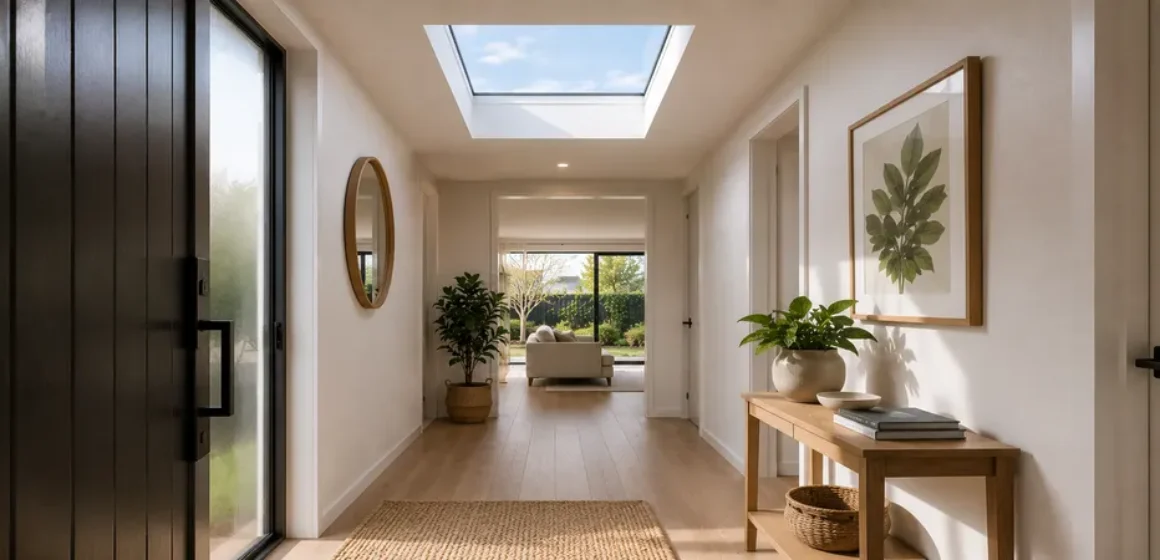
In some homes, a fixed skylight above the entry may create a stronger arrival point. In others, a tubular skylight or Sky tube in the hallway may solve the more practical daylight problem.
The right solution depends on where the darkness actually sits.
When a fixed skylight may suit an entryway
A fixed skylight may suit an entryway where a stronger daylight opening is wanted and the room proportions can support it.
It may be worth considering when:
- The entry is wide enough to suit a visible skylight
- The space feels flat or enclosed during the day
- The homeowner wants a brighter arrival point
- The ceiling height or shape supports a skylight opening
- The entry connects with a formal hallway or living space
- Roof and ceiling conditions are suitable
- Privacy and glare can be managed
- Ventilation is not the main concern
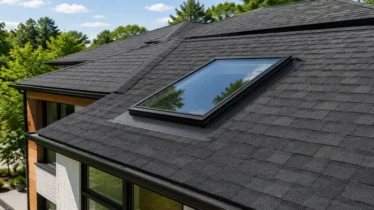
A fixed skylight can give an entryway a more open feeling. It may work especially well in a foyer, wider entrance, stairwell entry or front hall where the skylight becomes part of the home’s first impression.
However, fixed skylights still need careful planning.
Size, placement, roof pitch, flashing, internal finishing, ceiling proportions, front door position and hallway connection all matter.
A fixed skylight should feel integrated with the entry, not forced into it.
When a tubular skylight or Sky tube may be better
A tubular skylight or Sky tube may suit many Hamilton and Cambridge entryways, especially where the entrance is compact or connected to a narrow hallway.
It may be a good option where:
- The entry is small
- The hallway is the darker area
- A full skylight would feel too large
- The space mainly needs practical daylight
- The ceiling and roof path are suitable
- The homeowner prefers a subtle ceiling diffuser
- The entry is part of a narrow passage
- Daylight is needed without a strong design feature
A tubular skylight brings daylight from the roof through a reflective tube to a ceiling diffuser. In an entryway, this can help the space feel less enclosed without requiring a large visible roof opening.
It may be especially useful where the homeowner says:
“The front door area is not huge. It just feels too dark.”
A tubular skylight or Sky tube can be a practical answer in that situation, provided the roof-to-ceiling path works.
Is a vented skylight needed in an entryway?
In most entryways, ventilation is not the main reason to choose a skylight.
An entryway usually needs daylight and a clearer feeling of arrival. Airflow may be managed through doors, windows or the wider home ventilation approach.
A vented skylight may be discussed only in specific cases, such as:
- A larger foyer with high ceilings
- A stairwell entry where warm air gathers
- An entry connected to a stuffy upper-level space
- A home where natural airflow is part of the wider design
- A roof and ceiling layout that makes a vented unit practical
For most standard entries, a fixed skylight, tubular skylight or Sky tube is more likely to be considered first.
A vented skylight adds complexity and should be chosen only when airflow is a real need.
Daylight and ventilation should not be confused.
Front doors, sidelights and skylights
Some entryways can be improved through better door glazing or sidelights. Others cannot.
A front door with glass panels, sidelights or a nearby window may bring daylight into the entry. But the benefit may be limited if the front porch is shaded, privacy is a concern, the glass is small, or the entry leads immediately into a dark hallway.
A skylight may be worth considering where:
- Door glazing is limited
- Privacy reduces side light
- A porch or veranda blocks daylight
- The hallway beyond remains dark
- The entry faces a shaded direction
- The homeowner does not want to alter the front door
- Overhead daylight would reach the space more effectively
This does not mean a skylight is always better than improving door glazing.
It means the source of daylight matters.
If the problem is that daylight cannot reach the entry from the side or front, overhead daylight may be a better path to assess.
Covered porches and verandas
Covered porches and verandas are common reasons entryways feel darker.
They can be useful for shelter, character and weather protection, but they also reduce the daylight reaching the front door and entry area.
This can be especially relevant in Cambridge homes with older character features, established gardens or deeper entry points. It can also apply to Hamilton homes with covered front doors, garage-forward layouts or shaded entrances.
A skylight may help where the porch blocks wall-level daylight but the roof and ceiling layout allow overhead daylight inside.
However, placement needs care.
The skylight should not simply brighten an area near the door while leaving the connected hallway dull. It should support the way people move into the home.
Sometimes the best location is not directly above the door. It may be slightly further into the entry or hallway where the daylight can serve both the entrance and the transition space.
Entryways in older homes
Older homes often have entryways and hallways that rely on borrowed light.
A central hallway may begin at the front door, with bedrooms or living rooms off each side. The entrance may have character features, but limited natural brightness. In winter, the space can feel darker than the rest of the home.
A skylight or tubular skylight may be worth considering where:
- The front hall is dark during the day
- The hallway relies on borrowed room light
- The entry has a covered veranda
- The original window or door glazing is limited
- The homeowner wants daylight without changing the front facade
- The roof and ceiling structure are suitable
Older homes need careful assessment.
Roof framing, ceiling materials, wiring, insulation, roof condition and previous alterations may all affect what is practical.
The skylight should also respect the character of the entry. A subtle tubular skylight or carefully positioned fixed skylight may suit better than an oversized feature.
The aim is to improve the space without making it feel out of place.
Entryways in newer homes
Newer homes can also have dark entryways.
A modern home may have an internal-access garage, compact frontage, deep entrance, hallway-based layout or limited side windows due to privacy and boundary constraints. Some entryways are efficient but not naturally bright.
A skylight may help where:
- The entry sits away from external windows
- The front door is solid or partly solid
- The hallway begins immediately from the entrance
- The entry feels dark despite modern finishes
- The space relies on downlights during the day
- The home has a deeper floor plan
- Neighbouring homes or fences limit side light
In newer homes, ceiling and roof layout still need assessment. There may be trusses, ducting, insulation, wiring, downlights, alarm sensors or other ceiling services to consider.
A tubular skylight or Sky tube may suit compact entries. A fixed skylight may suit wider foyers or higher-ceiling entry spaces.
The home may be newer, but the daylight problem can still be real.
Entryways near internal access garages
Many Hamilton homes have entryways connected to internal access garages.
This can create a darker transition area, especially where the entry, hallway, laundry or garage access zone sit together. The space may be practical, but it can feel heavy or under-lit during the day.
A tubular skylight or Sky tube may be worth considering where:
- The entry from the garage feels dark
- The front entry and garage entry connect through one hallway
- The laundry or toilet nearby is also dark
- The ceiling light is used during the day
- The homeowner wants practical daylight rather than a feature
- The roof path is suitable
In this type of layout, it may be useful to assess the entire transition zone, not just the front door.
A well-placed daylight point may improve the entry, hallway and garage connection together.
The goal is to make everyday movement through the home feel clearer.
Entryways and stairs
Some homes have entryways connected to stairwells or split-level spaces.
A stairwell entry can benefit from daylight, but placement and safety need careful thought.
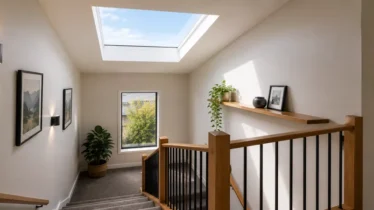
A fixed skylight may suit some stairwell entries where the ceiling height and roof layout support a larger daylight opening. A tubular skylight or Sky tube may suit more compact landings or darker transition spaces. A vented skylight may be considered only where airflow is also relevant and operation is practical.
Consider:
- Stair position
- Landing daylight
- Handrail and wall shadows
- Glare on steps
- Ceiling height
- Roof access
- Whether daylight improves safety and orientation
- Whether the entry and stairwell need one solution or separate daylight points
The aim is not simply a brighter stairwell.
It is better visibility, clearer movement and a more welcoming transition into the home.
Glare and polished entry finishes
Entryways can include reflective surfaces.
These may include:
- Polished timber floors
- Tiles
- Mirrors
- Glass doors
- Gloss paint
- Feature lighting
- Metal fittings
- Framed artwork
- Console tables
- Stair balustrades
A skylight placed without considering these surfaces may create glare or harsh reflections at certain times of day.
This is especially relevant where the entry is narrow or has a strong line of sight from the front door.
A skylight should make the entry feel softer and clearer, not harsh.
Placement, size, diffuser style, glazing and light control may all matter depending on the entry.
For many compact entries, a tubular skylight or Sky tube may provide a more diffused result than a larger fixed skylight.
Privacy from the street and neighbours
Entryways often face the street, driveway or neighbouring properties.
This can limit how much daylight homeowners want to bring through front-facing glass. A large glass door or side window may not suit every home because privacy, security and street exposure matter.
Overhead daylight may help where:
- The homeowner wants to keep a solid or semi-solid front door
- The entry faces a busy street
- Side windows would overlook neighbours
- Privacy coverings reduce daylight
- The entry is close to a boundary
- Front glazing is not practical or desired
A skylight can sometimes bring daylight into the entry without increasing street-facing exposure.
However, privacy from above should still be considered in some settings, especially on sloped sites, near multi-storey neighbours or where roof angles create unusual sightlines.
A daylight solution should respect how private the entry needs to feel.
Entryway skylight placement
Placement should follow how people move through the space.
A skylight or diffuser may be useful:
- Near the front door
- In the centre of the entry
- Slightly into the hallway
- Over a stair landing
- Near a console table or shoe area
- Where the entry transitions into living spaces
- Where the darkest section begins
- Where one daylight point can support both entry and hallway
The best placement is not always directly above the front door.
If the front door area already receives some light, but the hallway immediately beyond is dark, the daylight may need to land further inside. If the entry itself feels enclosed, a central placement may work better. If the entry is long or narrow, a tubular skylight or multiple daylight points may need consideration.
A good entryway skylight should support arrival and movement.
It should not just brighten one isolated patch.
Skylight size in an entryway
Entryway skylight size should suit the space.
A large skylight may work in a wide foyer, high-ceiling entry or stairwell. But in a compact entry, it may feel excessive or visually unbalanced. A tubular skylight or Sky tube may provide enough daylight with a smaller ceiling presence.
Size should consider:
- Entry width
- Ceiling height
- Hallway connection
- Front door position
- Floor finishes
- Existing windows
- Roof orientation
- Desired daylight level
- Whether the skylight is intended as a feature
- Whether glare is likely
- Whether one daylight point is enough
Bigger is not automatically better.
An entryway usually needs welcoming daylight, not maximum brightness.
The right size is the one that makes the space feel clearer and more balanced.
Roof and ceiling considerations
An entryway skylight must work with the roof system.
Important considerations include:
- Roof type
- Roof pitch
- Roof profile
- Flashing requirements
- Roof condition
- Water flow direction
- Valleys, ridges and gutters
- Porch roof connection
- Existing roof penetrations
- Solar panels
- Ceiling cavity depth
- Rafters or trusses
- Wiring
- Security systems
- Smoke alarms
- Lighting circuits
- Insulation
- Ducting
- Internal finishing requirements
For tubular skylights and Sky tubes, the roof-to-ceiling tube path matters. For fixed skylights, framing, flashing and internal lining need careful planning.
Entryways may also have lighting, alarms, sensors or ceiling features that affect placement.
Photos of the entry, ceiling and roof can help make the enquiry more useful.
The room shows the daylight problem. The roof helps determine the solution.
Renovation timing
Entryway improvements are often part of broader home upgrades.
A homeowner may be repainting, changing flooring, replacing the front door, improving lighting, renovating the hallway, updating stairs or improving the overall first impression of the home.
This is a good time to consider daylight.
Early planning can help coordinate:
- Skylight or diffuser placement
- Ceiling lights
- Smoke alarms or sensors
- Front door changes
- Painting
- Flooring
- Hallway improvements
- Stairwell lighting
- Electrical work
- Roof access
- Internal finishing
If skylight planning is left too late, the best ceiling position may already be affected by lights, alarms, wiring or finished surfaces.
For Hamilton and Cambridge homeowners planning spring improvements, winter is a useful time to assess whether the entryway lacks natural daylight.
Winter shows the issue clearly.
When an entryway skylight may not be the first answer
A skylight may not be the best first step in every entryway.
Other improvements may need review first if:
- The entry already has enough daylight
- The main issue is poor artificial lighting
- Dark paint or flooring is absorbing light
- The front door could be improved with glazing
- The hallway rather than the entry is the real problem
- The roof above is unsuitable
- The ceiling is crowded with services
- Glare would be difficult to manage
- The room layout is about to change
- The homeowner expects a skylight to fix a cold entry
A skylight improves daylight. It does not replace heating, insulation, lighting design or layout planning.
Sometimes a better front door, lighter finishes, improved lighting or hallway changes may be the first step.
Other times, overhead daylight may be the most practical improvement.
The key is diagnosing the entry properly.
Common mistakes with entryway skylights
Placing the skylight directly above the door without checking the hallway
The hallway beyond may be the darker and more important area.
Choosing a large skylight for a compact entry
A tubular skylight or Sky tube may provide enough daylight with less visual impact.
Ignoring glare
Tiles, polished timber, mirrors and glass can reflect light.
Forgetting privacy
Street-facing and neighbour-facing entries may benefit from overhead daylight, but privacy still needs thought.
Treating the entry separately from the home flow
The entry, hallway, stairs and living areas often work together.
Assuming ventilation is needed
Most entries need daylight more than a vented skylight.
Ignoring ceiling services
Lights, alarms, sensors and wiring can affect placement.
Planning only for appearance
The entry should feel better to use, not just look brighter in photos.
Avoiding these mistakes helps create a more natural and practical result.
Illustrative example only
A Hamilton homeowner has a front entry that opens into a narrow hallway. The front door has a small glazed panel, but a covered porch reduces the amount of daylight reaching the entry. In winter, the entry light is used during the day, and the hallway feels dull from the moment someone walks in.
The homeowner asks whether a skylight above the front door would help.
A fixed skylight may be worth considering if the entry is wide enough and the homeowner wants a stronger daylight feature. However, if the hallway beyond is the darker area, a tubular skylight or Sky tube slightly further inside may be more practical. The roof path, existing lights, smoke alarm, porch roof and ceiling structure would all need review.
In a Cambridge home with a wider foyer, a fixed skylight may create a better arrival point. In a compact hallway-style entry, a tubular skylight may be the cleaner solution.
The same problem, a dark entry, can require different answers.
What to send when asking for an entryway skylight quote
Good information helps shape a better recommendation.
For an entryway skylight enquiry, send:
- Photos of the entry from the front door
- Photos looking back towards the front door
- A photo of the ceiling
- A photo of the hallway beyond the entry
- A photo showing the darkest section
- A photo of the front door and any side windows
- A photo of the porch or covered entrance, if relevant
- Roof photos above or near the entry, if possible
- The approximate entry and hallway dimensions
- Whether the home is in Hamilton, Cambridge or nearby Waikato
- Whether the entry connects to stairs, garage access or a hallway
- Whether glare or privacy is a concern
- Whether renovation, painting or flooring work is planned
- Whether you prefer a fixed skylight, tubular skylight or Sky tube option
- The roof type, if known
These details help determine whether the entry itself needs daylight, whether the hallway is the main issue, and which skylight option may be most suitable.
The best entryway skylight outcome
The best result is not an entry that feels overly bright.
It is an entry that feels clearer, more welcoming and more connected to the home.
A good outcome may mean:
- The first space feels less flat in winter
- The entry light is needed less during the day
- The hallway connection feels more natural
- Visitors arrive into a brighter, calmer space
- The front door area feels less enclosed
- A stairwell or transition area feels safer and clearer
- Privacy is maintained
- Glare is managed
- The product suits the room and roof together
An entryway sets the tone.
If it feels dark every day, it may be worth giving it the same daylight attention as the rooms beyond it.
Planning your next step
If your Hamilton or Cambridge entryway feels dark, flat or overly dependent on artificial lighting during the day, it may be worth exploring whether overhead daylight could help.
A fixed skylight may suit wider entries, foyers and stairwell entrances where a stronger daylight opening is wanted. A tubular skylight or Sky tube may suit compact entries, narrow hallways and transition spaces where subtle practical daylight is enough. A vented skylight is usually only worth discussing where airflow is genuinely part of the issue.
Skylights NZ can help you review which option may suit your entryway, roof type, ceiling layout and desired outcome.
To start planning your options, use the Skylights NZ enquiry form:
https://inquiry.skylights.co.nz/inquiry
You may also find these useful:
- Skylight installation services
- Request a skylight quote
- Skylight options for NZ homes
- Dark Hamilton Hallways: Why Winter Shows the Problem Clearly
- Living Room Skylights in Cambridge Homes: Winter Daylight for Everyday Spaces
- The 3pm Winter Test: Is Your Waikato Room Asking for Better Daylight?
- Tubular Skylights for Waikato Hallways, Toilets and Walk-in Wardrobes
FAQs
Is a skylight a good idea for a dark entryway?
A skylight may be a good idea for a dark entryway if the space lacks useful daylight and has a suitable roof and ceiling layout. The best option depends on entry size, hallway connection, roof type, ceiling layout, privacy and glare.
What type of skylight is best for an entryway?
A fixed skylight may suit a wider entry or foyer where a stronger daylight feature is wanted. A tubular skylight or Sky tube may suit compact entries, narrow hallways and transition spaces where practical daylight is enough.
Should the skylight go above the front door or hallway?
It depends on where the daylight problem is strongest. If the entry itself is dark, a skylight near the front door may help. If the hallway beyond is darker, a tubular skylight or Sky tube further inside may be more useful.
Can an entryway skylight help with privacy?
An entryway skylight may improve daylight without increasing street-facing glass or side-window exposure. Privacy still depends on roof angle, neighbouring properties, glazing, placement and the home’s layout.
Does an entryway need a vented skylight?
Most entryways need daylight more than ventilation. A vented skylight may only be worth considering in larger foyers, stairwell entries or spaces where airflow is genuinely part of the issue.
What should I send for an entryway skylight quote?
Send photos of the entry, hallway, ceiling, front door, porch or covered entrance, and roof above or near the space if possible. Include entry dimensions, roof type if known, whether the hallway is also dark and whether privacy or glare is a concern.