Circular dome on square base vs circular base: which is better for your NZ roof?
A homeowner in Hamilton and an installer stand on a scaffold, looking at the roof.
The homeowner points to the marked opening.
“We know we want a circular dome. But I’ve been told it can sit on a square base or a circular base. Does that really make a difference?”
From the street, both options can look like “a round skylight”. Up close, the base is where the skylight and the roof learn to work together.
For New Zealand homes, choosing a circular dome skylight square base NZ configuration, or a circular dome with a circular base, affects:
- how easily the skylight can be flashed into metal, tile or membrane roofs
- the neatness of detailing at ridges, hips and gutters
- internal throat sizing and ceiling finish
- future maintenance and replacement.
This guide looks at base choice in plain English. The goal is not to turn you into a roofer, but to help you understand:
- what the base does
- where a square base often makes sense
- where a circular base may be preferred
- how roof type and region influence the decision.
1. First principles – what the base actually does
A circular skylight is really two main parts working together:
- the dome – catching and diffusing light
- the base – connecting the dome to the roof and the internal shaft.
The base:
- is shaped to sit on a particular roof profile
- allows flashings to shed water away from the opening
- provides a transition between roof shape and throat size.
Whether that base is square or circular, the job description is the same:
- hold the dome securely
- keep water moving off the roof in controlled ways
- provide the right internal opening for the shaft and ceiling line.
2. Square bases – why they are so common on NZ roofs
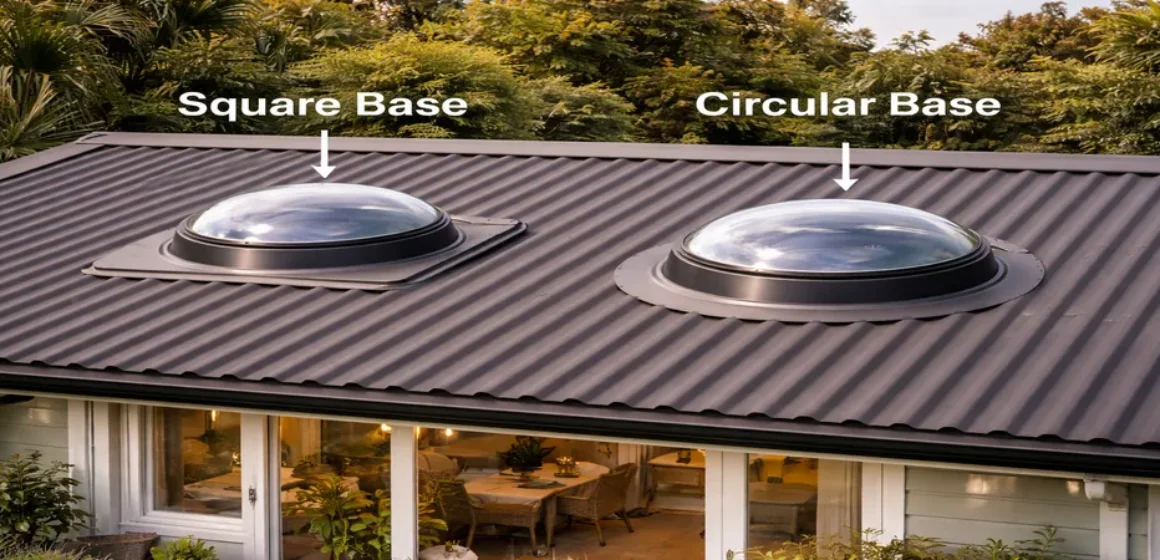
Walk around a typical New Zealand suburb and many circular domes you see from the ground are likely sitting on square or rectangular bases.
How a square base works
A square base:
- has straight sides that align with the roof’s sheet or tile directions
- gives the installer simple, straight lines for flashings
- creates a clear, box-like frame around the circular dome.
On common NZ roof types, this can be highly practical.
Metal longrun and trapezoidal profiles
On longrun metal roofs (corrugated or trapezoidal):
- a square base can be set out so that its edges sit cleanly across the ribs
- flashings can be formed as familiar straight aprons, side flashings and back trays
- roofers are often very comfortable with these details.
On trapezoidal profiles, the square base helps:
- control where cut sheets end
- manage water paths at the top and sides of the skylight
- align with standard sill and apron flashing techniques.
Concrete and pressed metal tiles
On tiled roofs, square bases:
- can be integrated by lifting tiles and shaping the base to sit under and around them
- allow apron and side flashings to be stepped or notched into the tile pattern
- give a defined footprint that is easy to read from above.
In these cases, a circular base that tries to follow each tile rib closely can be more challenging to detail.
Internal throat sizing
Inside the home, a square base often corresponds to a square or rectangular throat.
That can be helpful when:
- building a straight, insulated shaft
- lining the throat with plasterboard
- aligning the opening with room geometry.
Illustrative Example Only: In a Wellington villa re-roof, the owners wanted circular domes over a new hallway and stair. The roofer recommended domes on square bases to work cleanly with the new longrun profile. Inside, this allowed for straight, well-insulated throats that aligned with the corridor and stair layout.
3. Circular bases – where a round footprint earns its place
A circular base is exactly what it sounds like: the dome sits on a round upstand rather than a square frame.
From above, the whole unit reads as a circle on the roof.
Roof types where circular bases can shine
Circular bases are often considered where:
- roof finishes are membrane or shallow-pitch systems
- the roof has a very clean, minimal expression
- the design language favours pure geometry.
In some membrane roofs and low-slope situations, a circular upstand:
- can simplify the way membrane runs around the opening
- may reduce sharp corners where water and debris could collect
- supports a very “object-like” reading of the skylight.
On high-end metal roofs with standing seams or concealed fixings, the decision may be more about visual intent:
- the architect wants a pure circle against the roof
- the base and flashings are designed as part of a custom package.
Internal expression
Inside the home, a circular base naturally aligns with:
- circular or curved internal throats
- strong feature statements over entries or focal points
- ceilings where the circle is allowed to be clearly legible.
This is more common in architect-led projects where the skylight is a key part of the interior composition.
4. Side‑by‑side comparison – square vs circular base in practice
Rather than thinking of one option as “better”, it can be helpful to compare how each behaves under common headings.
Roof compatibility
- Square base:
- Very versatile across longrun metal, trapezoidal, concrete tile and pressed metal tile roofs.
- Often aligns with existing roofing trade detailing.
- Circular base:
- Well suited to some membrane roofs and specific metal systems where details are carefully designed.
- May be more specialised on tiled roofs.
Flashings and water management
- Square base:
- Straight flashings along each side.
- Clear top apron/back tray and side flashing logic.
- Familiar to most NZ roofers.
- Circular base:
- Flashings and membrane need to negotiate a curve.
- Detailing may be more bespoke.
- In some high-end systems, this is fully resolved by the supplier.
Aesthetic on the roof
- Square base:
- Reads as a circle within a square when viewed from above.
- Often visually aligned with sheet or tile layout.
- Can be less noticeable from the street on busy roofscapes.
- Circular base:
- Reads as a pure circle.
- Stronger visual statement on simple roof forms.
- May be preferred when the roof is a major design feature.
Inside the home
- Square base:
- Straight throats are easy to frame, insulate and line.
- Simple to align with rectangular rooms and hallways.
- Circle of light on the floor can still be strong and clear.
- Circular base:
- Can support fully circular or flared throats with a sculptural feel.
- Often paired with feature ceilings or bespoke plasterwork.
- May involve more careful internal finishing.
Maintenance and replacement
- Square base:
- Established detailing makes inspection familiar to roofers.
- Replacement domes on the same footprint can be more straightforward in future.
- Circular base:
- Maintenance will often be handled by installers familiar with that particular system.
- Replacement may require like-for-like units from the same or a compatible supplier.
5. Roof type snapshots – how base choice plays out across NZ
Different parts of New Zealand favour different roof types, which often influence base decisions.
Longrun metal roofs – suburban and rural
Across Waikato, Taranaki, Canterbury plains and many regional towns, longrun metal is common on:
- family homes
- lifestyle blocks
- rural sheds and workshops.
Here, square bases:
- sit neatly across ribs
- are straightforward to flash
- suit both homes and utility buildings.
Circular bases may appear on more bespoke projects where the roof and skylight system have been designed together.
Urban villas and bungalows – tiled or re-roofed
In Auckland, Wellington, Dunedin and other older suburbs, villas and bungalows may have:
- original concrete tiles
- new longrun replacements
- mixed roof forms after extensions.
Square bases offer installers:
- flexibility across different pitches and junctions
- the ability to work with existing tiles or new metal
- a clear, boxy footprint that suits complex roofscapes.
Membrane and low-slope roofs
In some contemporary builds and city infill projects, membrane roofs and low slopes are more common.
Here, base decisions are often made as part of the:
- overall membrane detailing strategy
- parapet and drainage design
- relationship between the roof and any rooftop decks or usable spaces.
Circular bases may be part of a specific system choice, while square bases remain entirely viable depending on how the roof is set out.
6. How base choice interacts with other decisions
Base shape does not sit in isolation. It interacts with other key decisions you are making about the skylight.
Diameter and feature level
- Larger feature domes on simple roof forms may justify the extra design work behind a circular base.
- Modest circular domes used primarily for function often sit happily on square bases.
Material and thickness
Your choice of:
- acrylic thickness (3 mm vs 4.5 mm)
- plastic vs glass
will influence framing and fixing, which then feed back into base design.
It is better to discuss base, material and thickness together as one integrated package.
Regional climate and exposure
Coastal wind, alpine snow and urban density all affect how roof penetrations are detailed.
In more exposed areas, installers may favour:
- square bases with proven flashing details
- or circular-base systems with very specific, tested detailing.
Either way, the climate context shapes the base conversation.
7. A simple decision guide for NZ homeowners
You do not need to choose a base shape alone. Use this short guide to structure your conversation with your installer or designer.
Step 1 – Identify your roof type
Is it longrun metal, trapezoidal, concrete tile, pressed metal tile or membrane? Take clear photos from the outside if you are not sure.
Step 2 – Decide how visible the skylight is from the street
If the roof is highly visible and part of the architecture, base aesthetics may matter more. If it is mostly hidden, practicality may take priority.
Step 3 – Clarify whether this is a feature or a quiet upgrade
If the skylight is intended as a hero element, a circular base may be considered as part of a broader design concept. If it is mainly solving a light problem, a square base is often the straightforward choice.
Step 4 – Ask your installer which base they can detail best on your roof
A well-executed square base is better than a circular base that is difficult to flash correctly. The quality of detailing is more important than the shape of the footprint.
Step 5 – Check how base choice affects future maintenance
Ask what replacement might look like in 10 or 20 years and whether one base form offers simpler future options for your roof type.
Skylights New Zealand and our installer partners regularly help homeowners work through these questions so circular dome skylight square base and circular base options can be compared fairly.
Make an enquiry via Skylights New Zealand
Share your roof type, a few photos, and whether the skylight is a feature or a quiet upgrade. A skylight professional can then talk you through base options that make sense for your roof, region and project goals.
FAQs – circular dome on square base vs circular base in NZ
Q1. Is a square base or circular base better for most NZ homes?
Neither is automatically better. Square bases are very versatile on common NZ roof types, while circular bases suit some membrane roofs and design-led projects. The best choice depends on roof type, exposure and design intent.
Q2. Will people see the square base from inside the house?
Not usually. Inside, the visible shape is created by the throat and ceiling finish. Even with a square base, the ceiling opening and the pool of light can still read as a clear circle.
Q3. Are circular bases more watertight than square bases?
Both can be watertight when correctly designed and installed. Water tightness comes from good detailing and workmanship rather than the base being square or circular.
Q4. Is a circular base always more expensive?
Not always, but it can involve more bespoke detailing or specific systems. In many standard residential projects, square bases are the more economical and familiar option.
Q5. Can I change from a square base to a circular base later?
Changing base type usually involves more than swapping the dome. It can require new flashings and adjustments to the roof opening. It is best to decide base shape as part of the initial design.
Q6. How do I know which base my roof suits best?
Take photos of your roof and share them with a skylight professional. They can explain which base shapes work best with your roof profile, region and the type of skylight you have in mind.