Circular skylights in alpine and inland climates: Queenstown, Wanaka and beyond
1. Alpine light has its own rhythm
Winter in Queenstown often starts quietly.
Frost settles on roofs. The Remarkables sit in shadow. Inside, heaters flick on long before the sun crests the hills.
Then, on a clear day, something changes:
- low winter sun cuts across the valley
- sky turns a sharp, high-altitude blue
- rooms on the wrong side of the house can still feel dim, even at midday.
This pattern repeats across Wanaka, Central Otago and the Mackenzie country:
- cold winters with frost, occasional snow and long nights
- strong sun on clear days with high UV at altitude
- interiors that must cope with both chilly mornings and bright afternoons.
In these conditions, circular skylights alpine homes NZ are not simply decorative. They are tools for:
- catching low winter light and bringing it deeper into the plan
- managing condensation risk in well-insulated, airtight homes
- acting as sculptural elements in chalet-style and contemporary alpine design.
All examples in this article are Illustrative Only. Our aim is to help you ask better questions and brief your design and install team clearly.
2. What alpine and inland climates do to roofs and skylights
Before thinking about dome size or shaft shape, it helps to understand what the climate does to the building envelope.
Cold, frost and occasional snow
Alpine and inland regions experience:
- repeated freeze–thaw cycles
- frost on roofs many mornings in winter
- occasional or regular snow, depending on altitude and local conditions.
For circular skylights, this means:
- snow load and drift must be considered on roof planes
- water can refreeze around roof elements if drainage is not well planned
- materials and seals must cope with expansion and contraction.
Low winter sun, high summer intensity
The sun’s path in alpine areas has two distinct personalities:
- Winter – low angles, shorter days, light that may only reach parts of the house.
- Summer – long, clear days with strong, direct sun and high UV.
Circular skylights can help by:
- capturing valuable winter light on roof planes that still see the sun
- diffusing summer light so it feels generous rather than harsh
- complementing, not replacing, windows that manage views and cross-ventilation.
Airtight homes and moisture behaviour
Many alpine builds are:
- highly insulated
- relatively airtight compared to older NZ housing
- reliant on controlled ventilation.
This makes moisture management around skylights important. Warm, moist indoor air meeting cold surfaces can create condensation issues if shafts and junctions are not detailed well.
3. Light behaviour inside alpine homes – winter, shoulder seasons and summer
Thinking season by season helps keep expectations realistic.
Winter – making the most of low-angle light
In winter, circular skylights can:
- pull light into rooms that sit in the house’s interior
- give depth to spaces on the cooler, less sun-exposed sides
- create pockets of brightness that make mornings feel more liveable.
Illustrative Example Only: In a Wanaka home, a circular skylight over the internal part of the living area catches winter light from a north-facing roof plane. Even when the lakeside windows see less direct sun, the centre of the room still feels alive.
Design focus:
- positioning the skylight on roof planes that reliably receive winter sun
- sizing shafts and throats to bring light down without creating glare on seating
- integrating with overall heating strategy so daylight and warmth support each other.
Shoulder seasons – balancing gain and glare
In autumn and spring:
- days can swing between chilly and surprisingly warm
- heating may be needed some mornings and evenings
- mid-afternoon light can still feel strong.
Circular skylights here need to:
- avoid introducing excessive heat on mild days
- keep light soft enough for reading, working or relaxing
- work alongside window shading and ventilation.
Summer – high-altitude clarity and control
Summer days in Central Otago and the Mackenzie country can be intense:
- long daylight hours
- bright, clear skies with strong UV
- outdoor life dominating, but interiors still in use.
Circular skylights in summer should:
- provide even, diffused light in main living and circulation spaces
- avoid creating hot spots under domes
- be considered alongside night-time cooling strategies.
4. Material and thickness choices in alpine settings
Homeowners in Queenstown and Wanaka often ask whether alpine conditions change the best choice of dome material.
Acrylic domes – clarity with careful detailing
Acrylic remains a common choice for circular domes in alpine homes because it:
- delivers good optical clarity and soft daylight
- weighs less than glass
- sits in a practical cost band for many projects.
In frost-prone, inland climates, thickness and quality matter:
- 3 mm acrylic may suit smaller domes on well-sheltered roofs
- 4.5 mm acrylic is often preferred for larger diameters or more exposed ridgelines, where extra rigidity and strength are important.
Polycarbonate – where impact and robustness are key
In some alpine locations:
- snow shedding from higher roofs
- occasional debris carried by wind
- particularly exposed sections
may lead designers to consider polycarbonate domes, especially for:
- more industrial or utility buildings
- certain rural properties with high exposure.
As with coastal homes, light character and expectations should be discussed using real samples where possible.
Glass – select, design-led applications
Glass circular skylights appear in:
- high-end contemporary alpine houses
- carefully detailed chalet-style designs
- spaces where the ceiling and roof are treated as a continuous architectural composition.
They typically involve:
- higher structural and installation complexity
- more substantial support systems
- a different cost level to acrylic or polycarbonate.
Most circular skylights alpine homes NZ solutions will be found in well-specified acrylic or polycarbonate, with thickness tuned to diameter, roof pitch and exposure.
5. Roof forms in alpine regions – steep pitches, sheds and chalet lines
Alpine and inland homes often use roof shapes that respond to snow, wind and views.
Steep pitched roofs
Many alpine roofs are:
- steeply pitched to shed snow and water
- oriented to manage views and sun
- finished in longrun metal.
Circular skylights on these roofs need:
- base and flashing systems suited to steeper pitches
- positions that avoid heavy snow drift zones where possible
- thoughtful integration with structural framing.
Mono-pitches and contemporary forms
Modern Wanaka and Central Otago homes often favour:
- single long mono-pitches
- paired sheds forming simple, graphic rooflines.
Circular domes here can:
- act as focal points on the “quiet” roof plane away from main views
- bring light into the internal parts of open-plan spaces
- be positioned to read as deliberate, sculptural forms from outside.
Chalet-style and gable forms
In some alpine builds:
- gables and chalet forms frame views and create dramatic interiors
- circular skylights can work with exposed rafters and timber linings.
Integration points include:
- aligning shafts and throats with structural rhythm
- choosing dome sizes that feel balanced with gable span and height
- working closely with roofers so snow and ice do not compromise flashings.
6. Circular skylights as sculptural elements in alpine interiors
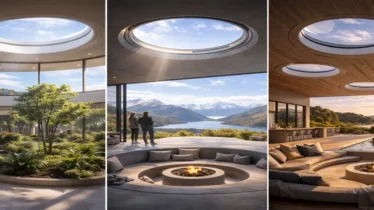
Beyond performance, alpine homes often use circular skylights as sculptural pieces.
Framing the sky and peaks
In living rooms and double-height spaces, circular domes can:
- bring patches of sky and cloud movement into view
- complement large windows that frame mountains or lakes
- create shifting patterns of light on timber or concrete surfaces.
Illustrative Example Only: A Central Otago home uses a circular skylight above a timber-lined ceiling in the main living area. While large windows frame the valley, the dome adds a constantly changing circle of sky that shifts with cloud and season.
Supporting quiet zones
In alpine climates, quiet indoor corners matter on storm days.
Circular skylights can gently lift:
- reading nooks near fireplaces
- window seats overlooking snow-covered gardens
- small workspaces tucked within open-plan rooms.
Connecting levels and entries
In two-storey alpine homes, circular domes:
- brighten stairwells, reducing the reliance on artificial light
- draw people up towards views
- make entries feel generous even when boots, coats and ski gear crowd the floor.
7. Condensation and moisture – keeping alpine skylights comfortable
Cold outside, warm inside is exactly the condition where condensation can appear if detailing is not handled well.
Where condensation tries to form
Potential risk points around circular skylights include:
- the inside surface of the dome, particularly overnight
- the shaft walls, if they are poorly insulated
- junctions at the ceiling where warm, moist air can leak.
How good detailing helps
Homeowners do not need to know every technical term, but it is useful to ask about:
- shaft insulation – is the shaft insulated in line with surrounding roof and ceiling?
- vapour control – how is warm, moist indoor air managed so it does not get trapped in cold cavities?
- ventilation strategy – how does the skylight design work with mechanical or passive ventilation?
In some locations and room types (bathrooms, laundries), a vented circular skylight or paired ventilation system may be recommended.
Early discussion of condensation risk is a sign of a careful, alpine-aware design process.
8. Regional snapshots – Queenstown, Wanaka, Central Otago and the Mackenzie
Each alpine and inland region has its own rhythm.
Queenstown
- Mix of compact sections and steep sites.
- Strong seasonal shifts, with tourism and daily life intertwined.
- Many homes chasing views of specific ranges and lake angles.
Circular skylight themes:
- bringing light into internal portions of view-focused layouts
- integrating domes with steep roofs on constrained sites
- planning for snow and frost alongside year-round use.
Wanaka
- Slightly more open sites in many areas.
- Strong outdoor lifestyle and lakefront focus.
- Many family homes needing flexible, comfortable living spaces.
Circular skylights often aim to:
- create generous, soft light in main living zones
- support quieter corners for reading or working on cold days
- balance summer brightness with winter warmth.
Central Otago
- Wide skies, strong seasonal contrasts, and often drier conditions.
- Lifestyle blocks and small towns with their own character.
Circular domes here can:
- emphasise big-sky feelings in rural homes
- work with darker cladding and roofs to create striking interiors
- sit carefully within long, simple roof forms.
Mackenzie country
- High, open landscapes with dark-sky characteristics in some areas.
- Strong appeal for stargazing and night-sky awareness.
In these homes, circular skylights may be:
- tuned to capture specific day-time light while managing night-time darkness
- used in combination with carefully chosen artificial lighting
- integrated into designs that respect both star viewing and thermal comfort.
9. Planning an alpine circular skylight – a practical checklist
To make an enquiry for an alpine or inland home more productive, it helps to gather specific information.
Before you speak with a skylight professional, note:
- Location and altitude
- e.g. “edge of Wanaka township” or “rural site near Twizel”.
- Roof form and pitch
- mono-pitch, gable, chalet form; approximate pitch if known.
- Room use and seasonality
- where you will be in winter mornings vs summer evenings.
- Existing windows and view direction
- which way your main glazing faces and what it looks onto.
- Comfort priorities
- more winter light, reduced reliance on electric lighting, sculptural effect, or a balance of all three.
Skylights New Zealand uses this kind of detail to match circular skylights alpine homes NZ solutions to the actual behaviour of your site and home.
Make an enquiry via Skylights New Zealand
Include a short note about how your home feels in winter and where you would most value a change in light. A skylight professional can then outline circular skylight options that respect both your climate and your architecture.
FAQs – circular skylights in alpine and inland NZ homes
Q1. Are circular skylights suitable for homes that get snow?
Yes, provided snow load, roof form, base design and flashing details are considered as part of the overall roof solution. Site-specific advice is important.
Q2. Will a circular skylight make my alpine home lose heat?
Any opening in the building envelope needs thoughtful design. With well-insulated shafts, appropriate products and good detailing, circular skylights can support comfort rather than undermine it.
Q3. Do alpine circular skylights need special materials?
They often use similar materials to other regions (acrylic or polycarbonate), but thickness, quality and detailing may be adjusted for frost, snow and temperature swings.
Q4. How do I reduce condensation risk around a skylight in a cold climate?
Good shaft insulation, careful vapour management and an overall ventilation strategy are key. These should be addressed by your designer and installer early in the process.
Q5. Can I use a circular skylight mainly as a sculptural feature in an alpine home?
Yes, many designs do just that, but it is still important to consider comfort, maintenance and climate behaviour alongside the visual goal.
Q6. Is retrofitting a circular skylight into an existing alpine home possible?
Often it is, subject to roof structure, access and overall design. An initial assessment with photos and basic site information will help clarify feasible options.