Circular skylights in compact urban Auckland and townhouses
1. When neighbours are closer than the sky
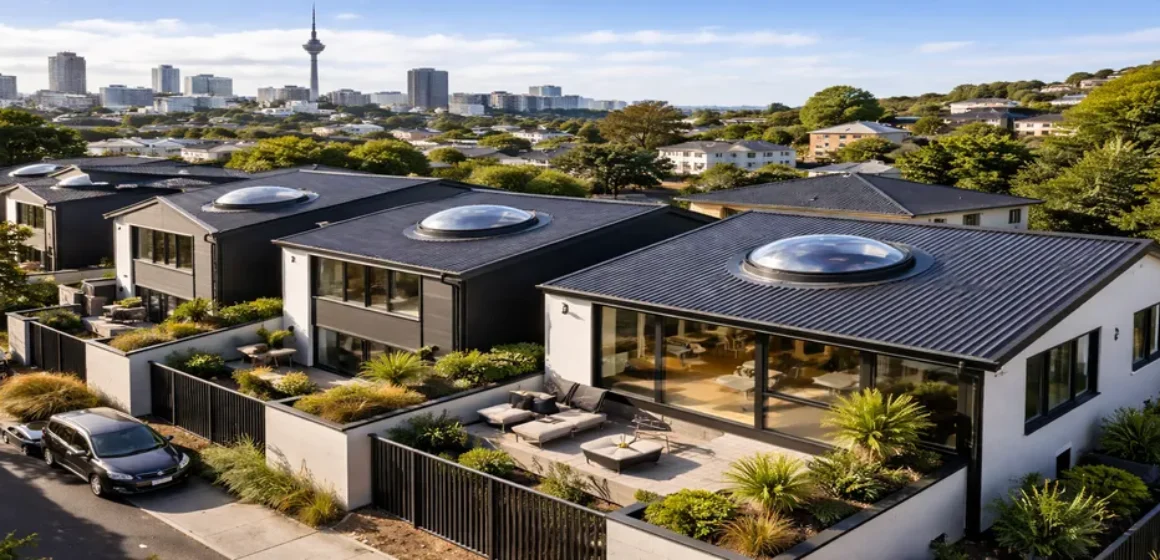
In many parts of Auckland, homes are getting closer together.
Townhouses in places like Stonefields, Hobsonville Point, Mt Wellington, New Lynn and parts of the central isthmus share:
- narrow frontages
- small courtyards
- side walls that sit only a few metres from the neighbour.
Inside, it is common to find:
- internal bathrooms with no external window
- central stairs in the middle of the plan
- living spaces that sit deep within the building, away from street or courtyard.
In this context, circular skylights Auckland townhouses are not just a design flourish. They are often one of the most practical ways to:
- get daylight into the centre of the plan
- improve everyday comfort and safety
- protect privacy in dense, built-up streets.
This article focuses specifically on compact urban Auckland rather than freestanding homes with large roofs and gardens. All scenarios are Illustrative Only, designed to help you talk more clearly with designers, builders and skylight professionals.
2. How density and plan depth shape daylight
Townhouses and compact infill homes behave differently from older standalone houses.
Narrow frontages and shared walls
A typical two- or three-storey townhouse may have:
- one main face to the street or lane
- one face to a courtyard or rear boundary
- one or two party walls with no windows at all.
This means side-facing windows are limited or non-existent, and daylight must travel further from the building edges.
Deep plans and stacked rooms
Internally, rooms are often:
- stacked over two or three levels
- linked by stairs through the centre of the plan
- arranged so that kitchens, dining and living zones sit partway between front and back.
Natural light from windows can struggle to reach:
- the middle of the ground floor
- internal corridors or hallways
- bathrooms and laundries without external walls.
Privacy constraints on windows
In denser Auckland suburbs, neighbours may sit:
- directly across a narrow lane
- side by side across low fences
- above or below in multi-level developments.
This makes some side-facing or low windows feel exposed, even with blinds, and can limit how open you feel comfortable being.
Circular skylights, placed thoughtfully, bypass many of these constraints by:
- bringing light from above rather than from street or boundary
- supplying daylight without exposing your interior to direct overlooking
- working within the footprint you already have.
3. Why circular skylights suit compact urban homes
There are several reasons circular skylights pair well with townhouses.
1. They work with limited roof area
Even small roof sections can often accommodate a circular dome because:
- the footprint is compact and flexible
- bases can be matched to common townhouse roof types (longrun, membrane, some tiled roofs)
- they can sit between other roof elements like vents and flues.
2. They bring light down through multiple levels
In some designs, a circular skylight can:
- light the top floor directly
- send reflected light down stairwells
- subtly improve lower-level light, even if the main shaft stops at one level.
3. They protect privacy by avoiding overlooking
Circular skylights do not present a side-facing opening. Instead, they:
- frame the sky, not the neighbour’s windows
- allow you to keep bathrooms, bedrooms and living zones bright without losing privacy
- let you move more freely inside without worrying about being seen.
4. They work with modern planning rules
Because they are roof-based and non-overlooking, circular skylights can sometimes be easier to integrate within modern planning frameworks than additional side windows. Your designer or architect can advise how they fit within your local rules.
4. Key townhouse zones where circular skylights make a difference
Let’s look at where circular skylights typically earn their place inside compact Auckland homes.
4.1 Internal bathrooms and ensuites
In many townhouses, bathrooms sit:
- in the middle of the floorplate
- against party walls
- with no external windows at all.
A circular skylight above the bathroom can:
- remove the need to turn lights on during the day
- make mirror use and grooming easier
- help the room feel larger and less enclosed.
Paired with suitable ventilation, it also supports moisture control and comfort.
Illustrative Example Only: A Hobsonville Point townhouse uses a circular skylight over an internal upstairs bathroom. Even on overcast days, the room stays bright enough for everyday use without artificial lighting.
4.2 Central stairs and landings
Townhouse stairs often:
- run through the centre of the plan
- connect front and back over two or three levels
- receive little direct light from external windows.
A circular skylight positioned over part of the stair or a small landing can:
- improve safety by making treads more visible
- create a pleasant shaft of daylight that draws you up through the home
- reduce the “tunnel” feeling common to internal stairs.
4.3 Middle-of-plan kitchens and dining zones
Many compact Auckland homes place kitchens in the centre, with:
- a living area facing the street or courtyard
- dining and kitchen activities closer to the middle.
Here, a circular domed skylight can:
- bring light over an island or dining table
- make food preparation easier without harsh downlighting
- help the middle of the home feel as alive as the edges.
4.4 Top-floor retreats and workspaces
Some townhouses place:
- a small second living area
- a study or work-from-home corner
- a main bedroom suite on the upper level.
A circular skylight above a reading chair or work desk can create a calm, bright zone away from side-window views and distractions.
5. Privacy, views and neighbours – skylights vs side windows
In compact suburbs, privacy is one of the main reasons people look up instead of out.
What skylights avoid
Unlike side windows, circular skylights:
- do not open onto neighbouring windows at eye level
- do not invite direct view lines from passing pedestrians
- are less affected by required privacy screens, frosted glass or high sill heights.
Managing inside–outside relationships
This does not mean skylights replace all windows. Instead, they:
- complement front and rear windows that handle views and ventilation
- lift the quality of light in spaces where clear glass is impractical
- allow you to keep curtains or blinds drawn on certain windows without losing all daylight.
Feeling less “on show”
With good skylight placement, many townhouse owners find that they:
- feel more comfortable moving through the home during the day
- can work, cook or relax without constantly adjusting blinds
- enjoy a sense of openness despite close boundaries.
6. Roof types and detailing in compact Auckland developments
Townhouses use a relatively limited set of roof types, which helps when planning circular skylights.
Mono-pitch longrun roofs
Many modern developments use:
- simple mono-pitch roofs draining to one side
- longrun metal with internal or external gutters
- clear upstand or parapet edges.
Circular skylights on these roofs usually:
- sit on a square base matched to longrun profiles
- rely on well-formed flashings that respect fall direction
- are placed to avoid valleys, sumps and complex junctions.
Parapet and membrane roofs
Some urban townhouses have:
- flat or near-flat roofs
- membrane systems behind parapet walls.
Circular domes on these roofs often require:
- integrated upstands that sit above finished roof level
- careful detailing to avoid ponding water near the skylight
- coordinated design between roofer and skylight supplier.
Re-roofed or mixed materials
In older infill areas, a townhouse may be attached to or adjacent to older structures with:
- tiled roofs
- patched or re-roofed sections.
It is important that any circular skylight:
- is matched to the specific roof area it sits on
- works with the existing drainage paths
- respects any shared flashing or guttering arrangements.
7. Everyday comfort – sound, heat and artificial lighting
In a compact home, small changes in comfort are very noticeable.
Sound
Townhouses sit closer to roads, neighbours and shared driveways. Circular skylights should:
- feel as solid and quiet as the rest of the roof in normal weather
- avoid noticeable rattling or whistling in wind
- be considered in the context of overall acoustic design.
Heat and light balance
Auckland has a mild but humid climate. Circular skylights in townhouses need to:
- provide generous daylight without overheating key spaces
- work alongside ventilation strategies (windows, fans, or mechanical systems)
- help reduce reliance on artificial lighting during the day.
Artificial lighting coordination
Skylights do not replace artificial lighting, but they change how it feels. When planning, consider:
- how downlights and pendants will work at night when the skylight is dark
- how task lighting and ambient lighting can complement daytime daylight
- whether a dimmer or multiple lighting circuits will give you flexibility.
8. Planning a circular skylight for an Auckland townhouse – checklist
To make an enquiry more productive, it helps to gather some simple information.
Before you contact a skylight professional, note:
- Your suburb and development type
- e.g. “three-level townhouse in Stonefields” or “terraced home in Mt Eden”.
- Roof type and access
- longrun mono-pitch, parapet/membrane, or other – and how roof access is currently handled.
- Rooms you are concerned about
- internal bathrooms, middle-of-plan kitchen, central stair, top-floor retreat.
- Privacy considerations
- where you currently feel over-looked or keep blinds closed during the day.
- Comfort priorities
- more natural light, improved safety on stairs, better bathroom usability, or a calm reading/working nook.
Skylights New Zealand uses this information to match circular skylights Auckland townhouses solutions with how your home and street actually behave.
Make an enquiry via Skylights New Zealand
Attach photos of the room and roof, along with a sentence or two about when the space feels darkest or most closed in. A skylight professional can then outline circular skylight options that respect your privacy, your neighbours and your daily routine.
FAQs – circular skylights in compact urban Auckland and townhouses
Q1. Are circular skylights suitable for terraced and attached townhouses?
Yes. Provided the roof type, structure and access are suitable, many terraced homes can accommodate circular skylights, particularly over internal bathrooms, stairs and central living zones.
Q2. Will a circular skylight reduce my privacy in a dense suburb?
Circular skylights generally improve privacy because they bring light from above rather than through side-facing windows. They are a useful option when neighbours are close.
Q3. Can I retrofit a circular skylight into an existing townhouse?
Often yes. A site-specific assessment is needed to confirm feasibility, but many townhouse roofs can accept circular domes as part of a retrofit project or re-roof.
Q4. Will adding a skylight make my Auckland townhouse too hot in summer?
With careful design – considering dome type, shaft design, orientation and room use – circular skylights can provide comfortable light without excessive heat. They should be planned alongside overall ventilation.
Q5. Do circular skylights work with small roof areas shared with vents and flues?
In many cases, yes. The circular footprint can often be positioned between other roof elements, but exact placement and detailing need to be checked by your installer.
Q6. Do skylights affect planning or consent for Auckland townhouses?
Your designer or architect can advise on local requirements. In general, roof-based skylights may be simpler to integrate than additional side windows, but each project must be checked on its own merits.