Why your Auckland lounge feels bright but still hot (and how skylight placement changes that)
Late February in Auckland has a particular feel. The house is full of daylight, the sky is a mix of blue patches and high cloud, and yet the lounge still gets that heavy, warm “stuck air” feeling by mid-afternoon. You look around and think: It’s bright in here, so why does it feel like the room is holding heat?
This is one of the most common Auckland comfort puzzles, and it usually comes down to two things most homeowners never get shown clearly:
- Light and heat are not the same thing
- Where daylight enters matters as much as how much daylight you get
In other words, skylight placement Auckland homes choose can either calm a room down or quietly make the hot spots worse, even when the space looks beautifully lit.
Let’s break it down in plain English, with Auckland realities in mind: coastal humidity, changeable cloud cover, and homes that often rely on cross-breezes that do not always arrive when you need them.
Bright does not always mean comfortable
A lounge can be bright for reasons that have nothing to do with “good” daylight.
Common Auckland scenarios:
- Low sun angles hitting through a west-facing window and bouncing off pale walls.
- Large glazing areas that deliver plenty of visible light but also bring in unwanted heat.
- Dark roof spaces and insulation patterns that make the ceiling act like a warm blanket later in the day.
- Still, humid air that stops your body from cooling properly, even if the temperature is not extreme.
A simple way to think about it:
- Visible light is what helps you see.
- Solar heat is what warms surfaces and air over time.
You can have a lounge that looks bright but keeps storing heat in the couch fabric, timber flooring, rugs, and even the plasterboard. By 3pm, it feels like the room is “radiating” warmth back at you.
The Auckland lounge heat audit you can do in 3 minutes
No tools. Just a quick check that helps you pinpoint the real cause.
Step 1: Find the hot surfaces
Walk through the lounge and lightly touch:
- the floor where sun hits
- the top of the sofa backrest
- the wall nearest the brightest window
- the air near the ceiling line
If surfaces feel warm, the room is storing heat, not just “being warm”.
Step 2: Identify the “light entry direction”
Ask: where is most of the light actually coming from?
- low and sideways (windows)
- high and overhead (potential skylight zone)
- reflected (light bouncing from a deck, driveway, or pale fence)
Step 3: Notice the time pattern
In Auckland, many lounges overheat in a predictable window:
- 1pm–5pm if west-facing or north-west leaning
- late morning if north-facing with large glazing
This time pattern matters because skylight placement can be used to shift the balance from harsh side-light to steadier top-down light.
Skylight placement Auckland: the three-zone comfort map
Instead of thinking “Where can we fit a skylight?”, think like this:
Zone 1: The light-support zone (best for comfort)
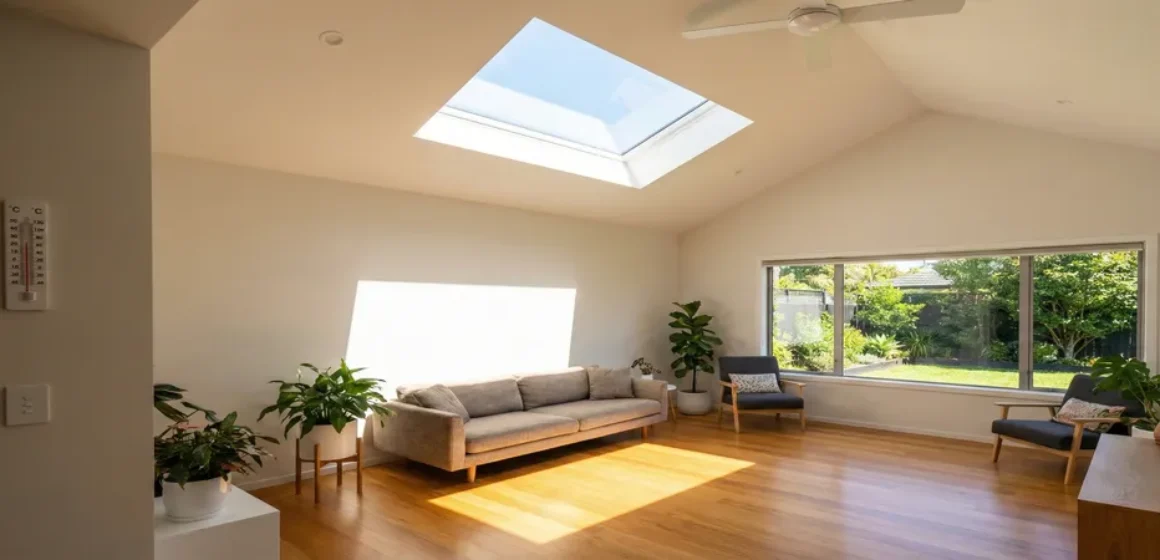
This is where a skylight improves daylight without amplifying heat load.
Typical placement:
- above the centre of the room
- above the main circulation area
- above zones that currently rely on artificial lighting during the day
Why it works:
- It adds usable light where you need it, so you can reduce reliance on side windows being “fully open” for brightness.
- It spreads light more evenly, which often reduces the harsh contrast that makes you squint and feel warmer.
Zone 2: The glare-risk zone (needs careful handling)
This is where skylights can cause discomfort if placed poorly.
Typical placement:
- directly above TV viewing positions
- directly above reflective surfaces (glass tables, polished floors)
- aligned with strong afternoon sun angles
The issue is not “too much light”. It is light landing in the wrong place at the wrong time of day.
Zone 3: The heat-amplifier zone (avoid in most lounges)
This is where a skylight might increase heat gain or create a hot patch.
Typical placement:
- above seating where people sit for long periods
- in areas with limited airflow and low ceiling height
- under roof sections that already get intense afternoon sun exposure
The fix is usually not “no skylight”. It is better placement, or the right skylight specification paired with the right location.
Why overhead light often feels cooler than side light
This surprises people, but it makes sense once you see it.
Side light from windows can:
- hit surfaces directly and warm them fast
- create bright patches that make you close curtains, which traps warm air
- cause glare, which feels like “heat” even when it is primarily brightness discomfort
Overhead light from a well-placed skylight can:
- spread more evenly across the room
- reduce the need to rely on afternoon side-light for brightness
- create a calmer visual environment, which genuinely changes how comfortable a room feels
There is also a psychological piece here. Even on warm Auckland days, a balanced, overhead daylight pattern often feels “cleaner” and less harsh, which reduces that drained, headachy feeling some people get in bright rooms.
The placement moves that usually improve comfort in Auckland lounges
These are the placement decisions that most reliably create a “why didn’t we do this earlier?” result.
1) Move the daylight towards the middle, not the edges
If your lounge is bright at the perimeter (near windows) but dim at the centre, people tend to open curtains wide and rely on direct sun.
A skylight in the right central position can soften that behaviour: the room stays usable without turning the lounge into a heat-trap.
2) Use top-down light to reduce west-window dependence
Auckland’s late-day sun can be punishing in the wrong room.
If you currently manage comfort by shutting curtains, you are also shutting down airflow and trapping warmth. A skylight can help you keep the room pleasantly bright while controlling what you do with windows and curtains.
3) Treat glare like a placement problem first, not a blind problem
Blinds help, but glare is often the result of light arriving at the wrong angle.
Better skylight placement can prevent the need to “fight” the room every afternoon.
What about glazing, coatings, and the “heat control” stuff?
Skylights are not one-size-fits-all, especially in Auckland where you can get humidity, high UV, and mixed sun in the same week.
Here are the only technical terms worth knowing, in plain language:
- Low-E coating: a thin layer on the glass that helps manage heat transfer. Think of it like a smart filter that lets light in while reducing some heat movement.
- SHGC (Solar Heat Gain Coefficient): a simple rating of how much solar heat comes through. Lower generally means less heat gain.
- Double glazing: two layers of glass with a sealed gap. This helps with insulation and comfort stability.
Homeowner takeaway:
- If your lounge already runs warm, specification matters, but placement still comes first. A perfect product in the wrong spot still creates discomfort.
If you want to explore skylight types and how they behave, this is a useful starting point:
https://www.skylights.co.nz/types-of-skylights/
Illustrative Example Only: the classic “bright but hot” Auckland lounge
A family in a central Auckland suburb had a north-west facing lounge that looked stunning in photos but felt uncomfortable most afternoons.
Their pattern:
- Curtains closed by 2–3pm to cut glare
- Air felt heavy, even with windows cracked open
- The centre of the room still felt dim, so lights went on early
What changed:
- A skylight was planned to introduce light into the centre zone, reducing reliance on direct side sun for brightness.
- Glare was treated as a placement decision, not just a curtain decision.
Their reflection afterwards was simple:
“We didn’t realise the room could stay bright without feeling like it was holding heat.”
A quick placement checklist before you make decisions
If you are planning an upgrade, these questions prevent most regret:
- Where do people sit for long periods in the lounge?
- What time of day does discomfort peak?
- Which direction does the brightest light come from in summer?
- Do you close curtains to control glare?
- Does the room rely on side windows for most usable daylight?
- Is there a central zone that stays dim even on bright days?
If you would like a professional view on your lounge layout and roof conditions, you can start with a simple enquiry here:
https://inquiry.skylights.co.nz/inquiry
For Auckland-specific guidance and context, see:
https://www.skylights.co.nz/skylights-auckland/
FAQs (unique to this topic)
Does adding a skylight always make a lounge hotter?
Not always. Heat outcomes depend on skylight placement, glazing choice, roof orientation, and how the room is currently managing light (curtains, airflow, and shading).
Why does my lounge feel hot even when it is cloudy outside?
Auckland’s bright overcast can still deliver strong daylight, and your lounge may already be storing heat in surfaces. Humidity can also make the air feel heavier, even at moderate temperatures.
What is the biggest skylight placement mistake in lounges?
Placing the skylight where it creates a glare patch over seating or screens, or relying on placement that increases afternoon exposure rather than balancing the room’s overall light.
Is glare a skylight problem or a window problem?
Often it is a light direction problem. Skylight placement can reduce reliance on harsh side sun and improve comfort before you reach for heavier blinds.
Should a lounge skylight be centred?
Centred placement often helps with even light distribution, but the best position depends on roof framing, orientation, and where the room is currently uncomfortable. The goal is balanced light, not a perfect geometric centre.