The renovation sequence: when to plan a skylight in an Auckland renovation (and what to lock in early)
Most skylight regrets in renovations are not about the skylight.
They are about timing.
Auckland renovations often start with good intentions: new kitchen, better bathroom, open up the living room, modernise the look. Then the build gets busy, ceilings go in, lighting is decided, and someone says: “Should we add a skylight?”
At that point, you are no longer choosing the best daylight outcome. You are choosing what is still possible.
This guide is a renovation-first framework for skylight renovation Auckland planning. It shows when to make the skylight decision, what to lock in early, and where people lose money and quality by leaving it too late.
The renovation rule that matters most
Skylights are a structural and roof integration decision before they are a design decision.
That does not mean they are complicated. It means the best results come when the skylight is planned while you still have freedom in:
- ceiling layout and lining
- roof penetrations and water paths
- lighting plan
- framing constraints
Once those are fixed, skylights can still be installed, but you are playing within a smaller box.
A simple renovation timeline for skylights (Auckland edition)
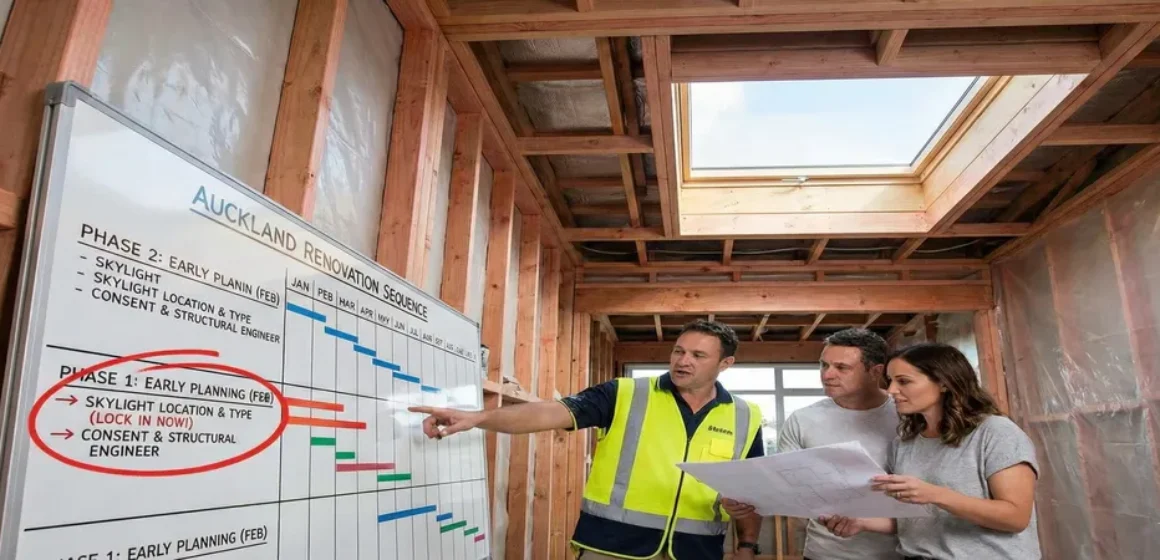
Think in five phases. Your goal is to make the skylight decision before the “point of no easy return”.
Phase 1: Concept and layout
This is where you decide what you want the home to feel like.
Skylight questions to answer here:
- Which rooms feel dull even in daytime?
- Which areas have “bright edges and dull centre” on overcast days?
- Where do you want the ceiling to feel lifted?
Auckland note: overcast daylight is common. If a room works on grey bright days, it will feel excellent on sunny days.
Useful internal reference for skylight types and behaviours:
https://www.skylights.co.nz/types-of-skylights/
Phase 2: Design development and budgeting
This is when you protect your budget from late surprises.
What to lock in:
- skylight type decision (tubular, fixed, opening)
- rough placement intent (ceiling lift vs spotlight)
- whether ventilation is part of the goal
- whether any shafts will be needed (flat ceilings under pitched roofs)
A practical reminder:
If you budget for “a skylight” without deciding the type and intent, the cost range is too wide to be meaningful.
Phase 3: Pre-build and trade coordination
This is the phase that prevents rework.
What to coordinate:
- roof type and flashing approach
- ceiling framing constraints
- lighting plan (avoid placing downlights where overhead daylight will do the job)
- ducting and services conflicts (bathroom extraction, rangehood ducting, heat pump lines)
This is also when you confirm whether any consents or documentation are needed for your specific scope. Keep it simple and project-specific.
Phase 4: Construction, before linings go on
This is the “point of no easy return”.
The skylight decision should already be made by now. If it is not, you risk:
- cutting into finished ceilings
- rework on insulation and vapour control layers
- compromised placement because framing is already fixed
If you want the skylight to look intentional, this is the phase to protect.
Phase 5: Finishing and comfort tuning
This is where you refine the outcome.
What matters here:
- final trim quality
- light control choices if needed (especially in sun exposed rooms)
- ensuring the room feels evenly bright, not harsh
The three renovation mistakes that create expensive skylight compromises
Mistake 1: Deciding skylights after the ceiling plan is final
This usually forces placement into whatever space is left, not where the light would work best.
Outcome:
A skylight that looks fine but does not fix the real problem.
Mistake 2: Treating the skylight like a decorative feature
In Auckland homes, the biggest wins often come from functional daylighting:
- hallways
- internal bathrooms
- stairwells and landings
- deep kitchen zones
These are the spaces that change how the whole home feels.
Mistake 3: Underestimating roof water paths
The best skylight is only as good as the roof integration. Auckland weather is not only rain, it is wind-driven rain. Flashing detail and drainage paths matter.
A renovation-friendly skylight brief (copy and paste)
If you are talking to a builder, designer, or installer, a good brief sounds like this:
- Room: [Kitchen / hallway / bathroom / living]
- Renovation stage: [Concept / design / pre-build / build]
- Goal: [Ceiling lift / centre brightness / ventilation / reduce daytime lights]
- Roof type: [Long-run metal / tile / unsure]
- Ceiling type: [Flat / raked / unsure]
- Concern: [Glare on TV / humidity / privacy / rain noise near bedrooms]
- Priority: [Comfort first / aesthetics / budget certainty]
It keeps the conversation practical and avoids generic advice.
Illustrative Example Only: the renovation that nearly missed the best daylight moment
A homeowner planned a kitchen and living refresh and kept talking about “better light”. The skylight decision was left until late, after ceiling framing was already set.
They could still add daylight, but the best placement was no longer available without structural changes. The final solution improved the room, but it was not the ideal outcome they could have achieved with an earlier decision.
Their reflection afterwards:
“We should have decided while the ceiling was still a blank canvas.”
The best time to plan a skylight in a renovation
If you want the simplest rule:
Plan skylights during design and confirm them before ceiling and roof details are locked in.
That gives you:
- better placement
- cleaner finishes
- fewer compromises
- more predictable costs
For Auckland planning and local context:
https://www.skylights.co.nz/skylights-auckland/
If you want a recommendation based on your renovation scope, roof type, and the rooms you are changing, start here:
https://inquiry.skylights.co.nz/inquiry
FAQs (unique to this topic)
When is the best time to add a skylight during a renovation?
During design and pre-build, before ceilings and roof integration details are finalised. That is when placement and detailing can be optimised with minimal rework.
Can I add a skylight after the renovation is finished?
Yes, but options may be limited by framing, ceiling layout, and service runs. It can also increase cost and reduce placement freedom.
What should I decide first: skylight type or location?
Start with the room goal and how you want the light to behave. That usually informs type, then the best location can be assessed within roof and framing constraints.
Will skylights complicate my build timeline?
If planned early, skylights can be integrated cleanly. Late decisions are what tend to add delays due to redesign, rework, or product lead coordination.
Do I need to plan skylights differently for Auckland’s climate?
Often, yes. Overcast daylight performance, humidity in certain rooms, and wind-driven rain exposure all influence the best type, placement, and detailing choices.