The ventilation decision: when an opening skylight makes sense in Auckland’s late-summer humidity
Auckland has a particular late-summer feeling: the air is warm, the sky is bright, and the house still feels a bit heavy. Not necessarily hot, just slow to refresh. You open a window and it helps, but the room never quite “clears”. Bathrooms linger damp. Kitchens hold cooking smells. Upstairs bedrooms feel stale by bedtime.
This is usually a ventilation question, not a skylight question.
But in some homes, an opening skylight becomes one of the cleanest ways to solve it, because it uses a simple principle: warm, moist air rises. If you give it a high exit point, it can leave more effectively.
This article is a decision guide for Auckland homeowners. It will help you decide when an opening skylight Auckland homes benefit from is genuinely worth it, and when you are better focusing on other parts of the ventilation system first.
The Auckland humidity reality (why “just open a window” sometimes fails)
Late summer in Auckland often means the outdoor air already carries moisture. When you open windows, you might be swapping indoor air for outdoor air that is not much drier.
That does not mean ventilation is pointless. It means ventilation needs to be:
- directional (air must move through, not just in)
- complete (you need an inlet and an outlet)
- timed (some conditions vent better than others)
An opening skylight can help because it creates a high-level outlet that encourages upward air movement, especially when indoor air is warmer than outdoor air.
A simple rule: an opening skylight is only as good as the air path beneath it
This is the part most people miss.
If there is no way for fresh air to enter low in the room or nearby spaces, an opening skylight can still vent, but it will be limited. You need an airflow path.
Think of it like breathing:
- A room needs an inhale (inlet) and an exhale (outlet).
- An opening skylight provides a strong exhale point.
The “opening skylight decision matrix” (Auckland edition)
Use this to decide whether opening makes sense.
Opening skylight is usually a strong fit when:
1) You have an upstairs heat or humidity build-up
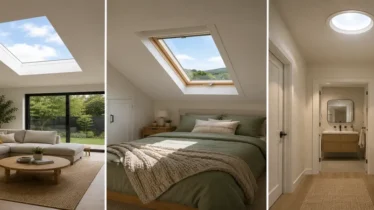
Warm, moist air collects higher in a home. Opening skylights can help release it, especially in bedrooms, stairwells, and upper-level living zones.
2) The room has moisture events
Bathrooms, kitchens, laundries, and some ensuite areas create moisture quickly. Opening skylights can help clear steam and reduce lingering dampness when paired with proper extraction or airflow.
3) You have a central room with limited window ventilation
Some Auckland floorplans have internal bathrooms, stairwells, or corridors that simply do not have effective window options. A high-level vent can be a practical solution.
4) You have a clear inlet path
If you can open a lower window or maintain a reliable under-door gap, an opening skylight becomes much more effective.
5) You want comfort control, not just daylight
If your main goal is “freshness” and air movement, opening skylights can add genuine comfort, not just brightness.
Opening skylight may be the wrong tool when:
1) The issue is extraction, not ventilation
If a bathroom fan is underpowered or poorly ducted, an opening skylight will not fix the core issue. Extraction removes moisture. Ventilation swaps air. They work together, but they are different.
2) Outdoor air is the problem
If your home is near a busy road, strong odours, or you have wind-driven rain exposure, opening skylights may be less useful at certain times. You need the right product choice and usage habits.
3) The room already ventilates well
If the room has good crossflow and clears quickly after use, the extra cost and complexity of an opening skylight may not deliver enough benefit compared with a fixed skylight.
4) You are trying to solve a “sticky” feeling with no airflow plan
An opening skylight can help, but it works best as part of a complete air path, not as a standalone guess.
The Auckland “stack effect”: the quiet reason opening skylights work
Warm air rises. In Auckland homes, this becomes noticeable in late summer when indoor air holds warmth and moisture.
When you open a high point (like an opening skylight), you often create:
- upward airflow out of the skylight
- gentle draw of air from lower openings or adjacent rooms
This is why opening skylights can make a home feel like it “lets go” of stale air faster.
A simple analogy:
Opening a skylight can act like lifting the lid slightly on a warm room. It gives built-up air a clean exit.
Where opening skylights tend to perform best in Auckland homes
Bathrooms with recurring dampness
Especially internal bathrooms where moisture lingers, and where a window does not exist or does very little.
Stairwells and central circulation spaces
These are natural chimneys in many homes. A high opening can transform how the whole upper level refreshes.
Upstairs bedrooms that feel stale by bedtime
Not always because of heat, but because air movement is limited and humidity sits.
Kitchens where humidity and cooking smell linger
Opening skylights can assist, but only when the rangehood is doing its job as well. If the rangehood is weak, fix that first.
For skylight type comparisons (fixed vs opening vs tubular):
https://www.skylights.co.nz/types-of-skylights/
Illustrative Example Only: the house that never “cleared” after dinner
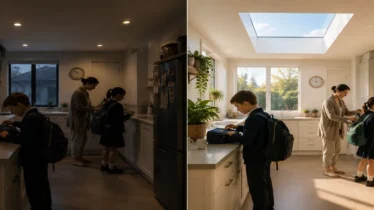
A Greater Auckland household described an open-plan home where the kitchen and living area felt heavy in late summer evenings. They opened windows, but the space still felt slow to refresh, especially on humid nights.
The key improvement came from creating a true airflow path: lower openings for fresh air, and a high-level outlet that allowed warm, moisture-laden air to escape more easily.
Their reflection afterwards:
“It stopped feeling like the air was trapped in the house.”
Planning questions to ask before choosing opening vs fixed
These questions prevent you from paying for “opening” when what you need is better planning.
- What problem are we solving: humidity, heat, smell, or stale air?
- Does the room have a reliable inlet path for fresh air?
- Is extraction already performing properly where moisture is created?
- Is the roof exposure suitable for opening (wind-driven rain considerations)?
- How will the skylight be operated safely and easily (manual vs powered)?
- Would a fixed skylight plus improved extraction deliver the same outcome?
If you want a clear recommendation based on your Auckland home layout, roof type, and comfort goals, start here:
https://inquiry.skylights.co.nz/inquiry
For Auckland coverage and guidance:
https://www.skylights.co.nz/skylights-auckland/
FAQs (unique to this topic)
Does an opening skylight help with humidity in Auckland?
It can, especially when warm, moist air is trapped and needs a high-level exit point. It works best when there is also an inlet path and effective extraction where moisture is generated.
Is an opening skylight a replacement for a bathroom fan?
No. Fans remove moisture from the air. An opening skylight helps with air exchange. Many homes benefit most from using both correctly.
Where should an opening skylight be placed for best ventilation?
High points where warm air collects, such as stairwells, upstairs zones, and rooms with persistent moisture. Placement should also consider roof exposure and usability.
Will an opening skylight let in rain in Auckland weather?
A quality product and correct installation should manage typical weather, but wind-driven rain exposure still matters. Product choice and roof detailing are key.
When is a fixed skylight the better choice?
When your main goal is daylight and the room already ventilates well, or when you can achieve the ventilation outcome more effectively through extraction and airflow improvements.