Vented skylights in summer: when airflow beats another fan
New Zealand bathrooms do a lot of work in summer.
More showers. More beach days and swims. More humidity coming in on towels and damp gear. And when the room has limited windows, it can start feeling like the air never fully resets.
If you have ever walked into a bathroom hours after a shower and thought, it still feels damp in here, you are noticing a real airflow problem, not just “a warm day”.
A vented skylight is not the answer for every bathroom. But in the right space, it can do something a normal extractor fan struggles with: let warm, moisture-heavy air escape at the highest point, naturally and quickly.
The bathroom problem most people try to solve the wrong way
When a bathroom feels steamy and stale, homeowners often default to one of two moves:
- run the extractor longer, or
- buy a stronger fan.
Sometimes that helps. Sometimes it changes very little.
A simple reason is that fans move air, but bathrooms often fail on air pathway, not fan power. If fresh air cannot enter easily and damp air cannot leave efficiently, the room stays heavy.
“The mirror clears, but the room still smells damp by the evening.”
That comment is common, and it usually points to trapped moisture in the air and on surfaces, not just steam in the moment.
Why high-level airflow matters in summer
Warm air rises. Moist air rises with it.
In a bathroom, the highest point is often the ceiling, and that is where heat and humidity tend to linger. If your ventilation system is not effectively clearing that ceiling zone, the room can feel stuffy even when the fan is running.
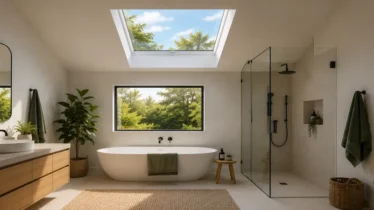
A vented skylight creates a high-level release point, which can change how the whole room behaves after a shower.
A useful analogy is to think of the bathroom like a bottle.
- If the top of the bottle is sealed, moisture swirls around and settles back.
- If you open the top, it vents quickly.
That is the role a vented skylight can play when it is specified and installed correctly.
When a vented skylight is genuinely the better solution
A vented skylight tends to outperform “another fan” when the room has one or more of these conditions:
The bathroom has limited windows, or none at all
If there is no practical way for damp air to escape naturally, the room depends entirely on mechanical extraction.
The ceiling zone stays warm long after showers
If the room feels hotter near head height, and the air feels heavy, it often means warm, moist air is sitting high and slowly re-mixing.
The space is used frequently throughout the day
Family bathrooms often do not get a true “dry-out window”. A vented skylight can help the room recover faster between use.
There is a history of condensation and damp smells
This is not about blame or alarm. It is simply a signal that the room’s moisture load is not clearing efficiently.
When a vented skylight is not the best first step
There are situations where a vented skylight may be helpful, but it should not be the first lever you pull.
If the fan is undersized or incorrectly ducted
If an extractor is not venting outdoors properly, no skylight will compensate for that.
If the bathroom has no reliable way for fresh air to enter
Air needs a path. If the room is sealed and there is no under-door gap or make-up air route, a vented skylight alone may not perform as expected.
If the issue is mostly cold-surface condensation in winter
A vented skylight can still help, but the strategy may shift toward insulation, heating behaviour, and ventilation timing.
The best results come when the room is treated as a system.
A quick “bathroom airflow check” you can do in two minutes
You are looking for whether the room can actually exchange air.
- After a shower, close the bathroom door
- Turn the fan on for 10 minutes
- Open the door and notice the air
If the air feels like it “pours out” and is noticeably warmer and damp, the room likely needs a clearer high-level release and a better make-up air path.
Now look at the basics:
- Is there an under-door gap, or does the door seal tight?
- Does the fan duct to outside, not into the roof space?
- Does the bathroom have any window opening capability?
This is not a technical audit. It is simply a way to identify if airflow pathways are part of the problem.
The summer playbook: comfort-first options (in the right order)
You do not need to jump straight to “replacement”. A smart approach is staged.
Step 1: Improve the airflow pathway (often overlooked)
Small changes can make a big difference:
- ensure the fan is venting outdoors correctly,
- ensure the room can draw in fresh air (even a modest under-door gap helps),
- avoid closing the door too tightly during the dry-out window.
Step 2: Add high-level venting where it makes sense
If the room continues to trap warm, damp air, a vented skylight becomes a strong option because it releases air where it collects.
In summer, this can help the bathroom feel:
- less stuffy,
- quicker to dry,
- more comfortable after back-to-back use.
To learn more about vented skylights, see: click here
Step 3: Get the skylight specification right
Not all vented skylights behave the same way. Performance depends on:
- the unit type,
- roof direction and exposure,
- how the venting is controlled,
- proper sealing and weathertight installation.
A well-specified unit should improve airflow without creating new issues such as glare or discomfort.
Manual vs solar venting: what matters for bathrooms
Homeowners often ask whether they need solar-powered venting or manual operation.
The more useful question is: how will you actually use it?
- If the bathroom is used frequently, you want venting that is easy to use consistently.
- If the skylight will sit out of reach, you want a control method that is practical, not theoretical.
The best option is the one that fits your daily routine.
Illustrative example only: a realistic NZ scenario
A homeowner in Tauranga had a windowless ensuite that felt damp and stale in summer, especially after morning showers. The extractor fan was functional, but the room still held warmth and humidity through the day.
A simple review identified two contributors:
- the room had limited make-up air, so extraction was underperforming,
- warm air was pooling near the ceiling with no high-level release.
Once airflow pathways were improved and a high-level venting strategy was introduced, the ensuite started clearing faster and felt noticeably fresher after use.
The change was not dramatic visually. It was practical: the room stopped feeling “sticky” by the afternoon.
What to consider before you install a vented skylight in a bathroom
A vented skylight should be chosen with the room’s real behaviour in mind.
Consider:
- roof type and pitch (and what installation method is appropriate)
- where the skylight will sit relative to shower steam and moisture load
- how the vent will be operated (reach, routine, consistency)
- whether the bathroom can draw in fresh air to replace what is vented out
If you want the result to feel natural and reliable, these details matter more than marketing features.
A calm next step if you are weighing options
If your bathroom feels steamy and stale in summer, it is worth exploring whether the issue is fan power, airflow pathway, or the lack of a high-level release.
If you share a few photos and basic details, we can point you toward the best comfort-first approach for your space, including whether a vented skylight is likely to make a meaningful difference.
Start here: https://inquiry.skylights.co.nz/inquiry