Where should a skylight go? How placement changes the result
A skylight is only as good as its placement.
The product matters. The roof matters. The flashing matters. The installation quality matters. But even a well-made skylight can disappoint if the daylight lands in the wrong place.
A skylight positioned for symmetry may brighten the ceiling but miss the kitchen bench. A bathroom skylight placed without thinking about privacy, steam or the vanity may improve the room less than expected. A hallway diffuser installed at one end may leave the darkest part of the passage unchanged. A bedroom skylight placed above the bed may create unwanted brightness when the room needed daylight near the wardrobe or desk.
Good skylight placement starts with one practical question:
Where should the daylight land?
This guide explains how New Zealand homeowners can think about skylight placement before requesting a quote, including room use, roof conditions, glare, privacy, ventilation and the difference between fixed skylights, vented skylights, tubular skylights and Sky tubes.
Why placement matters more than size
Many homeowners assume the main decision is skylight size.
Size matters, but placement often matters more.
A smaller skylight placed correctly can be more useful than a larger skylight placed poorly. This is especially true in kitchens, bathrooms, hallways and offices, where the daylight needs to support a specific activity.
Good placement can:
- Bring daylight to the part of the room that is actually used
- Reduce reliance on artificial lighting during the day in suitable rooms
- Make a dark hallway feel more connected
- Improve a kitchen work zone
- Help a bathroom feel less enclosed
- Make a compact room feel clearer
- Avoid unnecessary glare
- Preserve privacy
- Support airflow when a vented skylight is suitable
Poor placement can:
- Brighten the wrong area
- Create glare on screens or reflective surfaces
- Leave the darkest zone unchanged
- Make the skylight feel visually awkward
- Increase summer discomfort
- Miss the room’s main task area
- Add cost without delivering the expected improvement
A skylight should solve a room problem, not simply occupy a roof position.
Start by mapping the room, not the roof
The roof determines what is possible, but the room determines what is valuable.
Before looking at roof access, first identify how the room is used.
Ask:
- Where do people stand, sit or work?
- Which part of the room feels darkest?
- Where is artificial lighting used during the day?
- Is the goal task light, general daylight or a stronger visual feature?
- Does the room need privacy?
- Does the room need airflow as well as daylight?
- Are there screens, mirrors, glossy benches or reflective surfaces?
- Is the room used mostly in the morning, afternoon or all day?
- Would daylight in one area improve the whole room?
Once the daylight target is clear, the roof and ceiling can be assessed to see what is practical.
This order matters.
If the process starts with the easiest roof location, the final result may not match the way the room is used.
The daylight landing zone
A useful way to think about skylight placement is the “daylight landing zone”.
This is the part of the room where natural light needs to arrive for the upgrade to feel successful.
In a kitchen, the landing zone may be the island or preparation bench. In a bathroom, it may be the vanity, central floor area or shower approach. In a hallway, it may be the darkest section of the passage. In a home office, it may be the general room area rather than directly on the screen. In a laundry, it may be the appliance or sorting area.
The daylight landing zone should guide placement.
A skylight does not always need to be centred in the room. It needs to be useful.
That is the difference between a skylight that looks tidy on a plan and a skylight that changes the room.
Kitchen skylight placement
Kitchens are one of the most placement-sensitive rooms in the home.
The most common mistake is assuming a kitchen window means the kitchen is well lit. In many homes, window light reaches the sink but not the bench, island, scullery or darker side of the room.
What to assess
- Where is the main food preparation area?
- Does the bench need lights on during the day?
- Is the island naturally lit?
- Is a covered deck, eave or neighbouring structure blocking side light?
- Are there glossy benchtops that may create glare?
- Is the kitchen part of an open-plan room?
- Is ventilation or warm air also a concern?
Placement guidance
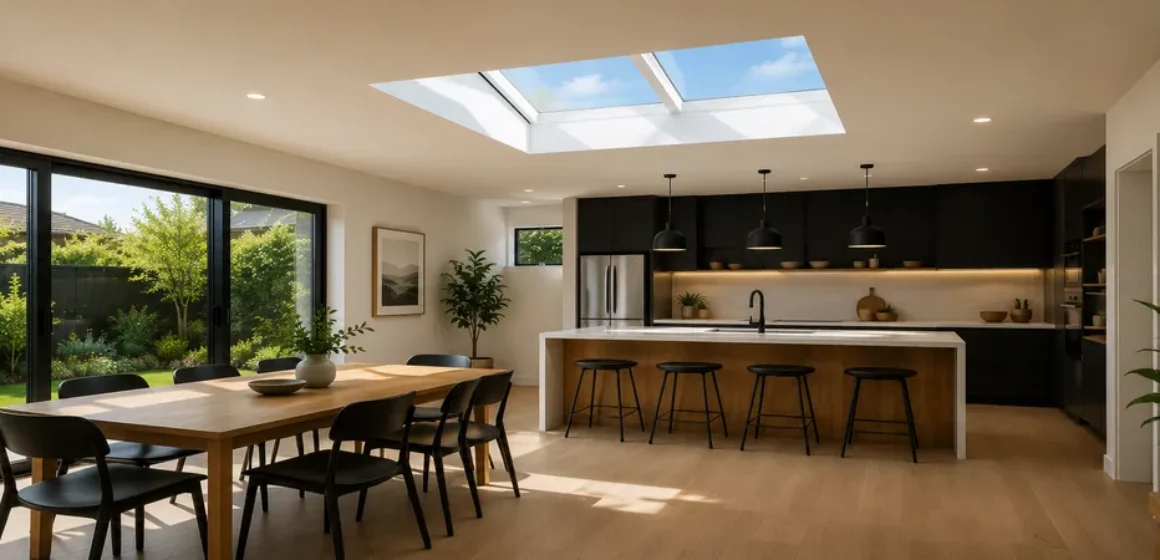
A fixed skylight may work well when placed over or near the working zone, rather than simply centred in the kitchen. In an open-plan kitchen, the skylight may need to support the kitchen zone without making the dining or living area feel visually unbalanced.
A tubular skylight or Sky tube may suit a scullery, pantry, small kitchen or darker transition area.
A vented skylight may be considered where airflow has a clear purpose, but it should not replace a suitable rangehood.
The best kitchen skylight placement should help the room work better at breakfast, during food preparation and on dull winter days.
Bathroom skylight placement
Bathroom skylights need careful placement because bathrooms combine privacy, moisture, mirrors, fixtures and daily use.
A bathroom skylight should improve the feel of the room without creating awkward glare, poor privacy or unrealistic ventilation expectations.
What to assess
- Is the main issue daylight, steam, privacy or all three?
- Where is the vanity?
- Is the shower area dark?
- Does daylight need to reach the centre of the room?
- Would the skylight be directly above a mirror?
- Is the window small, frosted or shaded?
- Is there an extractor fan?
- Would a vented skylight genuinely help with airflow?
Placement guidance
For many bathrooms, the best placement may be near the centre of the room, vanity zone or darker floor area rather than directly over the shower by default.
A tubular skylight may suit a compact bathroom where practical daylight is the main goal. A fixed skylight may suit a larger bathroom or renovation. A vented skylight may suit some bathrooms where daylight and airflow are both relevant.
Moisture still needs proper attention. A skylight can improve daylight, and a vented skylight may support airflow in some rooms, but steam and condensation may still require extraction and ventilation planning.
Hallway skylight placement
Hallways often look simple, but placement can make or break the result.
A hallway may be long, narrow, L-shaped, central, low-ceilinged or broken by doorways. A single daylight point placed at one end may not help the darkest part.
What to assess
- Where is the hallway darkest?
- Does one end already receive borrowed light?
- Is the passage long or short?
- Is it straight or L-shaped?
- Are there existing lights, smoke alarms, vents or access panels?
- Does the hallway connect bedrooms, bathroom, laundry or entry areas?
- Is there roof space above the hallway?
Placement guidance
A tubular skylight or Sky tube is often suitable for hallways because the goal is usually practical daylight rather than a large skylight feature.
The diffuser should be positioned where it changes the hallway’s daily use. In some longer hallways, more than one daylight point may need to be considered. In a wider entry or stair landing, a fixed skylight may be suitable if a more visible result is wanted.
The goal is to improve the centre of the home, not simply add a bright spot to the ceiling.
Living room skylight placement
Living rooms need balanced daylight.
A skylight placed without thought can create one bright area while leaving the rest of the room unchanged. It may also create glare on televisions, polished floors or seating areas.
What to assess
- Which part of the room feels under-lit?
- Is the room deep, narrow or open-plan?
- Does daylight reach only the window side?
- Is a covered deck or veranda shading the room?
- Where is the seating area?
- Is there a television or screen?
- Would the skylight create glare or heat discomfort?
- Is the goal a design feature or general daylight improvement?
Placement guidance
A fixed skylight often suits living rooms where stronger daylight and visual openness are wanted. Placement should bring light deeper into the room, especially where side windows do not reach.
Avoid choosing placement purely for ceiling symmetry. Consider furniture, screens, summer sun and how the room is used throughout the day.
A living room skylight should make the space feel more usable and balanced, not just brighter in one patch.
Bedroom skylight placement
Bedrooms need a more personal placement decision.
A skylight in a bedroom can improve daylight, privacy and room usability, but it should not disrupt sleep, create unwanted glare or cause summer discomfort.
What to assess
- Is the room used during the day?
- Is it a main bedroom, child’s room, guest room or bedroom-office?
- Where is the bed?
- Where is the wardrobe or dressing area?
- Is there a desk or reading chair?
- Would morning light affect sleep?
- Would blinds be needed?
- Is privacy a concern from side windows?
Placement guidance
A fixed skylight may suit larger bedrooms or bedroom-office spaces where stronger daylight is wanted. A tubular skylight or Sky tube may suit smaller bedrooms, guest rooms or dressing areas where subtle daylight is enough.
A skylight does not always belong above the bed. In many bedrooms, daylight may be more useful near the wardrobe, desk or darker centre of the room.
The placement should suit the room’s daily use and rest patterns.
Home office skylight placement
Home offices need useful daylight without screen glare.
This makes placement especially important.
What to assess
- Where is the desk?
- Which way does the screen face?
- Is there already glare from the window?
- Is the room used for video calls?
- Does the office feel dull after lunch?
- Can the desk be moved?
- Would blinds be needed?
- Is the room also used as a bedroom or spare room?
Placement guidance
A fixed skylight may suit a home office where the room needs stronger natural light. A tubular skylight or Sky tube may suit a compact office where soft general daylight is enough.
Avoid placing daylight where it reflects directly onto screens. Sometimes the best placement is not directly over the desk, but in a position that lifts the overall room light without causing glare.
The goal is work comfort, not maximum brightness.
Laundry, pantry and wardrobe placement
Small service rooms usually need practical daylight.
The skylight or diffuser should support the task area.
What to assess
- Where do people stand or work?
- Is there a bench, appliance, shelving or wardrobe rail?
- Does the room need lights on every time?
- Is the ceiling crowded with vents, lights or access panels?
- Is the room internal or beside a garage or hallway?
- Is ventilation also a concern?
Placement guidance
A tubular skylight or Sky tube is often suitable for laundries, pantries, wardrobes and toilets. The diffuser should be positioned to light the working area, not blocked by shelving, tall cabinetry or partitions.
If moisture is present in a laundry, ventilation needs separate assessment.
A small-room daylight upgrade should feel simple, but it still needs thoughtful placement.
Fixed skylight placement vs tubular skylight placement
Different products need different placement thinking.
Fixed skylight placement
A fixed skylight usually creates a stronger visual effect. It may involve a larger opening, light well, internal finishing and more visible ceiling change.
Placement should consider:
- Room layout
- Desired visual effect
- Light spread
- Glare
- Furniture position
- Roof pitch
- Framing
- Internal finishing
- Summer comfort
- Blinds or accessories
Tubular skylight and Sky tube placement
A tubular skylight or Sky tube usually delivers daylight through a ceiling diffuser.
Placement should consider:
- The darkest part of the room
- Task area
- Ceiling diffuser position
- Tube path from roof to ceiling
- Framing, ducting and wiring
- Existing lights, vents and access panels
- Whether one or more daylight points are needed
A tubular skylight may look simpler from inside, but the roof-to-ceiling path still matters.
Roof realities that affect placement
The ideal room location may not always match the ideal roof location.
This is where assessment matters.
Practical roof and ceiling factors include:
- Roof type
- Roof pitch
- Roof condition
- Flashing requirements
- Rafters or trusses
- Roof cavity depth
- Wiring and plumbing
- Ducting and extraction systems
- Existing downlights
- Ceiling access panels
- Insulation
- Solar panels or roof penetrations
- Valleys, ridges, gutters and roof junctions
- Safe roof access
A skylight needs to work for the room and the roof.
Sometimes the placement can be adjusted slightly without losing the room benefit. Sometimes a different product type is more suitable. Sometimes more investigation is needed before the best location can be confirmed.
Good skylight planning balances desire with buildability.
Glare: when daylight becomes uncomfortable
More light is not always better.
Glare can make a room less comfortable, especially in home offices, living rooms, kitchens and bedrooms.
Potential glare issues include:
- Reflection on laptop or TV screens
- Bright patches on glossy benchtops
- Direct light into eyes while seated
- Morning brightness over a bed
- Reflections from mirrors or glass shower screens
- Harsh contrast in small rooms
This does not mean skylights should be avoided. It means placement, glazing, blinds and room layout should be considered.
The best skylight placement improves the room without making it harder to use.
Privacy: why overhead daylight can help
In many homes, privacy limits wall-window daylight.
This is common in townhouses, compact sections, bedrooms near boundaries, bathrooms beside fences and homes with close neighbours.
A skylight can bring daylight from above without increasing visibility from the side.
This is especially useful for:
- Bathrooms
- Bedrooms
- Home offices
- Internal hallways
- Compact living spaces
- Dressing areas
Placement still matters. In bedrooms and bathrooms, the skylight should support privacy, comfort and use. Overhead daylight can solve some privacy challenges, but the room still needs thoughtful planning.
Ventilation and placement
If a vented skylight is being considered, placement must account for airflow.
A vented skylight may be useful where warm, moist or stale air gathers. This can apply to bathrooms, kitchens, upper-level rooms and raked-ceiling spaces.
Ask:
- Where does warm or moist air gather?
- Would opening the skylight help in normal use?
- Can the skylight be operated easily?
- Would weather exposure be a concern?
- Is extraction still needed?
- Would the skylight release heat at the wrong time in winter?
A vented skylight should be placed where opening it makes practical sense.
It should not be chosen only because it sounds more complete.
One skylight or more than one?
Placement also affects whether one skylight is enough.
A single skylight may work well in a compact room, hallway section or focused kitchen zone. A larger room, long hallway or open-plan area may need more careful daylight distribution.
Questions to ask:
- Is the room long or deep?
- Does one area receive light while another remains dark?
- Would one skylight create a bright patch rather than balanced daylight?
- Is the goal task light or whole-room improvement?
- Would two smaller daylight points work better than one larger one?
- Would a tubular skylight suit one zone and a fixed skylight suit another?
The answer depends on room shape, roof suitability and desired outcome.
More skylights are not automatically better. Better distribution is the goal.
Common placement mistakes
Mistake 1: Centring the skylight by default
A centred skylight can look tidy but may not support the room’s use.
Mistake 2: Ignoring the main task area
In kitchens, laundries, bathrooms and offices, daylight should support the activity.
Mistake 3: Forgetting glare
Screens, mirrors, glossy benches and bed positions all matter.
Mistake 4: Choosing the roof location before the room need
The easiest roof location is not always the best room outcome.
Mistake 5: Treating all daylight products the same
Fixed skylights, vented skylights, tubular skylights and Sky tubes have different placement requirements.
Mistake 6: Ignoring future renovations
If cabinetry, ceiling work, painting or roofing is planned, skylight placement should be discussed early.
A simple skylight placement checklist
Before making an enquiry, work through this checklist.
Room use
- What room is being improved?
- How is it used?
- When does it feel darkest?
- Where should daylight land?
- Is ventilation also needed?
Interior layout
- Where are benches, beds, desks, mirrors or screens?
- Are there glossy or reflective surfaces?
- Are there privacy concerns?
- Would blinds be useful?
- Would the room layout change later?
Ceiling and roof
- Is there roof space above or near the room?
- Is the ceiling flat, sloped or raked?
- Are there existing vents, lights or access panels?
- What roof type and pitch are present?
- Are there roof obstacles such as solar panels, vents or valleys?
Product fit
- Is a fixed skylight, vented skylight, tubular skylight or Sky tube most likely to suit?
- Is a visible skylight feature wanted?
- Is a subtle ceiling diffuser enough?
- Is airflow part of the brief?
This checklist helps turn a general skylight idea into a clearer placement conversation.
What to send when asking for placement advice
Photos are especially useful for skylight placement.
Send:
- A wide photo of the room
- A photo from each corner if possible
- A photo of the ceiling area
- A photo of the darkest part of the room
- A photo showing benches, beds, desks, mirrors or screens
- Photos of the roof above or near the room
- Any known roof type or pitch details
- Notes about when the room feels darkest
- Notes about privacy, glare, ventilation or moisture concerns
This information helps the skylight specialist understand both the room and the roof.
The better the context, the better the placement recommendation.
Illustrative example only
A homeowner wants a skylight in the kitchen and assumes it should be centred in the room. During review, it becomes clear that the window already lights the sink area, while the island and preparation bench remain in shadow.
A centred skylight would look balanced on paper, but it may not solve the real problem.
A better placement may be closer to the working zone, provided the roof and ceiling layout allow it.
In another home, a hallway has a dark middle section but borrowed light at both ends. A tubular skylight diffuser placed at one end would add light where it is least needed. Placing it closer to the central dark zone may deliver a better result.
Both examples show the same principle.
Placement should follow the daylight problem.
The best placement feels obvious afterwards
Good skylight placement often feels simple once it is done.
The kitchen bench is easier to use. The hallway no longer feels like a dark connector. The bathroom feels less enclosed. The bedroom receives daylight where it is useful. The office feels less flat without screen glare.
That kind of result does not happen by accident.
It comes from asking the right question at the start:
Where should the daylight land?
When that answer is clear, the rest of the skylight decision becomes stronger.
Planning your next step
If you are considering a skylight but are unsure where it should go, start by identifying the room’s daylight landing zone.
Skylights.co.nz can help you consider whether a fixed skylight, vented skylight, tubular skylight or Sky tube may suit your room, roof type and desired placement.
To start planning your options, use the Skylights.co.nz enquiry form:
https://inquiry.skylights.co.nz/inquiry
You may also find these useful:
FAQs
Where is the best place to put a skylight?
The best place to put a skylight is where daylight will improve the room’s use most. This may be over a kitchen work area, a dark hallway zone, a bathroom vanity area, a home office workspace or the deeper part of a living room.
Should a skylight be centred in the room?
Not always. A centred skylight may look balanced, but the best placement depends on where daylight is needed. In many rooms, useful placement matters more than symmetry.
Where should a skylight go in a kitchen?
A kitchen skylight should usually support the main working zone, such as the bench, island or preparation area. Placement should also consider glare, roof structure, cabinetry, ventilation and room layout.
Where should a skylight go in a bathroom?
Bathroom skylight placement should consider privacy, the vanity, shower area, central floor space, mirrors, ventilation and moisture. A skylight does not always need to sit directly above the shower.
Is a tubular skylight placement different from a fixed skylight?
Yes. A tubular skylight or Sky tube uses a roof collector, reflective tube and ceiling diffuser. Placement must consider the diffuser location inside the room and the path from roof to ceiling.
What photos help with skylight placement advice?
Send photos of the room, ceiling, darkest area, key furniture or fixtures, and the roof above or near the room. Also note where daylight is needed and whether glare, privacy or ventilation are concerns.