Open-Plan Skylights in Morrinsville Homes: Where Overhead Daylight Makes Sense
Open-plan living can make a home feel larger, more connected and easier to use.
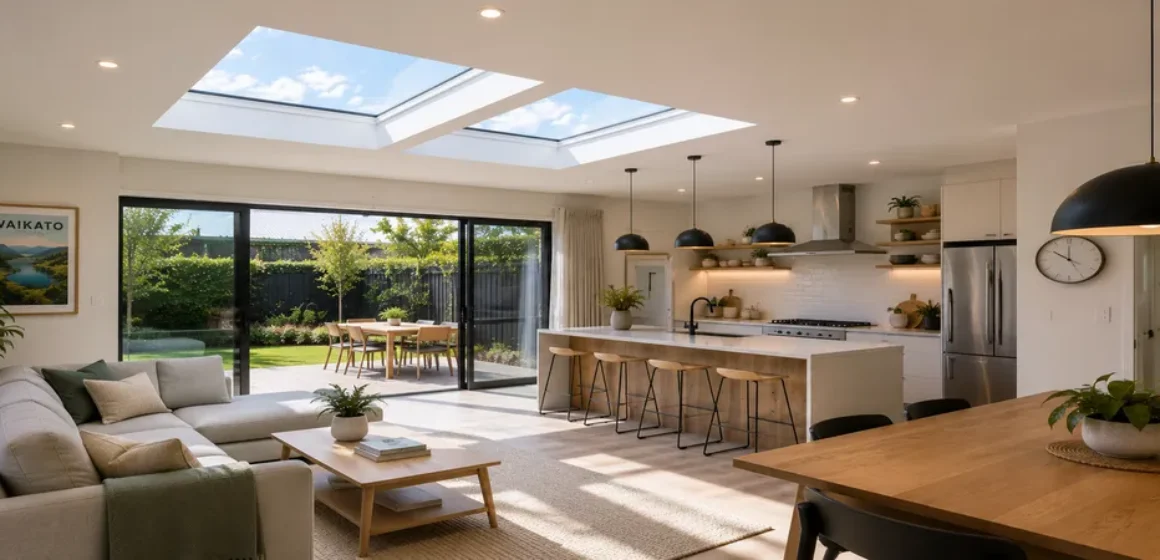
The kitchen, dining and living areas work together. The room can support family routines, entertaining, children’s activities, relaxed evenings, weekend cooking and everyday movement through the home. When the daylight is right, an open-plan space can feel warm, natural and inviting.
But when the daylight is uneven, the whole area can feel slightly off.
One part of the room may be bright while another feels dull. The kitchen may receive decent window light, but the living area sits in shadow. The dining space may feel good in summer, but flat in winter. The island may need lights on during the day. A deeper section of the room may never receive enough useful natural light.
For homeowners considering an open plan skylight Morrinsville project, the question is not simply whether a skylight will make the space brighter.
The better question is:
Where does overhead daylight actually make sense in the open-plan area?
A fixed skylight may suit some open-plan kitchens, dining areas and living spaces where stronger daylight is needed. A vented skylight may be worth considering where airflow is also part of the issue. A tubular skylight or Sky tube may suit darker transition areas, sculleries, pantries, hallways or compact corners connected to the open-plan zone.
This guide explains how to think clearly about open-plan skylights in Morrinsville homes before making an enquiry.
Why open-plan rooms can still feel dark
Open-plan spaces are often assumed to be naturally bright.
Sometimes they are. Large windows, ranch sliders, open layouts and connected living zones can bring a lot of daylight into the home.
But open-plan does not automatically mean evenly lit.
A large room can still have areas where daylight does not reach properly. This can happen when:
- The room is deep
- Windows sit mostly on one side
- The kitchen is set back from the main glazing
- The dining area receives light, but the lounge does not
- The living area is shaded by a covered patio
- The kitchen island sits away from windows
- The ceiling is flat and wide
- Dark flooring or cabinetry absorbs light
- Neighbouring buildings, fences or trees reduce side light
- The room faces a shaded direction
- The space relies heavily on artificial lighting through winter
In open-plan rooms, the problem is often not total darkness.
It is imbalance.
One zone feels comfortable while another feels flat. A skylight can help in some situations, but only when it is placed where the daylight is genuinely needed.
The Morrinsville winter daylight problem
Winter often reveals open-plan daylight issues clearly.
During June, July and August, Morrinsville homes may feel more dependent on artificial lighting through the middle and later parts of the day. Doors are closed more often. Covered outdoor areas can reduce daylight into the room. Lower winter sun angles may leave some zones feeling flatter than others.
An open-plan area may feel worse in winter if:
- The living area sits deeper inside the room
- The kitchen island needs lights during the day
- The dining space feels dull after lunch
- The room has a shaded outdoor connection
- The lounge feels darker than the kitchen
- The pantry or scullery behind the kitchen has no natural light
- The room relies on one main wall of windows
- The central ceiling area feels visually flat
- The home has darker finishes or heavier furnishings
Winter is useful because it shows where the room is weakest.
If an open-plan space feels naturally comfortable in winter, it will often perform well for much of the year. If it feels dull, uneven or disconnected, overhead daylight may be worth considering.
Open-plan daylight is about zones
An open-plan space is one room, but it is not one activity.
It may include:
- A kitchen
- An island
- A dining table
- A living area
- A television zone
- A reading corner
- A scullery entrance
- A pantry
- A hallway transition
- A stairwell or entry connection
- A play area
- A work-from-home corner
Each zone has different daylight needs.
The kitchen needs practical light for preparation.
The dining area needs comfortable daylight without harsh glare.
The living area needs balanced light that does not affect screens.
The scullery or pantry may need subtle practical brightness.
The hallway transition may need daylight to connect the room to the rest of the home.
This is why open-plan skylight planning should start with the room layout.
Do not begin with the product. Begin with the zone that is not working.
Where overhead daylight may make sense
A skylight may make sense where daylight needs to reach the parts of the room that wall windows do not serve well.
This may include:
- Over or near a kitchen island
- Above a preparation bench
- Near the dining area
- In the darker centre of the room
- Over the rear section of the living area
- Near a reading or play area
- Above a transition between kitchen and lounge
- In a scullery or pantry connected to the main kitchen
- Near an internal hallway leading into the open-plan area
The best location depends on the room’s weak point.
A skylight placed near an already bright window may do little for the rest of the room. A skylight placed over a television zone may create glare. A skylight placed too far from the main use area may improve the ceiling but not the way the room functions.
The goal is useful daylight.
Useful daylight lands where people cook, gather, move, sit or work.
Kitchen zones in open-plan spaces
In many Morrinsville homes, the kitchen forms one side of the open-plan layout.
It may have a sink window, island, breakfast bar, scullery, pantry or connection to the dining area. Even when the kitchen has windows, the working areas may still lack daylight.
A skylight may be worth considering if:
- The island feels dull
- The main preparation bench lacks daylight
- The back wall of the kitchen feels flat
- The sink window does not light the rest of the kitchen
- The kitchen is set back from the main exterior glazing
- The scullery or pantry has no natural light
- The room relies on downlights during the day
A fixed skylight may suit the island or main kitchen zone where stronger daylight is wanted. A tubular skylight or Sky tube may suit a pantry, scullery or compact support area.
A vented skylight may be discussed if the kitchen also feels stuffy, but it should not replace suitable cooking extraction. Rangehoods, steam, cooking odours and appliance heat should be considered separately.
The kitchen skylight should support how the kitchen is used, not simply brighten the open-plan ceiling.
Dining areas and daylight comfort
Dining areas need comfortable daylight, not harsh brightness.
A dining table may sit between the kitchen and living area, near sliding doors, beside a window, or in the centre of the open-plan room. In winter, it may feel dull if window light does not reach far enough. In summer, it may become uncomfortable if overhead light is too strong or poorly controlled.
A skylight may be worth considering if:
- The dining area feels flat during the day
- It sits in the centre of the room
- It lacks direct window light
- It is used for homework, work or family activities
- It connects two brighter zones but feels dull itself
- The roof and ceiling layout are suitable
Placement should consider the table position, pendant lights, glare, ceiling height and whether the room is used heavily during summer.
A fixed skylight may suit some dining areas, especially where stronger daylight and openness are wanted. In smaller or more compact layouts, subtle daylight nearby may be enough.
A dining area should feel comfortable to sit in.
It should not feel like the brightest or harshest part of the room.
Living areas and television glare
The living zone is often the most sensitive part of an open-plan space.
It may include a television, sofas, lounge chairs, rugs, polished flooring, artwork, glass doors and reflective surfaces. A skylight can improve daylight, but poor placement can create glare or uneven contrast.
Before placing a skylight near the living area, consider:
- Where the television sits
- Which direction the seating faces
- Whether screens are used during the day
- Whether existing windows already create glare
- Whether the room has polished floors or light walls
- Whether blinds may be needed
- Whether the living area is used for reading or relaxing
- Whether daylight should land behind, beside or away from the screen
A fixed skylight may suit a living area where the back section feels dull or disconnected. But it must be placed carefully.
A tubular skylight or Sky tube may suit a nearby transition, hallway or darker corner where softer daylight is enough.
The living area should become more comfortable, not more difficult to use.
Open-plan rooms with covered outdoor areas
Many open-plan rooms connect to decks, patios or outdoor living areas.
This can be excellent for lifestyle, but covered outdoor areas can reduce the daylight entering the interior. A roof over a patio, pergola, veranda or deep eave may shade the windows and doors that once brought light into the room.
In winter, this can make the open-plan space feel especially flat.
A skylight may be worth considering where:
- The covered outdoor area blocks side light
- The dining or living zone feels shaded
- The room relies on artificial lighting during the day
- The central or rear part of the room lacks brightness
- The homeowner wants daylight without changing the outdoor cover
- The roof and ceiling layout support a suitable installation
Overhead daylight can sometimes help compensate for reduced wall-level daylight.
However, placement should still consider where the room is used, whether glare is likely, and how the skylight will perform in summer.
The outdoor cover may be useful. The interior may simply need another daylight source.
Open-plan rooms with dark centres
A common open-plan problem is the dark centre.
The windows may brighten the outer edges of the room, but the middle section feels flat. This can happen where the kitchen, dining and living zones are wide or deep, or where natural light enters from only one side.
A skylight may help if the central section is a genuine daylight gap.
Possible solutions include:
- A fixed skylight over the central zone
- A skylight near the transition between kitchen and living
- A smaller daylight point near the dining area
- A tubular skylight or Sky tube for an adjoining internal space
- More than one daylight point in larger or longer rooms
The centre of an open-plan room often affects how the whole space feels.
If it is dull, the room may feel disconnected even when windows are present.
A well-placed skylight can help bridge that gap.
Open-plan spaces and ceiling shape
Ceiling shape affects skylight decisions.
Some open-plan rooms have flat ceilings. Others have raked ceilings, exposed beams, bulkheads, step-down areas, open trusses or different ceiling heights between zones.
These features can create opportunities or constraints.
Consider:
- Is the ceiling flat or raked?
- Are there beams or bulkheads?
- Does the ceiling change between kitchen and living areas?
- Are there pendant lights over the island or dining table?
- Are there downlights, vents, speakers or alarms?
- Does the ceiling height suit a fixed skylight?
- Would a tubular skylight or diffuser look more natural?
- Would the skylight align with the room’s visual structure?
A skylight should feel like part of the ceiling design.
In open-plan spaces, the ceiling is highly visible. Poor placement can look awkward. Good placement can make the daylight feel intentional.
Fixed skylights for open-plan rooms
A fixed skylight may suit an open-plan room where the main issue is daylight and airflow is not the primary concern.
It may be worth considering when:
- The kitchen, dining or living zone feels dull
- The room has a deep floor plan
- Windows do not reach the central or rear section
- A stronger overhead daylight opening is wanted
- The roof and ceiling layout are suitable
- Glare and light control can be managed
- The skylight can be placed where it supports daily use
A fixed skylight can make an open-plan area feel more open and connected to natural light. It may suit kitchen islands, dining areas, dull living sections or central transitions.
However, open-plan rooms need careful planning.
One skylight can affect multiple zones. It may improve the kitchen but create glare in the lounge. It may brighten the dining area but make the ceiling feel visually unbalanced. It may work well in winter but need light control in summer.
A fixed skylight should be chosen for the room as a whole, not just one spot.
Vented skylights in open-plan spaces
A vented skylight may be worth considering when an open-plan room needs both daylight and airflow.
This can be relevant where:
- The room feels stuffy
- Warm air gathers near the ceiling
- The kitchen and living spaces connect closely
- Windows do not provide enough cross-flow
- The room has a high or raked ceiling
- The homeowner wants natural airflow as part of the improvement
- The skylight can be operated conveniently
A vented skylight can support airflow in suitable conditions.
However, it should not replace kitchen extraction. If cooking steam, odours or moisture are concerns, a suitable rangehood or extraction system may still be needed.
A vented skylight also adds more product and operation considerations. Manual, electric or solar options may be relevant depending on the installation and product type. If the skylight is hard to reach, operation needs to be considered early.
A vented skylight is useful when the airflow benefit is real.
If the room mainly needs daylight, a fixed skylight may be enough.
Tubular skylights and Sky tubes around open-plan areas
A tubular skylight or Sky tube may not be the first choice for the main open-plan living area if a stronger daylight effect is wanted.
However, it can be very useful around the edges of the open-plan space.
It may suit:
- Pantries
- Sculleries
- Internal hallways
- Entry transitions
- Separate toilets near the living area
- Laundry corners
- Walk-in storage
- Compact study nooks
- Dark passage areas leading into the open-plan room
These areas can affect how the open-plan space feels.
For example, a bright living area may still feel disconnected if the hallway leading to it is dark. A kitchen may feel complete, but the scullery behind it may feel like a cupboard. A dining area may be fine, while the entry transition remains dull.
A tubular skylight or Sky tube can provide practical daylight in those supporting spaces without adding a large skylight feature.
The wider open-plan experience may improve when the connected spaces are also addressed.
Glare and light control
Open-plan rooms often include multiple reflective surfaces.
These may include:
- Stone benchtops
- Kitchen islands
- Glass splashbacks
- Stainless appliances
- Polished floors
- Dining tables
- Large windows
- Television screens
- Glass doors
- Gloss cabinetry
- Light-coloured walls
A skylight placed without considering these surfaces may create glare, reflections or uneven brightness.
Light control may be important where:
- The room includes a television
- The skylight is near a screen
- The kitchen has reflective benchtops
- The dining table sits directly below the skylight
- The room receives strong summer light
- The homeowner wants more control over brightness
- The open-plan area is used for many different activities
Blinds may be worth discussing for some fixed or vented skylights.
For some compact support spaces, a tubular skylight or Sky tube may provide softer daylight that reduces glare concerns.
The aim is comfortable daylight, not uncontrolled brightness.
Open-plan skylights and summer comfort
A winter daylight problem should not create a summer comfort problem.
Open-plan areas are often used heavily in summer. Doors may be open, the room may connect to outdoor living, and daylight levels may already be strong at certain times of day.
Before choosing a skylight, consider:
- Roof orientation
- Summer sun exposure
- Glazing options
- Blind options
- Airflow
- Room temperature
- Screen glare
- Outdoor living shade
- How often the room is used during bright afternoons
- Whether the skylight is fixed, vented or tubular
A skylight that is welcome in July may need control in January.
This does not mean skylights are unsuitable. It means year-round performance should be part of the planning.
Open-plan rooms are too important to plan for one season only.
Artificial lighting still matters
A skylight can improve daytime natural light, but open-plan rooms still need artificial lighting.
The space may be used early in the morning, at night, during dark weather, for cooking, homework, reading, entertaining and relaxing.
A good open-plan lighting plan may include:
- Natural daylight from windows and skylights
- Kitchen task lighting
- Island lighting
- Dining lighting
- Living room lamps
- Ceiling lights
- Dimmable options
- Feature lighting
- Lighting for screens and reading
- Lighting for circulation areas
A skylight should work with artificial lighting, not replace it completely.
Good lighting in an open-plan room is layered.
Natural daylight is one important layer.
Roof and ceiling considerations
An open-plan skylight must work with the roof and ceiling structure.
Important considerations include:
- Roof type
- Roof pitch
- Roof profile
- Flashing requirements
- Roof condition
- Water flow direction
- Valleys, ridges and gutters
- Existing roof penetrations
- Solar panels
- Ceiling cavity depth
- Rafters or trusses
- Wiring
- Plumbing
- Ducting
- Rangehood paths
- Insulation
- Downlights
- Speakers
- Smoke alarms or sensors
- Pendant lights
- Internal finishing requirements
For fixed and vented skylights, roof opening, framing, flashing and internal lining need proper planning. For tubular skylights and Sky tubes, tube path and diffuser position matter.
Open-plan ceilings can be visually prominent, so placement should also consider how the skylight looks from multiple zones.
The roof determines what is possible.
The room determines what is useful.
Skylight size in open-plan rooms
Open-plan rooms are larger than many other spaces, so size needs careful thought.
A small skylight may not affect the room enough. A large skylight may create glare, contrast or summer brightness issues. More than one smaller daylight point may sometimes create a better spread than one larger opening.
Size should consider:
- Overall room size
- Zone layout
- Ceiling height
- Roof orientation
- Existing windows
- Main daylight problem
- Kitchen island position
- Dining table position
- Living seating arrangement
- Television location
- Surface reflectivity
- Whether blinds may be needed
- Whether the skylight is fixed, vented or tubular
The right size is not the biggest skylight available.
It is the daylight solution that makes the open-plan area work better.
Renovation timing
Open-plan skylights should be considered early in renovation planning.
If the kitchen, dining or living area is being redesigned, daylight should be part of the conversation before cabinetry, lighting, ceilings, rangehoods, beams and finishes are finalised.
Early planning helps coordinate:
- Skylight placement
- Kitchen island location
- Dining table position
- Living room layout
- Pendant lights
- Downlights
- Rangehood ducting
- Ceiling speakers
- Electrical work
- Roof access
- Internal finishing
- Blinds or light control
- Painting and ceiling repairs
If skylight planning happens too late, the best position may already be taken by lighting, cabinetry, ducts or structural features.
For Morrinsville homeowners planning a kitchen or living room upgrade, winter is a useful time to assess where daylight is missing before spring renovation activity begins.
Good open-plan daylight decisions are easier before the room is locked in.
When an open-plan skylight may not be the first answer
A skylight may not be the right first step in every open-plan space.
Other improvements may be better if:
- The room already has good natural light
- The issue is poor artificial lighting
- Furniture placement is blocking daylight
- Curtains or blinds are reducing useful light
- Dark finishes are absorbing light
- The main problem is heating or insulation
- The roof above is unsuitable
- Glare would be difficult to manage
- The layout is about to change
- The room is mostly used at night
- Ventilation or cooking extraction is the real issue
In some rooms, better artificial lighting, lighter finishes, window treatment changes, furniture repositioning or ventilation upgrades may come first.
In other rooms, overhead daylight may be the missing element.
A good recommendation should identify the true cause of the problem.
Common mistakes with open-plan skylights
Treating the whole room as one lighting problem
Open-plan spaces have zones. Each zone needs different daylight thinking.
Placing the skylight where the ceiling is empty
The best ceiling position is not always the most useful daylight position.
Ignoring television glare
A poorly placed skylight can make the living area less comfortable.
Lighting the kitchen but not the living area
The room should feel balanced, not divided.
Forgetting the scullery or pantry
Support spaces can make the main kitchen feel less complete if they stay dark.
Choosing size before placement
Where daylight lands matters more than simply making the skylight larger.
Planning only for winter
Summer brightness, heat and glare should also be considered.
Confusing ventilation with cooking extraction
A vented skylight may support airflow, but kitchen extraction needs separate planning.
Avoiding these mistakes can make the open-plan space feel more natural and usable.
The Morrinsville open-plan daylight test
Before asking for a quote, assess the open-plan space during the day with the lights off.
Ask:
- Which zone feels darkest?
- Is the kitchen, dining or living area the main problem?
- Does daylight reach the island?
- Does the dining area feel dull?
- Does the living area have TV glare now?
- Is the back of the room darker than the window side?
- Does the scullery or pantry feel disconnected?
- Is the issue worse in winter?
- Would overhead daylight improve the main use area?
- Would a fixed skylight, vented skylight or tubular skylight suit better?
- Would blinds or light control be needed?
- Is renovation work planned?
This test helps identify the real daylight gap.
It also helps decide whether the main open-plan space needs a skylight, or whether a connected support space needs daylight first.
Illustrative example only
A Morrinsville homeowner has an open-plan kitchen, dining and living area. The kitchen sink receives light from a side window, and the dining area receives some light from sliding doors. However, the living area sits deeper in the room and feels dull during winter afternoons. The pantry behind the kitchen also needs the light on every time.
The homeowner asks whether an open-plan skylight would help.
A fixed skylight may be worth considering for the duller living or central transition area, provided glare on the television can be managed. If the pantry is also a problem, a tubular skylight or Sky tube may be more suitable for that smaller support space. If the room feels stuffy as well as dark, a vented skylight may be discussed, but cooking extraction and airflow should be considered separately.
The open-plan room has more than one daylight problem.
The solution may involve more than one type of daylight strategy.
What to send when asking for an open-plan skylight quote
Good information helps shape a better recommendation.
For an open-plan skylight enquiry, send:
- Photos of the full open-plan space from several angles
- A photo of the kitchen island or main bench
- A photo of the dining area
- A photo of the living area
- A photo of the television wall, if relevant
- A photo of the ceiling
- A photo of the darkest zone
- Photos of the scullery or pantry, if relevant
- Roof photos above or near the room, if possible
- The approximate room size
- Whether the space is being renovated
- Whether glare is already a concern
- Whether airflow or cooking ventilation is also an issue
- Whether blinds or light control are important
- Whether you prefer fixed, vented, tubular skylight or Sky tube options
- The roof type, if known
- The time of day the room feels darkest
These details help determine whether a skylight is suitable, which product type may make sense, and where daylight should land.
The best open-plan skylight outcome
The best result is not simply a brighter open-plan room.
It is a better-balanced space.
A good outcome may mean:
- The kitchen island feels more usable during the day
- The dining area feels less flat in winter
- The living area feels better connected to the rest of the room
- The darker centre of the room receives useful daylight
- The scullery or pantry feels less enclosed
- Artificial lighting is needed less during daylight hours
- Television glare is avoided or managed
- Blinds or light control are considered where needed
- Ventilation is addressed separately where relevant
- The skylight suits the roof, ceiling and room layout
An open-plan room works best when its zones feel connected.
Good daylight can help that connection feel more natural.
Planning your next step
If your Morrinsville open-plan kitchen, dining or living area feels dull, uneven or overly dependent on artificial lighting during the day, it may be worth considering whether overhead daylight could help.
A fixed skylight may suit larger open-plan zones where stronger natural light is wanted. A vented skylight may suit some open-plan rooms where airflow is also a genuine concern. A tubular skylight or Sky tube may suit pantries, sculleries, hallways, compact corners and support spaces connected to the main area.
Skylights NZ can help you review which option may suit your open-plan space, roof type, ceiling layout and desired outcome.
To start planning your options, use the Skylights NZ enquiry form:
https://inquiry.skylights.co.nz/inquiry
You may also find these useful:
- Skylight installation services
- Request a skylight quote
- Skylight options for NZ homes
- Kitchen Skylights in Hamilton Homes: Where Daylight Should Actually Land
- Living Room Skylights in Cambridge Homes: Winter Daylight for Everyday Spaces
- Pantry and Scullery Skylights in Matamata Homes: When Kitchen Support Spaces Need Light
- Fixed or Vented Skylight for a Waikato Home: How to Choose Room by Room
FAQs
Is a skylight a good idea for an open-plan room in Morrinsville?
A skylight may be a good idea for an open-plan room if the kitchen, dining or living area lacks useful daylight and has a suitable roof and ceiling layout. Placement should consider room zones, glare, roof type, ceiling structure and year-round comfort.
Where should a skylight go in an open-plan space?
A skylight should be placed where daylight improves how the room is used. This may be over or near a kitchen island, dining area, dull living zone, central transition, darker back section, pantry or scullery. Placement should avoid glare on screens and reflective surfaces.
What type of skylight is best for open-plan living?
A fixed skylight may suit larger open-plan areas where stronger daylight is wanted. A vented skylight may suit some rooms where airflow is also needed. A tubular skylight or Sky tube may suit smaller support spaces such as pantries, sculleries and hallways.
Can a skylight cause glare in an open-plan room?
Yes, if placement, roof orientation, glazing and light control are not considered. Television screens, polished floors, benchtops, splashbacks and dining tables can all be affected by glare or reflections.
Do open-plan skylights need blinds?
Some open-plan skylights may benefit from blinds, especially where summer brightness, glare, television use or strong roof exposure are concerns. Light control should be discussed early rather than treated as an afterthought.
What should I send for an open-plan skylight quote?
Send photos of the kitchen, dining and living zones, ceiling, darkest area, television wall, pantry or scullery if relevant, and roof above or near the room. Include the room size, roof type if known, when it feels darkest, and whether glare, airflow or renovation work are concerns.