Skylights vs downlights in summer: comfort, colour, and running costs
In summer, New Zealand homes often look bright from the outside.
But inside, the experience can be mixed.
Some rooms feel fresh and easy to live in. Others feel slightly off: too hot by mid-afternoon, a bit flat under artificial light in the evening, or strangely tiring to spend time in when the sun is strong.
That is why “skylight vs downlights” is not really a lighting question.
It is a comfort question.
Downlights give you control on demand. Skylights give you daylight that changes with the day. In summer, those two behaviours can complement each other brilliantly, or clash if they are not planned with lived experience in mind.
This guide compares them the way homeowners actually feel them: comfort, colour, and running costs.
The simplest truth: they do different jobs
Downlights are reliable. They deliver light when you choose.
Skylights are responsive. They deliver light when the sky gives it.
That difference matters in summer because summer is when:
- daylight lasts longer
- sun intensity is higher
- rooms can overheat or glare more easily
- you spend more time moving between indoor and outdoor zones
The right choice depends on what the room needs most.
Comfort: what summer light does to a room
How downlights feel in summer
Downlights are steady and predictable. They are often most useful when:
- you want consistent light at night
- the room has awkward corners or deep zones
- you want task lighting for kitchens, bathrooms, or workspaces
But in summer, downlights can also feel a little “flat” compared with daylight, especially in open-plan living.
That is not a flaw. It is simply the difference between artificial and natural light.
How skylights feel in summer
A skylight changes the room’s atmosphere.
In the right space, summer daylight from above can feel:
- clearer and more energising in the morning
- calmer and more open during the day
- less reliant on artificial lighting for longer
But if the skylight is not planned for comfort, summer can reveal issues:
- glare hotspots
- harsh contrast on glossy surfaces
- heat build-up in rooms that already run warm
A skylight should not create a daily workaround.
Colour: why the room can look different under each option
Homeowners often notice this without having language for it.
They might say:
- “The room looks nicer during the day.”
- “At night it feels a bit clinical.”
- “The colours look different in the afternoon.”
Daylight carries a natural spectrum that changes through the day. It tends to make:
- timber look warmer
- paint colours feel more “true”
- spaces feel more alive
Downlights can still look excellent, but colour and mood depend heavily on the type of LED and how it is used.
In summer, when you move between outdoor and indoor light frequently, the contrast is more noticeable.
A skylight can help the home feel more consistent with the natural world outside, which is one of the reasons people describe it as “healthier” or “more normal”.
Running costs: what changes with each option
Downlights (direct energy cost)
Downlights cost money every time they are on.
In summer, many homeowners still use downlights during the day because:
- hallways are dark
- bathrooms have no windows
- stairwells and central zones feel dim
That is not unusual. It is simply a floor plan reality.
Skylights (indirect energy effect)
Skylights can reduce the need for lights during the day.
But running cost is not only about lighting electricity. In summer, it also includes comfort behaviours:
- fans
- air conditioning
- how often you feel the need to “cool the room down”
A skylight that introduces glare or heat in a warm room can push people toward cooling, which can offset some of the energy benefits.
That is why skylight planning should include comfort-led specification, not just “more daylight”.
The room-by-room comparison (lived experience)
Hallways and stairwells
Most NZ homes under-light these spaces.
- Downlights work, but they are often used during the day.
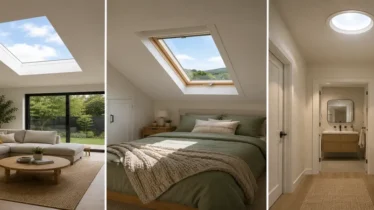
- A skylight (often tubular) can provide consistent daylight so the hallway stops feeling like a separate dark zone.
Bathrooms
- Downlights help at night, but do not change the room’s damp behaviour.
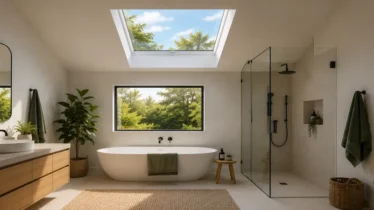
- A skylight can bring daylight into a windowless bathroom, and a vented skylight can improve how the room clears warm, humid air.
Kitchens
- Downlights are excellent for task zones, especially evenings.
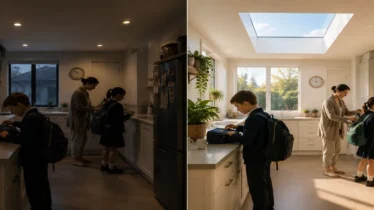
- Skylights can transform how the space feels during the day, but summer comfort matters. The goal is often even light, not direct sun on the benchtop.
Living areas
- Downlights are useful for evenings and mood control.
- Skylights can extend the “daylight feeling” deeper into the afternoon, but they must be planned to avoid glare during peak summer sun.
The best answer is often ‘both’, but specified properly
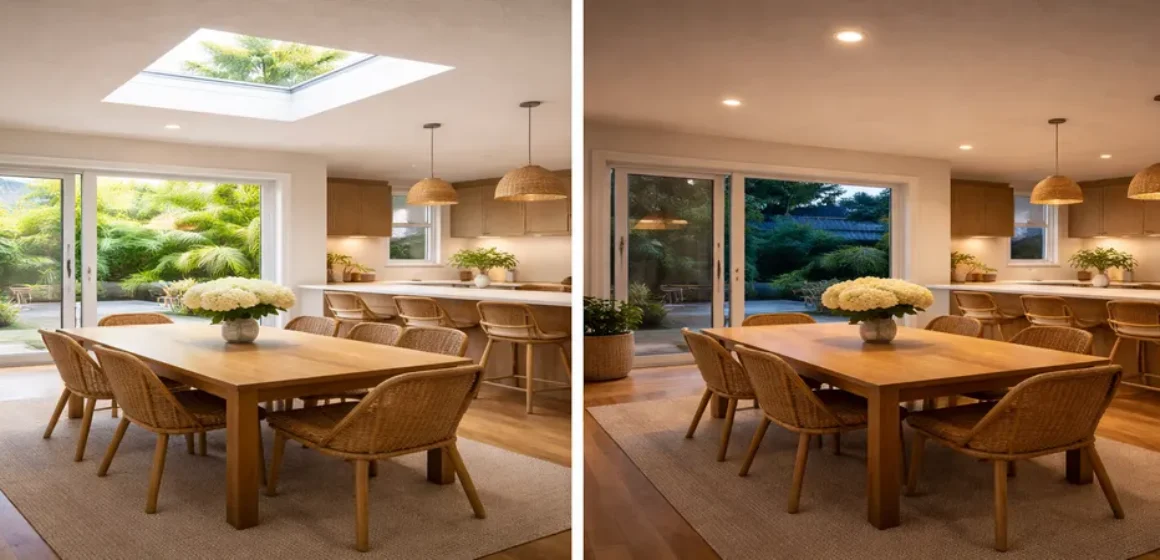
The most comfortable homes usually use skylights and downlights in complementary roles.
A practical pairing looks like:
- skylight for daytime natural light and atmosphere
- downlights for night-time consistency and task lighting
This avoids two extremes:
- relying on downlights all day in summer (which can feel flat and unnecessary)
- relying on skylights without controls (which can create glare or heat at the wrong time)
The common mistakes (and how to avoid them)
Mistake 1: Using downlights to fix a daylight problem
If the hallway is dark at midday, that is not really a “downlight issue”. It is a daylight distribution issue.
Mistake 2: Choosing a skylight for brightness instead of comfort
In summer, the difference between bright and comfortable matters.
A comfort-first skylight plan considers:
- roof direction and sun angle
- how the room is used in afternoons
- diffusion or glare control where needed
Mistake 3: Forgetting the seasonal swing
A solution that feels great in winter can behave differently in February.
That is why planning for summer comfort makes the skylight decision stronger, not weaker.
Illustrative example only: a realistic NZ scenario
A homeowner in Hamilton had an open-plan living space with downlights throughout. The room was functional at night, but during the day the centre still felt slightly dim, so the lights often went on even in summer.
They did not want a dramatic skylight. They wanted the room to feel naturally lit without making afternoons harsher.
The solution was a balanced approach:
- introduce daylight to the centre of the space in a comfort-led way,
- keep downlights for evening control,
- and ensure glare management was considered for summer use hours.
The home felt brighter in the day without becoming a room they had to “manage”.
A calm next step if you’re deciding between the two
If you are weighing skylights versus downlights, start by identifying whether the room’s real problem is:
- lack of daylight
- lack of night-time control
- summer comfort (glare or heat)
If you share a few photos and tell us when the room feels dim or uncomfortable, we can recommend the best approach for your home, including whether a skylight, better downlight planning, or a combined strategy makes most sense.
Start here: https://inquiry.skylights.co.nz/inquiry