H1 in real life: what changes when you add roof glazing (and what doesn’t)
By late summer in New Zealand, a lot of homes have the same rhythm.
The mornings feel good. The house is bright. You keep the lights off longer.
Then, somewhere around mid-afternoon, one room starts to feel different. The air gets heavier. You shift your chair. You close a curtain. You turn on a fan earlier than you planned.
That lived experience is why the H1 conversation has become more common.
Not because skylights are suddenly “a problem”, but because roof glazing changes how a room behaves — especially in a country where seasonal sun can swing from low winter light to strong summer afternoons.
This article is a plain-English guide to what H1 means in real life when you add roof glazing, what it changes, what it does not, and how to make skylight decisions that improve comfort rather than create new workarounds.
First, a 30-second translation of H1
H1 is the energy efficiency clause of the New Zealand Building Code. In simple terms, it focuses on how a building holds warmth when it is cold and avoids unnecessary heat build-up when it is warm.
Skylights and roof windows count as glazing in the building’s “thermal envelope”, so they are part of that comfort and efficiency picture.
This is not about banning daylight. It is about making sure daylight features do not undermine comfort.
What roof glazing changes in real homes (the parts you feel)
When you add a skylight, three things tend to change first.
1) The room’s light becomes more central and more honest
Light from above reaches places side windows cannot. That is often the point.
But it also means the room stops relying on light “spilling in” from one side. It becomes brighter where you actually live, not just near the window.
2) The room’s comfort becomes more sensitive to good decisions
A skylight can make a room feel calmer and more open.
It can also make the room more sensitive to:
- roof direction and sun angle
- glazing choice
- whether the room has a realistic airflow pathway
This is where H1-style thinking helps homeowners: not by adding complexity, but by making comfort the lead outcome.
3) Your daily habits can change (without you trying)
In a good skylight install, people notice:
- fewer daytime lights switched on
- a room that feels more “awake” earlier
- bathrooms and hallways that feel less like problem zones
That is not marketing language. It is what tends to happen when daylight is distributed well.
Myth 1: “H1 basically means skylights are a bad idea now.”
This is one of the most common misunderstandings.
Reality: H1 is not anti-skylight. It is anti-discomfort.
H1 aims to reduce the chance that parts of the home become harder to heat in winter or harder to keep comfortable in summer.
A skylight that is well planned can be fully aligned with that goal.
The key shift in 2026 is not “avoid skylights”. It is:
Choose roof glazing like you would choose a heating system: based on how you want the room to feel.
That means giving more weight to:
- comfort-led glazing specification
- placement that avoids harsh sun behaviour
- appropriate controls when needed
If you want a simple takeaway: H1 pushes the industry toward better skylights, not fewer skylights.
Myth 2: “If it overheats in summer, the skylight is the problem.”
Sometimes it is. Often it is not.
Reality: overheating is usually a system issue, not a single-feature issue
In summer, overheating often comes from a combination of:
- sun angle and roof direction
- the room’s ability (or inability) to release warm air
- dark surfaces that absorb heat
- large unshaded glazing elsewhere in the room
- limited cross-ventilation
A skylight can contribute, but it is rarely the only driver.
A useful way to think about it is this:
A skylight does not create summer sun. It decides how that sun enters and how the room deals with it.
The comfort-first fixes (before you abandon the idea)
If you are worried about summer overheating, these are the practical levers:
- Placement and orientation
Where the skylight sits can change whether it delivers soft daylight or direct afternoon sun. - Light quality (diffused vs direct)
Many living spaces feel best with even daylight, not a bright patch. Diffusion can matter more than size. - Controls when they earn their place
In some rooms, blinds or glare control are not “extras”. They are how you keep the room usable on peak summer days. - Ventilation strategy
Warm air rises. If heat collects at ceiling level and has nowhere to go, the room feels heavy. Vented solutions can help in the right spaces.
Myth 3: “Downlights are cheaper, so skylights don’t make sense anymore.”
Downlights feel like the practical answer because they are straightforward:
- predictable
- cheap to run per fitting
- instantly controllable
But this comparison often skips what homeowners are actually trying to fix.
Reality: downlights solve night-time control; skylights solve daytime quality
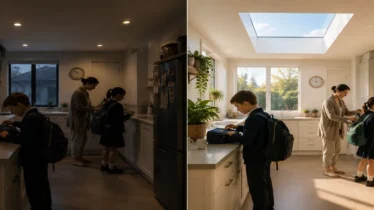
A dark hallway at midday is not a lighting-system problem. It is a daylight distribution problem.
Downlights will fix it, but they do it by turning daytime into a paid utility.
A skylight changes the room so the problem reduces naturally.
That difference matters in 2026, because homeowners are not only managing lighting costs. They are managing comfort, energy habits, and how the home feels across longer summer days.
The “honest comparison” question
Ask this:
Am I trying to make the space usable in the day, or just brighter at night?
- If it is a night-time task zone, downlights may be the right tool.
- If it is a daytime comfort and habit issue, skylights can change the baseline.
The best homes usually use both:
- skylights for daytime natural light
- downlights for evening control
What doesn’t change (the reassuring part)
When H1 enters the conversation, people sometimes assume everything becomes difficult.
In practice, a few things remain true.
You can still pursue beautiful daylight
H1 does not remove the value of daylight. It reinforces the idea that daylight should be comfortable.
“More light” is not the only goal
The best outcomes in 2026 are not about the biggest skylight. They are about light that feels good to live with.
A good recommendation is still based on your room
A hallway, a bathroom, and a living room do not want the same kind of skylight. That has always been true.
A simple 2026 decision framework (five-minute version)
If you want a clear direction quickly, walk through these four prompts.
1) What is the real problem?
- Daytime dimness?
- Stale air or damp?
- A room that feels closed-in?
- A summer comfort issue?
2) When do you use the room most?
Morning, afternoon, evenings — this affects sun behaviour and comfort needs.
3) Do you want direct sun or calm daylight?
Most living areas feel better with calm, even daylight.
4) Where does warm air go?
If the room already runs warm and has limited airflow, plan for how heat clears.
If you can answer those, you are already well positioned to avoid “too much skylight” and “wrong skylight” outcomes.
Illustrative example only: one NZ scenario
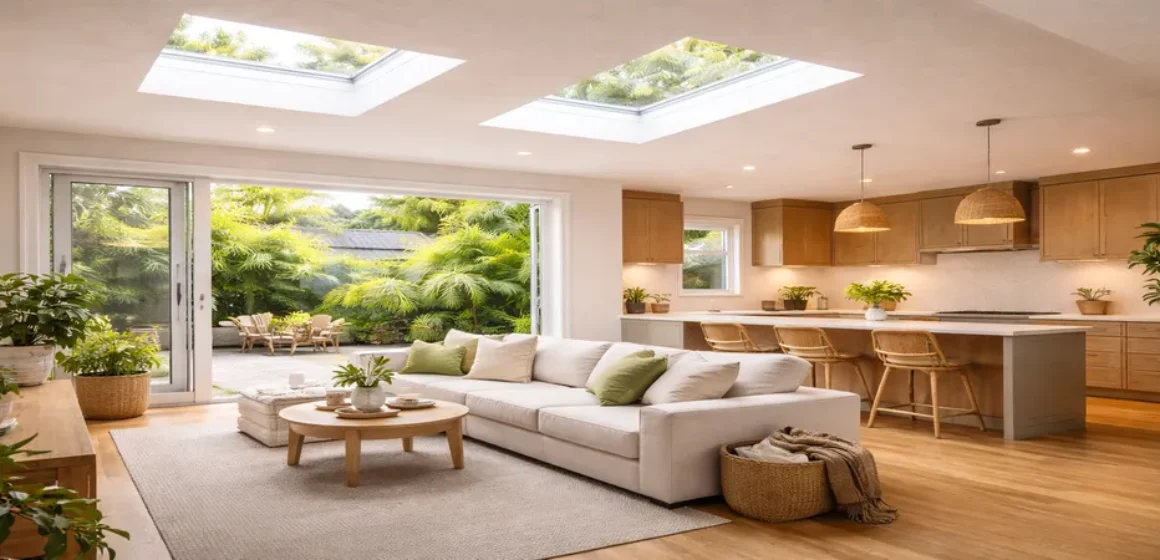
A homeowner in Tauranga wanted to brighten an open-plan living space and assumed H1 meant a skylight would be risky.
Their real concern was not compliance. It was comfort: the room already felt warm on still February afternoons.
Instead of abandoning the idea, the plan focused on:
- even daylight into the darker centre of the room
- avoiding a predictable afternoon hotspot
- including sensible comfort controls so the room stayed usable
The result was a room that felt brighter during the day without becoming something they had to manage when summer peaked.
A calm next step
H1 has made one thing clearer in 2026: roof glazing should improve a home’s comfort, not just its appearance.
If you are considering a skylight and want guidance that balances daylight, summer comfort, and real-life room behaviour, share a few photos and tell us when the room feels dim or uncomfortable.
Start here: https://inquiry.skylights.co.nz/inquiry