Kitchen Skylights in Hamilton Homes: Where Daylight Should Actually Land
A kitchen can have windows and still feel like it needs the lights on.
That is one of the most common daylight problems in Hamilton homes. The room is not always completely dark. It may have a window above the sink, a glazed door nearby, or borrowed light from the dining area. But the daylight does not always land where the kitchen is actually used.
The benchtop may feel dull. The island may sit in shadow. The back wall may need lights during the day. The pantry area may feel closed in. The kitchen may technically have natural light, but not enough useful daylight where cooking, preparing food, cleaning and gathering actually happen.
This becomes more noticeable in winter.
From June onwards, lower sun angles, shorter days, shaded side boundaries and closed-up homes can make kitchen lighting problems more obvious. A kitchen that felt acceptable in summer may feel flat, cold-looking or overly dependent on artificial lighting during winter.
For homeowners considering a kitchen skylight Hamilton project, the key question is not simply, “Where can we put a skylight?”
The better question is:
Where should the daylight land so the kitchen works better?
A fixed skylight may suit some Hamilton kitchens. A vented skylight may be worth considering where airflow is also part of the problem. A tubular skylight or Sky tube may suit smaller kitchen zones, pantries or darker transition areas. The right answer depends on the kitchen layout, roof type, ceiling structure, glare risk, ventilation needs and how the room is used every day.
This guide explains how to think clearly about kitchen skylights in Hamilton homes before making an enquiry.
Why kitchen daylight is different from general room brightness
A kitchen is not just another room that needs to look brighter.
It is a working space.
People prepare food, use knives, read labels, clean surfaces, make coffee, load dishes, help children with snacks, gather around benches and move between wet, hot and sharp zones. Daylight in a kitchen needs to support those everyday activities.
That means the right daylight location matters more than simply adding brightness to the ceiling.
A kitchen may feel dark because:
- The main window is too far from the working bench
- The sink area is bright but the island is dull
- Wall cabinets block or absorb light
- The dining side receives daylight but the preparation area does not
- The kitchen sits in the centre of an open-plan space
- The ceiling lights are doing most of the work during the day
- The room faces a shaded side boundary
- Neighbouring homes, fences or trees reduce side light
- Dark cabinetry, flooring or benchtops absorb daylight
- The kitchen was renovated without improving natural light
A skylight can help in the right situation, but only if it responds to the way the kitchen is used.
A bright patch in the wrong place may look impressive for a moment, but it may not improve the daily function of the room.
The Hamilton kitchen problem
Hamilton homes include a wide mix of kitchen layouts.
Some older homes have separate kitchens that sit at the back or side of the house. Some brick-and-tile homes have kitchens tucked between living and dining spaces. Many renovated homes have open-plan kitchens where the island becomes the centre of daily life. Newer homes may have sculleries, walk-in pantries and deeper floor plans where daylight does not reach every zone evenly.
The common issue is that kitchen daylight is often uneven.
A homeowner might say:
- “The kitchen has a window, but it still feels dark.”
- “The island needs lights on during the day.”
- “The back of the kitchen feels dull.”
- “The pantry area is always shadowy.”
- “The kitchen is okay in summer, but winter makes it feel flat.”
- “We want more natural light, but we do not want glare.”
- “We are renovating and want to get the daylight right.”
These are not all the same problem.
A dark island, a shaded sink, a gloomy scullery and a dull open-plan kitchen may need different daylight strategies.
That is why kitchen skylight planning should start with the kitchen zones, not the skylight size.
The most important question: where should daylight land?
Before choosing a product, identify the area that needs natural light most.
In a kitchen, daylight may need to support:
- The main preparation bench
- The island
- The sink
- The cooking zone
- The dining transition
- The scullery
- The pantry entrance
- The back wall
- The walkway between kitchen and living area
A skylight placed over the wrong zone may improve the room visually but not practically.
For example, a skylight placed near the window side of the kitchen may brighten an area that already receives daylight. Meanwhile, the island or rear bench may remain dull. A skylight placed too close to a reflective benchtop may create glare. A skylight placed without considering the roof above may lead to unnecessary complexity.
A good kitchen skylight should make the room easier to use.
That means daylight should land where the kitchen needs support, not simply where the ceiling has spare space.
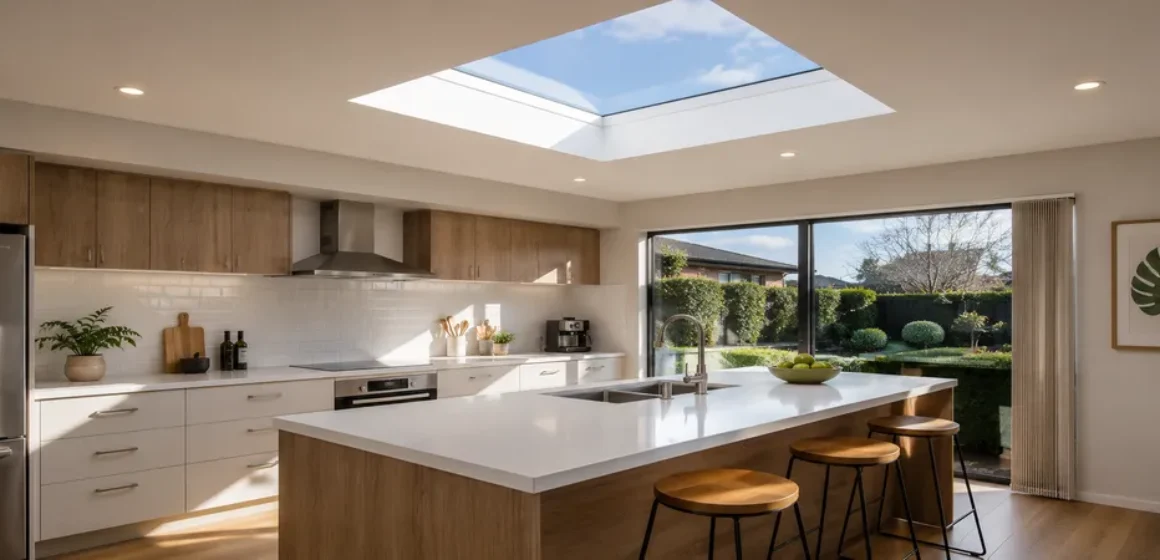
Kitchen island daylight
In many modern Hamilton homes, the kitchen island is the centre of the room.
It may be used for:
- Food preparation
- Casual meals
- Coffee
- Children’s homework
- Entertaining
- Serving
- Sorting groceries
- Working from a laptop
- Gathering during family routines
If the island sits away from the main wall window, it can feel dull during the day. Ceiling lights may be needed even when the rest of the open-plan area feels reasonably bright.
A skylight above or near an island can be worth considering, but placement must be handled carefully.
Important questions include:
- Will the daylight fall directly onto the main working surface?
- Could the skylight create glare on a polished benchtop?
- Will the light feel balanced with the dining or living area?
- Would blinds or glazing options be useful?
- Does the roof above allow sensible placement?
- Are there pendant lights, rangehoods or ceiling features in the way?
- Would the island remain comfortable in summer?
A kitchen island skylight should not be planned only for visual appeal. It should support the way the island is actually used.
Benchtop and preparation areas
The most useful kitchen daylight often lands on the areas where hands are working.
A skylight may help if the main preparation bench is away from the window or if overhead cabinets make the area feel shadowed.
However, daylight should complement, not replace, good task lighting.
Even with a skylight, kitchens still need suitable artificial lighting for early mornings, evenings, winter conditions and detailed tasks. A skylight improves daytime natural light. It does not remove the need for well-planned kitchen lighting.
For preparation areas, consider:
- Whether daylight reaches the benchtop evenly
- Whether upper cabinets cast shadows
- Whether the skylight would sit near reflective surfaces
- Whether the room needs stronger daylight or softer general light
- Whether the kitchen is used heavily in the morning, afternoon or evening
- Whether there is risk of glare from roof orientation or surface finishes
The aim is a kitchen that feels naturally usable during the day, not a kitchen that depends on one bright spot.
The sink window problem
Many kitchens have a window above the sink.
That can be pleasant, but it can also mislead homeowners into thinking the kitchen has enough daylight.
The sink may be bright while the rest of the kitchen remains dull.
This is common when:
- The sink is on an external wall
- The island sits further inside the room
- The benchtop wraps into a darker corner
- The dining side gets better light than the work zone
- The window faces a shaded side path or fence
- The window is small or privacy-limited
- The kitchen has darker cabinetry or flooring
A kitchen skylight may help by bringing daylight to the part of the room the wall window cannot reach.
This is one of the strongest reasons to consider overhead daylight in a kitchen.
The existing window is not always the issue. The issue is where the existing window light stops.
Open-plan kitchens need balance
Open-plan kitchens can be harder to plan than separate kitchens.
The skylight needs to work with the kitchen, dining and living areas together. If one area becomes much brighter than the others, the space can feel uneven. If the skylight is placed without considering the furniture layout, it may light the wrong part of the open-plan zone.
In an open-plan kitchen, consider:
- Where people gather most
- Whether the island or dining table needs daylight
- Whether the living area already has strong window light
- Whether the kitchen sits deeper inside the floor plan
- Whether the ceiling is flat, raked or stepped
- Whether the skylight should create a feature or subtle brightness
- Whether glare could affect seating, screens or polished surfaces
- How daylight will move through the space in winter and summer
A kitchen skylight should help the open-plan area feel more balanced, not visually divided.
The goal is not just to brighten the kitchen. It is to improve how the kitchen connects with the rest of the home.
Separate kitchens in older Hamilton homes
Older Hamilton homes often have more enclosed kitchens.
These rooms may sit at the rear or side of the house, with limited window light and less connection to living areas. The kitchen may be practical, but not naturally bright. In winter, it can feel especially flat.
A skylight may be worth considering if:
- The kitchen has a small window
- The room sits on the shaded side of the home
- The ceiling light is used during the day
- The kitchen feels cut off from brighter living areas
- The homeowner wants better daylight without changing the wall layout
- The roof and ceiling layout are suitable
In some separate kitchens, a fixed skylight can make the room feel more open. In others, a tubular skylight or Sky tube may be enough, especially if the kitchen is compact and mainly needs general daytime brightness.
A separate kitchen should not be treated the same as a large open-plan kitchen.
The scale of the room matters.
Pantries and sculleries
Pantries and sculleries can be overlooked in skylight planning.
These spaces are often internal, compact and dependent on artificial lighting. They may sit behind the main kitchen, where natural light does not reach.
A tubular skylight or Sky tube may be worth considering where:
- A walk-in pantry feels dark during the day
- A scullery is used regularly for preparation or cleaning
- The space has no window
- The ceiling and roof path are suitable
- A subtle daylight improvement is preferred
- The main kitchen is bright but the support area is not
A full fixed skylight may not be necessary in these areas. Often the goal is simple: make the space easier to use without turning on a light every time someone enters.
Pantry and scullery daylight can be a small improvement that makes the kitchen as a whole feel more considered.
Kitchen skylights and ventilation
Kitchens need careful ventilation thinking.
A vented skylight may be useful in some kitchens, especially where warm air gathers near the ceiling or the room feels stuffy. However, a vented skylight should not be treated as a replacement for a suitable rangehood or cooking extraction.
Cooking produces moisture, heat, steam, odours and airborne particles. These usually need dedicated extraction through the right system.
A fixed skylight improves daylight but does not provide airflow.
A tubular skylight or Sky tube brings daylight but does not ventilate the room by itself.
A vented skylight may support airflow in suitable conditions, but it is only one part of the wider ventilation picture.
For kitchen ventilation, consider:
- Existing rangehood performance
- Cooking frequency
- Ceiling height
- Window opening
- Whether the room feels stuffy
- Whether moisture or odour lingers
- Whether the kitchen connects to living areas
- Whether a vented skylight would be convenient to operate
- Weather exposure and control options
Daylight and ventilation should be discussed together, but not confused.
Glare and reflective surfaces
Kitchen skylights need careful glare planning.
Kitchens often include reflective surfaces such as:
- Stone benchtops
- Gloss cabinetry
- Stainless appliances
- Glass splashbacks
- Polished floors
- Light-coloured tiles
- Pendant lights
- Large windows nearby
A skylight placed without considering these surfaces may create bright reflections at certain times of year.
This does not mean skylights are unsuitable for kitchens. It means placement, glazing, roof orientation and light control should be considered properly.
Questions to ask include:
- Will daylight reflect off the island or benchtop?
- Does the kitchen receive strong summer sun from above?
- Would a blind be useful?
- Is the skylight intended to provide direct brightness or softer general daylight?
- Does the room have screens, dining seating or reflective finishes nearby?
- Would the skylight create comfort issues during parts of the day?
A well-planned kitchen skylight should make the room easier to use, not create harshness.
Skylight size in a Hamilton kitchen
Kitchen skylight size should follow the room, not the homeowner’s first guess.
A larger skylight may suit some open-plan kitchens or larger dining-kitchen spaces. A smaller skylight or tubular skylight may be better for compact kitchens, pantries or targeted daylight improvements.
Bigger is not automatically better.
A skylight that is too large for the space may create too much contrast, visual dominance, heat concerns or glare. A skylight that is too small or poorly placed may not solve the daylight issue.
Size should consider:
- Kitchen size
- Ceiling height
- Roof orientation
- Roof pitch
- Benchtop position
- Island size
- Cabinetry layout
- Surface reflectivity
- Existing windows
- Desired daylight level
- Whether blinds may be needed
- Whether the kitchen is open-plan or enclosed
The right skylight size is the one that supports the room comfortably and practically.
Roof type and kitchen skylight planning
A kitchen skylight becomes part of the roof system, so roof conditions matter.
Hamilton homes may have different roof types and profiles, including metal and tile roofs. The installation approach, flashing and product suitability depend on the specific roof.
Important considerations include:
- Roof type
- Roof pitch
- Roof profile
- Flashing requirements
- Roof condition
- Water flow direction
- Nearby valleys, ridges or gutters
- Existing vents or roof penetrations
- Solar panels
- Roof access
- Ceiling cavity
- Trusses or rafters
- Electrical wiring
- Ducting
- Rangehood paths
- Lighting layout
The ideal daylight location inside the kitchen may not always line up perfectly with the easiest roof position. This is where proper assessment matters.
For tubular skylights and Sky tubes, the tube path is important. For fixed and vented skylights, the roof opening, framing, flashing and internal finishing need careful planning.
The roof has a vote in the final recommendation.
Kitchen renovations: when to plan the skylight
A kitchen renovation is one of the best times to consider a skylight.
The ceiling, lighting, cabinetry, rangehood, electrical layout and internal finishes may already be under review. Adding skylight planning early can prevent compromises later.
Early planning helps with:
- Skylight placement
- Cabinetry layout
- Island position
- Pendant lighting
- Rangehood location
- Ceiling lighting plan
- Electrical work
- Internal finishing
- Roof access
- Blind or control options
- Coordination with painting or roofing work
The worst time to think about kitchen daylight is after the layout is finalised and the ceiling plan is locked in.
If a Hamilton kitchen renovation is planned for spring or summer, winter can be a practical time to assess how the room performs at its darkest.
That gives the homeowner better information before making design decisions.
Where a kitchen skylight may not be the first answer
A skylight may not be the right first step in every kitchen.
Other options may need to be reviewed first if:
- The main problem is poor artificial lighting
- The kitchen layout is about to change
- Dark cabinetry or finishes are causing most of the dullness
- The existing window is blocked by furniture or fittings
- The room already receives strong natural light
- The roof above is unsuitable
- Glare would be difficult to control
- Ventilation is the main issue and extraction is inadequate
- The homeowner expects a skylight to solve heat, dampness or cooking odours
In some kitchens, better task lighting, lighter finishes, layout changes or improved extraction may be more important.
In other kitchens, overhead daylight may be the missing piece.
The point is to solve the correct problem.
Fixed skylight, vented skylight or tubular skylight?
The best product depends on the kitchen’s actual need.
Fixed skylight
A fixed skylight may suit a kitchen where stronger overhead daylight is wanted and airflow is not the main concern. It may work well above islands, preparation zones, dining-kitchen areas or dull open-plan spaces.
Vented skylight
A vented skylight may suit some kitchens where airflow is also part of the concern. It should still be considered alongside proper cooking extraction, not as a replacement for it.
Tubular skylight or Sky tube
A tubular skylight or Sky tube may suit smaller kitchens, pantries, sculleries or compact zones where softer practical daylight is enough. It may also be useful where a full skylight would feel too visually dominant.
The best recommendation should come from the room, not from product preference.
Common mistakes with kitchen skylights
Kitchen skylight planning can go wrong when the product is chosen before the problem is understood.
Common mistakes include:
Placing the skylight where it is easiest, not where it is useful
The roof position matters, but the kitchen function matters too.
Lighting the wrong zone
A skylight should help the island, benchtop, sink, dining transition or darker part of the room, depending on the actual issue.
Ignoring glare
Reflective benchtops, splashbacks and floors can affect comfort.
Choosing size before placement
The right location often matters more than the largest skylight.
Confusing airflow with cooking extraction
A vented skylight may support airflow but does not replace a suitable rangehood.
Leaving skylight planning too late in a renovation
The best placement may be limited once cabinetry, lighting and ceiling plans are fixed.
Forgetting night-time lighting
A skylight helps during daylight hours. The kitchen still needs good artificial lighting.
Avoiding these mistakes can make the final result more useful and more comfortable.
The winter kitchen test
Winter is a good time to assess whether a kitchen needs better daylight.
Turn the lights off during the day and look at the room honestly.
Ask:
- Does the kitchen feel dull by late morning or mid-afternoon?
- Is the island or main bench in shadow?
- Does the sink window light reach far enough?
- Are ceiling lights used during daylight hours?
- Is the kitchen darker than the dining or living area?
- Does the pantry or scullery feel closed in?
- Is the room worse in winter than summer?
- Would overhead daylight improve the way the kitchen is used?
- Is the issue daylight, ventilation, layout, finishes or all of these?
- Is renovation planned soon?
This simple test helps clarify whether a skylight conversation is worthwhile.
It also helps identify where the daylight should land.
Illustrative example only
A Hamilton homeowner has an open-plan kitchen with a window above the sink and sliding doors in the dining area. In summer, the room feels acceptable because the dining side receives good natural light. In winter, the island and back bench feel dull during the day. The ceiling lights are used even when it is not dark outside.
The homeowner asks whether a kitchen skylight would help.
The answer depends on the daylight target.
If the island is the main problem, a fixed skylight near the island may be worth considering, provided roof and ceiling conditions allow it and glare can be managed. If the darker area is a compact scullery or pantry, a tubular skylight or Sky tube may be more appropriate. If the kitchen also feels stuffy, a vented skylight may be discussed, but the rangehood and extraction still need to be considered separately.
The key is not simply to add light.
The key is to place daylight where the kitchen actually needs it.
What to send when asking for a kitchen skylight quote
Good photos and clear context can make the recommendation more accurate.
For a kitchen skylight enquiry, send:
- Photos of the kitchen from several angles
- A photo of the ceiling
- A photo of the island, if there is one
- A photo of the main preparation bench
- A photo showing the sink window or existing natural light source
- A photo of any pantry or scullery area that feels dark
- Roof photos above or near the kitchen, if possible
- The approximate kitchen size
- Whether the kitchen is open-plan or separate
- Whether the home has a metal roof, tile roof or another roof type
- Whether glare is already an issue
- Whether ventilation or cooking odours are a concern
- Whether the kitchen is being renovated
- Whether you prefer a fixed, vented or tubular option
- The time of day the kitchen feels darkest
This information helps determine whether a fixed skylight, vented skylight, tubular skylight or Sky tube may suit the room.
It also helps avoid a generic answer.
The best kitchen skylight outcome
The best kitchen skylight result is not simply a brighter kitchen.
It is a kitchen where daylight improves daily use.
A good outcome may mean:
- The island feels more naturally usable
- The benchtop has better daytime brightness
- The kitchen feels less flat in winter
- The room connects better with the dining or living area
- The pantry or scullery feels less closed in
- Artificial lighting is needed less during daylight hours
- Glare is considered and managed
- Ventilation is discussed honestly
- The skylight suits the roof and ceiling structure
A kitchen is one of the hardest-working spaces in the home.
Its daylight should work just as hard.
Planning your next step
If your Hamilton kitchen feels dull in winter, start by identifying where the daylight is missing.
A fixed skylight may suit larger kitchens, islands, preparation areas and open-plan rooms where stronger daylight is wanted. A vented skylight may suit some kitchens where airflow also matters, but cooking extraction should still be considered separately. A tubular skylight or Sky tube may suit compact kitchens, pantries, sculleries or smaller daylight gaps.
Skylights NZ can help you review which option may suit your kitchen, roof type, ceiling layout and desired outcome.
To start planning your options, use the Skylights NZ enquiry form:
https://inquiry.skylights.co.nz/inquiry
You may also find these useful:
- Skylight installation services
- Request a skylight quote
- Skylight options for NZ homes
- Why Waikato Homes Feel Darker in Winter, and When a Skylight Can Help
- Dark Hamilton Hallways: Why Winter Shows the Problem Clearly
- Bathroom Skylights in Waikato: Daylight, Privacy and Ventilation Explained
FAQs
Is a skylight a good idea for a kitchen in Hamilton?
A skylight may be a good idea for a Hamilton kitchen if the room lacks useful natural daylight, especially around the island, benchtop or deeper parts of the kitchen. Suitability depends on roof type, ceiling layout, placement, glare control and ventilation needs.
Where should a kitchen skylight be placed?
A kitchen skylight should be placed where daylight will improve the room’s daily use. This may be near the island, preparation bench, sink area, dining transition, pantry or darker back section. Placement should also consider roof structure, glare, ceiling fittings and surface reflections.
Is a fixed or vented skylight better for a kitchen?
A fixed skylight may suit kitchens where daylight is the main goal. A vented skylight may be worth considering where airflow is also important, but it should not replace proper cooking extraction or a suitable rangehood.
Can a tubular skylight work in a kitchen?
A tubular skylight or Sky tube can work in some kitchens, especially smaller kitchens, pantries, sculleries or compact areas where softer practical daylight is enough. A larger fixed skylight may be better where stronger daylight or a visible sky connection is wanted.
Will a kitchen skylight cause glare?
A kitchen skylight can cause glare if placement, roof orientation, glazing and reflective surfaces are not considered. Benchtops, splashbacks, polished floors and glossy cabinetry can all affect glare, so daylight should be planned carefully.
What should I send for a kitchen skylight quote?
Send photos of the kitchen, ceiling, island, benchtops, existing windows, darker areas and roof above the kitchen if possible. Include the roof type, whether the kitchen is open-plan or separate, when it feels darkest, and whether ventilation or glare is a concern.