Bathroom Skylights in Waikato: Daylight, Privacy and Ventilation Explained
A bathroom can affect the way a home feels more than people realise.
It is one of the first rooms used in the morning. It is often used when the day is still dark, cold or slow to brighten. In winter, it can feel even more closed in, especially if the window is small, shaded, frosted, covered for privacy or facing a fence.
Many Waikato bathrooms have a familiar problem: they are private, but not pleasant.
The room may technically have a window, but it does not bring in enough useful daylight. The light may stay close to one wall. The shower area may feel dull. The vanity may need artificial lighting during the day. The room may feel colder because it looks shadowed. If steam, condensation or poor airflow are also present, the bathroom can feel heavier than it should.
For homeowners considering a bathroom skylight Waikato solution, the decision needs careful thinking.
A skylight can improve natural light. A tubular skylight or Sky tube may suit compact bathrooms where soft overhead daylight is enough. A vented skylight may support airflow in suitable situations. But daylight and ventilation are not the same thing, and a skylight should not be treated as a complete moisture solution by itself.
This guide explains how to think about bathroom skylights in Waikato homes, including daylight, privacy, ventilation, roof suitability, product choice and what to send when making an enquiry.
Why Waikato bathrooms can feel worse in winter
Bathrooms often reveal their weaknesses in winter.
During warmer months, a small bathroom window may feel acceptable. The room may dry more quickly. The home may be opened up more often. Daylight hours are longer, and the bathroom may not feel as enclosed.
In winter, the same room can feel very different.
Several things happen at once:
- The days are shorter
- Morning daylight is weaker
- The sun sits lower
- Windows may stay closed more often
- Steam lingers longer
- Frosted glass can limit brightness
- Privacy coverings reduce daylight
- South-facing or shaded windows struggle
- Artificial lighting is used more often
- Bathrooms can feel colder because they look darker
A bathroom does not need to be large or luxurious to feel better. But it does need to feel clean, usable and comfortable.
Natural daylight can help a bathroom feel more pleasant during the day. It can make surfaces easier to see, improve the way colours and finishes appear, and reduce the sense that the room is always dependent on electric lighting.
But if the room also has steam, condensation or airflow problems, those issues need to be considered separately.
The privacy problem
Bathroom windows are often compromised by privacy.
A window may exist, but it may face:
- A neighbouring property
- A side path
- A fence
- A driveway
- A deck
- A boundary wall
- A nearby outdoor area
- Another window
To maintain privacy, homeowners may rely on frosted glass, blinds, curtains, obscure film or keeping the window closed. These can protect privacy, but they can also reduce useful daylight.
That is one of the reasons a bathroom skylight can be worth considering.
Overhead daylight may allow the room to feel brighter without relying as heavily on side-facing window light. It can bring daylight from above, where privacy concerns are often reduced compared with wall windows.
This does not mean every bathroom needs a skylight. It means that in some bathrooms, the existing window is not failing because it is badly placed. It is failing because privacy limits how useful it can be.
A skylight can sometimes solve that daylight problem more naturally than making the wall window larger.
Daylight and ventilation are different problems
This is the most important point in bathroom skylight planning.
A bathroom may need daylight.
A bathroom may need airflow.
A bathroom may need both.
But these are not the same issue.
A fixed skylight can improve daylight, but it does not provide ventilation.
A tubular skylight or Sky tube can bring daylight into the room, but it does not ventilate the bathroom by itself.
A vented skylight may support airflow in suitable conditions, but it may not replace a proper extractor fan where moisture control is required.
This matters because bathrooms produce moisture through showers, baths, steam and wet surfaces. If the room already has condensation, mould or poor air movement, better daylight alone will not remove the cause.
A bathroom skylight should be selected based on what the room genuinely needs.
If the bathroom is mainly dark, daylight may be the priority.
If the bathroom is dark and stuffy, a vented option may be worth discussing.
If the bathroom has heavy condensation, extraction and broader ventilation should also be reviewed.
If the bathroom is being renovated, skylight planning should be considered alongside fan placement, ceiling layout, waterproofing, lighting and internal finishes.
A good outcome comes from separating the problems before choosing the product.
When a fixed skylight may suit a Waikato bathroom
A fixed skylight may suit a bathroom where the main problem is lack of natural light rather than airflow.
It may be worth considering when:
- The bathroom feels dark during the day
- The window is small, shaded or privacy-limited
- The shower, bath or vanity area lacks daylight
- The room has a suitable roof and ceiling layout
- A stronger sense of openness is wanted
- The homeowner does not need the skylight to open
- Existing mechanical extraction is already adequate or planned
A fixed skylight can bring overhead daylight into the room and make the bathroom feel less enclosed. It may also work well where the bathroom has modern finishes, a larger footprint, or a ceiling layout that can support a visible skylight opening.
However, placement still matters.
A fixed skylight should not be chosen simply because it looks attractive. It should be positioned so the daylight improves the room’s actual use.
For example:
- Over or near a vanity may help with daytime brightness
- Near a shower may help a dull wet area feel less enclosed
- Central placement may support overall room brightness
- Placement away from roof obstructions may be necessary
- Blinds or glazing choices may be relevant in some situations
The goal is not just to brighten the ceiling. The goal is to improve the bathroom experience without creating glare, heat discomfort or an awkward visual result.
When a tubular skylight or Sky tube may be better
A tubular skylight or Sky tube may be better for compact Waikato bathrooms where the goal is practical natural light rather than a large skylight feature.
This may suit:
- Small bathrooms
- Separate toilets
- Ensuite bathrooms
- Bathrooms with limited ceiling area
- Bathrooms beside internal hallways
- Rooms where a full skylight would feel too large
- Spaces where a softer diffuser-style light is preferred
- Bathrooms where the roof and ceiling alignment suit a tube path
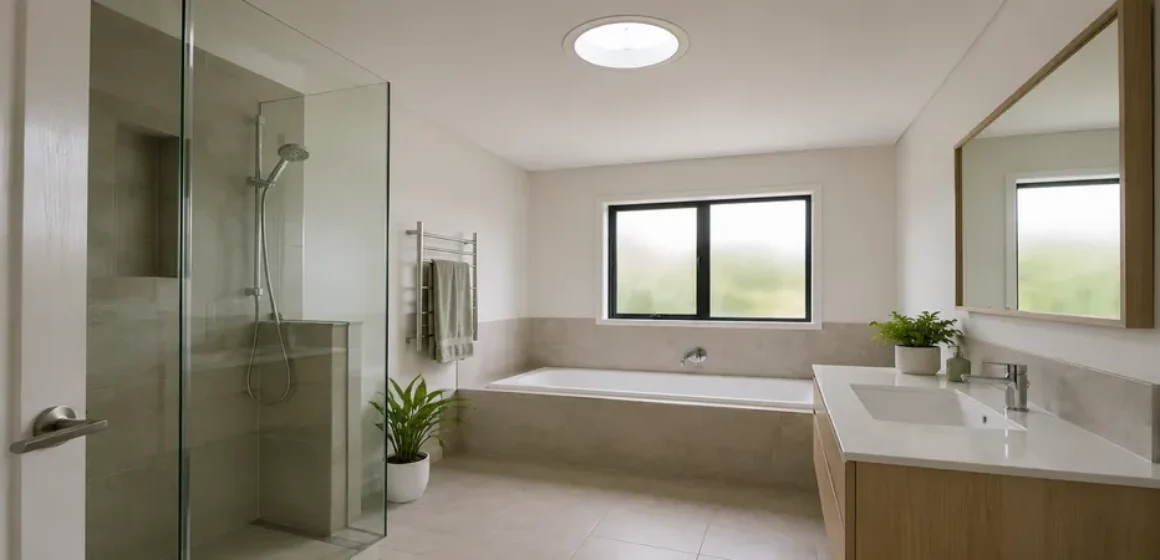
A tubular skylight brings daylight from the roof through a reflective tube and delivers it through a ceiling diffuser. In a bathroom, this can provide useful daytime brightness without making the skylight the dominant visual feature.
This is especially useful where the bathroom is small and the homeowner simply wants the room to stop feeling dull.
A tubular skylight or Sky tube should still be assessed carefully. Tube length, roof position, ceiling location, roof type, roof pitch, bends and obstructions can affect suitability.
It is also important to be clear that a tubular skylight improves daylight only. It does not provide airflow unless paired with another ventilation solution.
When a vented skylight may be worth considering
A vented skylight may be relevant when a bathroom needs both daylight and airflow.
It may be worth discussing when:
- The bathroom feels dark and stuffy
- The room has limited window opening
- The bathroom is upstairs or under a roof space
- Warm, moist air gathers near the ceiling
- The homeowner wants natural airflow as part of the solution
- The roof and ceiling layout are suitable
- The product can be operated safely and conveniently
A vented skylight can allow air to escape from a higher point in the room. This may support airflow in suitable bathrooms, especially when used alongside other ventilation methods.
However, it should not be oversold.
Bathrooms often still need mechanical extraction, especially where showers are used regularly. A vented skylight may help with airflow, but it does not automatically solve condensation, mould or dampness.
A vented bathroom skylight also needs practical consideration around:
- Rain sensors, where available
- Manual or powered operation
- User convenience
- Weather exposure
- Safety
- Cleaning access
- Placement
- Roof suitability
- Compatibility with the bathroom layout
A vented skylight may be a strong option, but only when the use case is clear.
Bathroom skylight placement: where should the daylight land?
Placement is one of the most important parts of the decision.
A bathroom skylight should be planned around how the room is used.
Consider the main zones:
Vanity area
Daylight near the vanity can make the room feel more natural during morning routines. However, artificial task lighting will usually still be needed for night use and detailed grooming.
Shower area
A shower can feel enclosed if it sits in a dark corner. Overhead daylight nearby may help the space feel more open and less boxed in.
Bath area
A skylight near a bath may create a calm daylight effect, but privacy, glare and roof placement still need thought.
Central room area
A central skylight or diffuser can support overall brightness, especially in small or compact bathrooms.
Separate toilet
A tubular skylight or Sky tube may be enough for a separate toilet where practical daylight is the main goal.
The best placement is not always the easiest ceiling position. It is the position that improves the room without creating new issues.
Privacy from above
Many homeowners ask whether bathroom skylights create privacy concerns.
In most situations, overhead daylight can offer better privacy than wall-facing windows, but the details still matter.
Privacy may depend on:
- Roof angle
- Neighbouring properties
- Higher neighbouring windows
- Hillside sites
- Multi-storey homes nearby
- Skylight placement
- Glazing type
- Blind options
- Bathroom layout
A skylight in a bathroom should be assessed with the surrounding property context in mind.
For many bathrooms, privacy is one of the reasons a skylight is attractive. It can bring daylight in without needing a larger wall window or relying on open blinds.
However, privacy should still be considered properly, especially in dense suburban settings, sloped sites or homes with nearby upper-level neighbours.
Condensation: what a skylight can and cannot do
This needs careful, honest explanation.
A brighter bathroom may feel fresher and more pleasant. A vented skylight may support airflow in suitable conditions. Better daylight can make surfaces easier to see and may make the room feel less closed in.
But condensation is a moisture issue.
It may be affected by:
- Shower use
- Steam volume
- Room temperature
- Insulation
- Window performance
- Extraction
- Airflow
- Heating
- Surface temperatures
- How long wet surfaces remain damp
- Whether clothes are dried indoors
- Overall home ventilation
A skylight should not be promoted as a guaranteed condensation fix.
If condensation is the main concern, the homeowner should consider extraction, ventilation, heating, insulation and bathroom use habits alongside any skylight decision.
A skylight may be part of a better bathroom environment, but it should not be treated as the only answer.
This honest framing helps homeowners make better decisions and builds trust.
Waikato bathroom types where skylights may help
Bathroom layouts vary across the Waikato.
Older family homes
Older homes may have smaller bathrooms, compact windows, separate toilets and central hallways. A tubular skylight or compact skylight may help bring daylight into rooms that were not designed around modern brightness expectations.
Brick-and-tile homes
Many suburban Hamilton homes include bathrooms tucked between bedrooms or near internal corridors. These bathrooms may have privacy-limited windows or shaded side aspects.
Renovated bathrooms
A bathroom renovation is a good time to consider daylight because ceiling work, extraction, lighting and layout may already be under review.
Ensuites
Ensuites are often smaller and may sit deeper within the floor plan. A tubular skylight or Sky tube may suit where subtle daylight is enough.
Rural and lifestyle properties
Larger Waikato homes may have bathrooms with bigger roof areas above, but roof pitch, ceiling cavity and access still need assessment.
Townhouses and compact homes
Privacy and boundary constraints can limit wall-window daylight. Overhead daylight may be worth considering where roof access allows.
The common theme is simple: the bathroom must be assessed as a room and as part of the roof system.
The renovation timing advantage
If a bathroom renovation is already planned, skylight thinking should happen early.
Too often, skylights are considered after the bathroom layout, fan, lights, ceiling lining and tiling decisions have already been made. That can limit the best options.
Early planning can help with:
- Skylight placement
- Extractor fan placement
- Ceiling lighting layout
- Shower and vanity positioning
- Internal finishing
- Roof access
- Electrical planning
- Waterproofing coordination
- Product selection
- Blind or control options
A bathroom skylight is not just a roof product. It affects how the room feels and how the ceiling is organised.
For Waikato homeowners planning winter or spring bathroom work, June to August can be a useful time to start assessing daylight problems before renovation decisions become fixed.
Choosing between fixed, vented and tubular options
A simple way to think about bathroom skylight choice is to start with the problem.
If the bathroom is mainly dark
A fixed skylight, tubular skylight or Sky tube may be suitable, depending on room size and roof conditions.
If the bathroom is small and practical
A tubular skylight or Sky tube may provide enough daylight without overwhelming the space.
If the bathroom is dark and needs airflow
A vented skylight may be worth discussing, but mechanical extraction may still be needed.
If the bathroom has strong privacy concerns
Overhead daylight may be helpful, but surrounding property context, glazing and placement should be reviewed.
If the bathroom has condensation or mould concerns
Do not treat daylight as the full solution. Ventilation, extraction, heating and moisture control should also be considered.
The product should follow the room problem.
Common mistakes with bathroom skylights
Bathroom skylight planning can go wrong when homeowners focus only on the idea of “more light”.
Common mistakes include:
Assuming any skylight will solve the room
A bathroom needs the right product, placement and roof suitability.
Confusing daylight with ventilation
A fixed skylight and tubular skylight do not provide airflow.
Expecting a skylight to remove condensation
Condensation needs broader moisture and ventilation thinking.
Choosing size before placement
A smaller daylight point in the right place may be better than a larger one in the wrong place.
Ignoring privacy from neighbouring properties
Overhead privacy is often better, but still worth assessing.
Forgetting night-time lighting
A skylight supports daytime brightness. Bathroom task lighting is still needed.
Leaving it too late in a renovation
Skylight planning should happen before ceiling, fan and lighting decisions are finalised.
Avoiding these mistakes can lead to a better result and a smoother enquiry process.
The role of artificial lighting
Even with a bathroom skylight, artificial lighting still matters.
A skylight improves daytime natural light. It does not replace night-time lighting, mirror lighting or task lighting.
A good bathroom may need:
- Natural daylight for daytime use
- Ceiling lighting for general brightness
- Vanity lighting for grooming
- Extraction for moisture
- Heating for comfort
- Privacy treatment where needed
- Sensible material and colour choices
A skylight should be part of the bathroom’s overall comfort and usability, not the only improvement.
This is especially important in winter, when bathrooms are used early in the morning and later in the evening when natural daylight may be limited.
What about skylight size in a bathroom?
Bathroom skylight size should be handled carefully.
A larger skylight may not always be better, especially in a small room. The wrong size or placement could create too much contrast, unwanted brightness, privacy concerns or visual imbalance.
Size should consider:
- Bathroom floor area
- Ceiling height
- Room layout
- Desired daylight level
- Shower, vanity and bath position
- Roof orientation
- Summer light and heat control
- Glazing and blind options
- Whether the product is fixed, vented or tubular
In some bathrooms, a compact tubular skylight may be enough. In others, a fixed or vented skylight may make more sense.
The right size is the one that supports the room comfortably.
Illustrative example only
A Waikato homeowner has a family bathroom with a small frosted window facing a side fence. In summer, the room feels acceptable because the house is opened up more often and the days are longer. In winter, the room feels dull by late morning. The vanity light is used during the day, and the shower area feels enclosed.
The homeowner asks whether a skylight could help.
If the main issue is daylight, a fixed skylight or tubular skylight may be worth considering. If the bathroom is compact and does not need a visible sky view, a tubular skylight or Sky tube may provide practical brightness. If airflow is also a concern, a vented skylight may be discussed, but the bathroom’s extractor fan and moisture management should still be reviewed.
The key is not to say, “This bathroom needs a skylight.”
The better approach is to ask, “Is the problem daylight, airflow, privacy, moisture, or a combination?”
That question leads to a more suitable recommendation.
What to send when asking for a bathroom skylight quote
Good information helps the recommendation become more accurate.
For a bathroom skylight enquiry, send:
- Photos of the bathroom from several angles
- A photo of the ceiling
- A photo of the shower, bath and vanity areas
- A photo of the existing window
- A photo showing what the window faces, if relevant
- Roof photos above or near the bathroom, if possible
- The approximate bathroom size
- Whether the bathroom is upstairs or downstairs
- Whether the roof is metal, tile or another type
- Whether the room has an extractor fan
- Whether condensation or steam is a concern
- Whether privacy is a major issue
- Whether you prefer a fixed, vented or tubular option
- Whether the bathroom is being renovated
These details help determine whether a fixed skylight, vented skylight, tubular skylight or Sky tube may be the best fit.
They also help avoid generic advice.
When a bathroom skylight may not be the first answer
A bathroom skylight may not be the right first step if:
- The bathroom already has good natural light
- The main issue is poor extraction
- There is an unresolved leak or moisture issue
- The roof above is unsuitable
- The bathroom is about to be reconfigured
- The ceiling is crowded with fans, lights or services
- Privacy concerns cannot be resolved with placement or glazing
- The homeowner expects daylight alone to fix condensation
- Better artificial lighting would solve the main problem
In these cases, a skylight may still be possible later, but the first priority may be ventilation, repair, heating, extraction or renovation planning.
A skylight should solve the right problem at the right time.
Why Waikato homeowners should assess bathrooms in winter
Winter is a useful time to assess bathroom comfort.
The room is being tested by shorter days, cooler mornings, more closed windows and heavier moisture loads from showers and indoor routines. If the bathroom feels dark, cold-looking, enclosed or unpleasant in winter, that is useful information.
It does not mean the solution is automatically a skylight.
It means the room deserves a practical review.
Ask:
- Does the bathroom need daylight?
- Does it need airflow?
- Does it need privacy?
- Does it need better heating or extraction?
- Is the current window doing enough?
- Would overhead daylight make the room more usable?
- Is renovation planned soon?
- Is the roof suitable?
Winter makes these questions easier to answer because the room’s weaknesses are more visible.
The best bathroom skylight outcome
The best bathroom skylight result is not simply a brighter room.
It is a bathroom that feels more usable, more natural and better considered.
A good outcome may mean:
- The bathroom feels less gloomy during the day
- The vanity area has better natural brightness
- A small room feels less enclosed
- Privacy is maintained more comfortably
- The room relies less on electric lighting during daylight hours
- The ceiling layout feels intentional
- Airflow is considered separately and honestly
- The product suits the roof and room together
For many Waikato bathrooms, the goal is not luxury.
The goal is a room that feels better to use every day.
Planning your next step
If your Waikato bathroom feels dark, private but closed-in, or heavily dependent on artificial lighting during the day, it may be worth considering whether overhead daylight could help.
A fixed skylight may suit a larger bathroom where stronger daylight and openness are wanted. A tubular skylight or Sky tube may suit compact bathrooms, ensuites, separate toilets and privacy-limited spaces. A vented skylight may suit some bathrooms where airflow is also part of the concern, but extraction and moisture control should still be considered separately.
Skylights NZ can help you review which option may suit your bathroom, roof type, ceiling layout and desired outcome.
To start planning your options, use the Skylights NZ enquiry form:
https://inquiry.skylights.co.nz/inquiry
You may also find these useful:
- Skylight installation services
- Request a skylight quote
- Skylight options for NZ homes
- Why Waikato Homes Feel Darker in Winter, and When a Skylight Can Help
- Dark Hamilton Hallways: Why Winter Shows the Problem Clearly
FAQs
Is a skylight a good idea for a bathroom in Waikato?
A skylight may be a good idea for a Waikato bathroom if the room lacks useful natural daylight and has a suitable roof and ceiling layout. The best option depends on room size, privacy, ventilation needs, roof type and placement.
What type of skylight is best for a bathroom?
A fixed skylight may suit a bathroom where daylight is the main goal. A tubular skylight or Sky tube may suit smaller bathrooms or separate toilets. A vented skylight may be worth considering where airflow is also needed, but bathroom extraction may still be required.
Can a bathroom skylight help with privacy?
A bathroom skylight can sometimes improve daylight while reducing reliance on side-facing windows that may face neighbours, fences or outdoor areas. Privacy still depends on roof angle, surrounding properties, glazing, placement and blind options.
Will a bathroom skylight stop condensation?
A skylight should not be treated as a guaranteed condensation solution. A fixed skylight or tubular skylight improves daylight, while a vented skylight may support airflow in suitable conditions. Condensation may also require extraction, heating, insulation and broader ventilation review.
Is a tubular skylight suitable for a small bathroom?
A tubular skylight or Sky tube can suit a small bathroom, ensuite or separate toilet where practical daylight is needed without a large visible skylight. Suitability depends on roof position, tube path, ceiling location and roof type.
What should I send for a bathroom skylight quote?
Send photos of the bathroom, ceiling, window, shower or vanity area, and roof above the room if possible. Include the bathroom size, roof type, whether there is an extractor fan, whether privacy is a concern, and whether condensation or airflow is an issue.