Walk-in Wardrobe Skylights in Te Awamutu Homes: Practical Daylight for Dressing Spaces
A walk-in wardrobe is easy to underestimate until it becomes frustrating to use.
It may be small, internal and tucked between the bedroom and ensuite. It may have no window. It may rely entirely on artificial lighting. It may be fitted with shelves, drawers, hanging rails and mirrors, but still feel dull during the day. Clothes can be harder to choose, colours can look unclear, and the space may feel more like storage than part of the bedroom.
In many Te Awamutu homes, walk-in wardrobes sit deep inside the floor plan. They are often designed for storage first and daylight second. That is understandable, but it can leave the room feeling closed in, especially through winter when natural light in the surrounding bedroom may already be weaker.
For homeowners considering a walk in wardrobe skylight Te Awamutu solution, the goal is not to create a dramatic skylight feature.
The goal is more practical:
Bring enough natural daylight into the dressing space so it feels clearer, easier to use and better connected to the bedroom.
A tubular skylight or Sky tube may suit many walk-in wardrobes because these spaces usually need soft, practical daylight rather than a large roof opening. A fixed skylight may suit some larger dressing rooms or wardrobe spaces where a stronger daylight feature is wanted. A vented skylight is usually not the first consideration unless airflow is genuinely part of the room’s issue.
This guide explains how to think clearly about skylights for walk-in wardrobes in Te Awamutu homes, including product choice, diffuser placement, roof suitability, privacy, lighting and renovation timing.
Why walk-in wardrobes often lack useful daylight
Walk-in wardrobes are usually internal spaces.
They are often placed where they make the bedroom layout work best, not where they receive natural light. This can make sense from a design point of view. A wardrobe does not usually need a wall window, and privacy is often easier when the space is internal.
But the trade-off is clear.
Many walk-in wardrobes rely completely on artificial lighting.
This can create several everyday problems:
- Clothing colours are harder to judge
- Dark garments can be difficult to separate
- Shelves and drawers feel shadowed
- The space feels closed in
- The wardrobe light is used during the day
- The room feels disconnected from the bedroom
- Mirrors may not be well lit
- Storage zones become less practical
- The wardrobe feels more like a cupboard than a dressing space
A walk-in wardrobe does not need strong direct sunlight.
In fact, harsh light may not be ideal. But it can benefit from soft, balanced daylight that makes the space easier to use during the day.
This is where a tubular skylight or Sky tube may be worth considering.
The Te Awamutu winter factor
Winter can make internal wardrobe spaces feel even more enclosed.
In Te Awamutu homes, bedrooms may already receive softer daylight through June, July and August. If the walk-in wardrobe sits behind the bedroom, beside an ensuite, or off a shaded side of the home, it may receive almost no borrowed daylight at all.
The bedroom may be acceptable, but the wardrobe remains dark.
This can be especially noticeable in the morning routine. The main bedroom light may be on. The wardrobe light may be on. The ensuite light may be on. The whole area becomes dependent on artificial lighting even after daylight has arrived outside.
Common signs include:
- The wardrobe light is used every time
- The space feels dull during winter mornings
- Clothing colours look different inside the wardrobe than near a window
- The wardrobe feels smaller than it is
- Storage feels harder to use
- The room feels less finished than the bedroom
- The adjoining ensuite or bedroom also feels low on daylight
- The wardrobe is avoided except for quick use
A daylight solution does not need to be large to make this space feel more practical.
It simply needs to be placed well.
Why a tubular skylight or Sky tube often suits walk-in wardrobes
A tubular skylight or Sky tube is often a strong option for walk-in wardrobes.
The reason is simple: most walk-in wardrobes need practical daylight, not a full skylight feature.
A tubular skylight brings daylight from the roof through a reflective tube and delivers it into the room through a ceiling diffuser. This can provide a softer and more contained daylight effect than a larger fixed skylight.
It may suit a walk-in wardrobe where:
- The room has no window
- The wardrobe is internal
- Artificial lighting is used during the day
- The space is small or narrow
- A full skylight would feel too large
- A subtle ceiling diffuser is preferred
- The ceiling and roof path are suitable
- The goal is practical brightness rather than a sky view
In a dressing space, diffused daylight can be useful because it improves visibility without making the room feel exposed or over-lit.
A walk-in wardrobe does not usually need a dramatic opening above the ceiling. It needs enough natural brightness to make the space easier to use.
That is why a tubular skylight or Sky tube is often worth assessing before assuming a larger skylight is needed.
When a fixed skylight may be worth considering
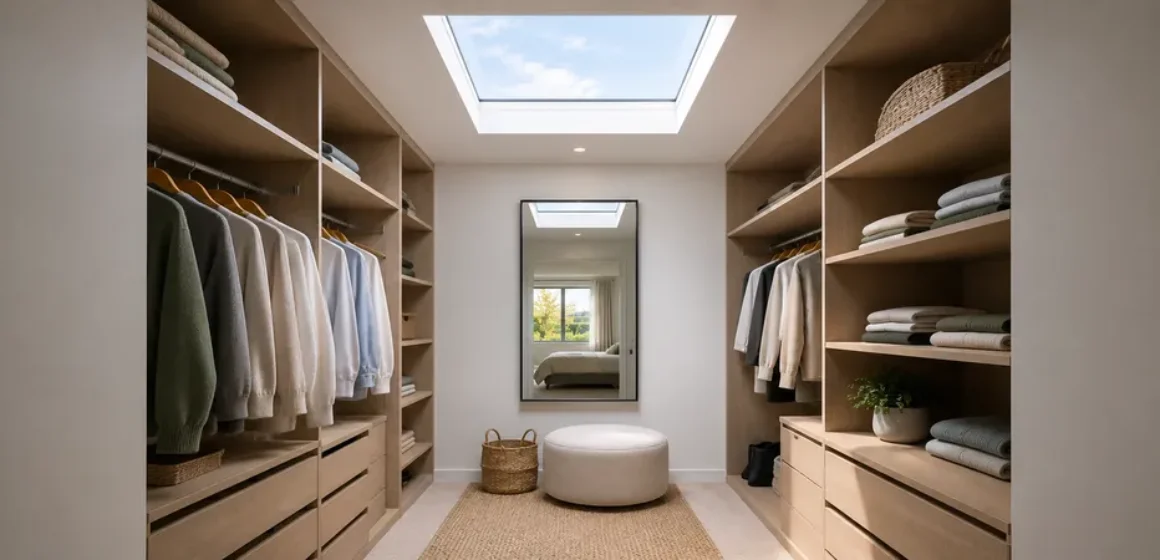
A fixed skylight may suit some walk-in wardrobes, but usually only where the space is larger or designed more like a dressing room.
It may be worth considering when:
- The wardrobe is spacious
- The ceiling height can support a visible skylight
- The homeowner wants a stronger daylight feature
- The wardrobe includes a dressing bench or mirror area
- The space connects strongly with the bedroom or ensuite
- A more open, premium feel is wanted
- The roof and ceiling layout are suitable
- Privacy and light control can be managed
A fixed skylight can create a more noticeable daylight effect than a tubular skylight. In a larger dressing room, that may be appropriate.
However, in many standard walk-in wardrobes, a fixed skylight may be more than the room needs. It may create too much visual impact or bring stronger light than necessary into a space designed for clothing storage.
The decision should be guided by the wardrobe’s size, layout and use.
If the goal is simply to see clothing more clearly during the day, a tubular skylight or Sky tube may be more practical.
Is a vented skylight needed in a wardrobe?
In most walk-in wardrobes, a vented skylight is not the first option.
The room usually needs daylight, not opening ventilation. However, airflow can still be relevant in some situations, especially if the wardrobe feels stale, poorly ventilated or affected by moisture from an adjoining ensuite.
A vented skylight may be discussed only if:
- The wardrobe is large enough to justify it
- Airflow is genuinely a concern
- The roof and ceiling layout are suitable
- The skylight can be operated conveniently
- The room connects to an ensuite or dressing area
- The issue is not better solved by other ventilation methods
For most wardrobes, other ventilation approaches may be more practical than an opening skylight.
It is important to be clear:
A fixed skylight improves daylight but does not provide airflow.
A tubular skylight or Sky tube improves daylight but does not ventilate the room by itself.
A vented skylight may support airflow in suitable conditions, but it should only be considered when airflow is a real need.
In a walk-in wardrobe, daylight and ventilation should be assessed separately.
Clothing, colour and daylight quality
One of the practical benefits of better wardrobe daylight is improved visibility.
Artificial lighting can be useful, but it may not always show colours naturally. Some lights make colours look warmer, cooler or flatter than they appear in daylight. Dark clothes can blend together. Navy, black, charcoal and deep green can be difficult to distinguish in a dim wardrobe.
Natural daylight can help make the space feel clearer.
This may be useful when:
- Choosing clothing in the morning
- Matching colours
- Sorting laundry
- Organising shelves
- Checking shoes or accessories
- Using a dressing mirror
- Keeping storage areas tidy
- Seeing into lower drawers or darker corners
The goal is not showroom lighting.
The goal is practical daylight that helps the wardrobe function better.
A tubular skylight or Sky tube can often provide enough diffused light to support this without making the space too bright.
Placement matters more than size
In a walk-in wardrobe, placement is usually more important than size.
A daylight point should support how the wardrobe is used.
Consider:
- Where the hanging rails are
- Where shelves are placed
- Whether there are drawers
- Whether there is a mirror
- Where the person stands while dressing
- Whether the wardrobe is narrow or square
- Whether the entrance is dark
- Whether the diffuser should sit centrally
- Whether light should fall near a dressing bench
- Whether existing ceiling lights or vents are in the way
A diffuser placed in the wrong location may brighten the entrance but leave the storage area dull. A skylight placed without considering shelving may not support the actual dressing zone.
For narrow wardrobes, a central diffuser may work well. For longer wardrobes, placement may need more care. For larger dressing rooms, more than one daylight point or a different product may be worth discussing.
The goal is not just to bring daylight into the room.
The goal is to bring daylight where it helps.
Walk-in wardrobes beside ensuites
Many walk-in wardrobes sit between the bedroom and ensuite.
This arrangement is practical, but it can create daylight and ventilation questions.
The wardrobe may receive no window light. The ensuite may have privacy-limited daylight. Moisture from the ensuite may also affect how the wardrobe feels if airflow is poor or the layout is tight.
A tubular skylight or Sky tube may help the wardrobe feel brighter during the day, but it does not solve ensuite moisture or airflow issues.
If the wardrobe is beside an ensuite, consider:
- Is the wardrobe itself dark?
- Is the ensuite also dark?
- Is moisture or steam entering the wardrobe area?
- Is there adequate extraction in the ensuite?
- Does the wardrobe feel stale?
- Are clothes stored near damp-prone areas?
- Would ventilation need separate attention?
- Would daylight in the wardrobe or ensuite be more useful first?
Sometimes the wardrobe needs daylight. Sometimes the ensuite needs daylight and ventilation review. Sometimes both rooms need separate consideration.
The rooms are connected, but they may not need the same product.
Walk-in wardrobes in main bedrooms
Main bedroom wardrobes often carry higher expectations than storage wardrobes.
They may be used daily, include better cabinetry, mirrors, shoe storage, drawers and dressing areas. If the space lacks daylight, it can feel less comfortable than the rest of the bedroom suite.
A skylight or tubular skylight may be worth considering if:
- The wardrobe is used daily
- The bedroom itself has limited daylight
- The wardrobe feels darker than the rest of the room
- The space has quality storage but poor visibility
- A mirror or dressing area needs better natural light
- The room is being renovated
- The roof and ceiling layout are suitable
A tubular skylight or Sky tube may suit many main bedroom wardrobes because it can provide practical brightness without the larger visual presence of a fixed skylight.
For larger dressing rooms, a fixed skylight may be considered if the homeowner wants a more open feel.
The decision should match the room’s scale.
Wardrobes in children’s rooms and spare rooms
Not all walk-in wardrobes are attached to main bedrooms.
Some children’s bedrooms, guest rooms and spare rooms also include robe spaces or small walk-in storage areas. These may be used for clothing, toys, linen, luggage, sports gear or household storage.
A skylight may not always be needed, but daylight can be useful if the wardrobe is used often and feels dark during the day.
A tubular skylight or Sky tube may suit:
- Small robe rooms
- Internal storage wardrobes
- Guest-room wardrobes
- Children’s storage spaces
- Linen or multi-purpose storage areas
- Rooms where a full skylight would be unnecessary
In these cases, the goal is practical access rather than a premium dressing-room effect.
If the wardrobe is rarely used, better artificial lighting may be enough. If it is used daily and feels enclosed, overhead daylight may be worth assessing.
A good recommendation should match the frequency of use.
Privacy in dressing spaces
Walk-in wardrobes are private spaces.
That is one reason they often do not have windows. A wall window may create privacy concerns, especially if it faces a neighbour, side boundary, driveway, street or deck.
Overhead daylight can be useful because it may improve brightness without relying on a wall-facing window.
However, privacy should still be considered.
Important factors include:
- Roof pitch
- Nearby two-storey homes
- Upper-level neighbouring windows
- Hillside or sloped sites
- Skylight or diffuser type
- Glazing
- Blind options, where relevant
- Mirror placement
- Whether the room is used for dressing
A tubular skylight or Sky tube may be attractive in wardrobe spaces because the internal diffuser usually provides daylight without creating the same sense of exposure as a larger skylight opening.
In many walk-in wardrobes, privacy and subtlety matter just as much as brightness.
Will daylight affect clothing?
Some homeowners may wonder whether adding daylight to a wardrobe could affect clothing.
This is a sensible question.
A walk-in wardrobe usually needs practical daylight, not strong direct sun. Harsh or prolonged direct sunlight on clothing may not be ideal, especially for delicate fabrics, darker garments or items stored in exposed positions.
This is one reason a tubular skylight or Sky tube may suit many wardrobes. The daylight is typically diffused through a ceiling diffuser, rather than acting like a large direct window.
However, product selection and placement still matter.
Consider:
- Whether light falls directly onto hanging clothes
- Whether the room needs diffused daylight rather than strong light
- Whether a full skylight would be too much
- Whether blinds or light control are needed in a larger dressing room
- How often the wardrobe is used
- Whether valuable or delicate items are stored openly
The aim is to improve visibility without overexposing the space.
A wardrobe needs enough daylight to function well, not excessive brightness.
Mirrors and dressing areas
Mirrors can make wardrobe skylight planning more sensitive.
A mirror may reflect light in useful ways, but it may also create glare or uncomfortable brightness if the daylight source is poorly placed.
Before choosing a diffuser or skylight location, consider:
- Where the mirror is positioned
- Where the person stands
- Whether the mirror faces the skylight or diffuser
- Whether light will fall evenly
- Whether the room has glossy cabinetry
- Whether artificial lighting is also needed
- Whether shadows will affect dressing or grooming
A tubular skylight may provide softer daylight that works well with mirrors in some wardrobes. A fixed skylight may suit a larger dressing area, but glare and privacy should be considered carefully.
Good wardrobe lighting is about balance.
A mirror should help the room, not turn the daylight source into a glare problem.
Artificial lighting still matters
A wardrobe skylight does not replace artificial lighting.
It supports daytime use. The wardrobe will still need lighting for early mornings, evenings, dark weather and night use.
A good wardrobe lighting setup may include:
- Natural daylight from a tubular skylight, Sky tube or skylight
- Suitable ceiling lighting
- Task lighting near mirrors, where relevant
- Cabinet lighting in some designs
- Light-coloured internal finishes
- Practical switch placement
- Consideration of shadows from shelves and hanging rails
Daylight and artificial lighting should work together.
A skylight can make the wardrobe feel more natural during the day, but it should not be expected to make the room usable in every condition without electric lighting.
The most practical wardrobes use layered lighting.
Roof and ceiling considerations
A wardrobe skylight still needs proper roof planning.
Even though the room is small, the roof penetration and ceiling placement must be handled correctly.
Important considerations include:
- Roof type
- Roof pitch
- Roof profile
- Flashing requirements
- Roof condition
- Water flow direction
- Nearby valleys, ridges or gutters
- Ceiling cavity depth
- Rafters or trusses
- Wiring
- Plumbing
- Ducting
- Ensuite extraction ducts
- Insulation
- Existing ceiling lights or vents
- Solar panels or roof features
- Access for installation
For tubular skylights and Sky tubes, the tube path from roof to ceiling is especially important. A shorter, straighter path is usually simpler. If bends are needed, they should be assessed.
Wardrobes beside ensuites may have plumbing or ventilation nearby, so the ceiling cavity should not be assumed to be empty.
The room may be small, but the installation still becomes part of the roof system.
Diffuser style and ceiling appearance
The diffuser is the visible part of a tubular skylight inside the wardrobe.
Its appearance should suit the room.
In a walk-in wardrobe, the diffuser should feel clean and practical. It should work with the ceiling light, shelving layout and overall room proportions.
Consider:
- Diffuser size
- Diffuser position
- Ceiling light position
- Symmetry with cabinetry
- Whether the wardrobe is narrow or wide
- Whether the diffuser will clash with a fan, vent or access panel
- Whether the ceiling is flat or sloped
- Whether the room is being renovated
In a simple wardrobe, a central diffuser may be suitable. In a more designed dressing room, placement may need more attention so the ceiling looks intentional.
A good daylight upgrade should not look like an afterthought.
Renovation timing
A wardrobe renovation is a good time to consider daylight.
Many homeowners focus on cabinetry, shelving, drawers, mirrors, handles and finishes. Those choices matter, but daylight can affect how useful the whole space feels.
Early planning can help coordinate:
- Skylight or diffuser placement
- Cabinetry layout
- Hanging rail locations
- Mirror placement
- Ceiling light position
- Electrical work
- Ensuite ventilation
- Painting and internal finishes
- Roof access
- Insulation
- Ceiling repairs or lining
If skylight planning is left too late, the best diffuser position may already be blocked by cabinetry, lighting, ducting or ceiling services.
For Te Awamutu homeowners planning bedroom, ensuite or wardrobe upgrades, daylight should be considered before the final layout is locked in.
It is much easier to plan daylight early than to work around finished cabinetry later.
Walk-in wardrobe daylight and resale perception
A walk-in wardrobe is often seen as a desirable feature.
But if the space feels dark, awkward or closed in, it may not deliver the sense of quality the homeowner expects. Better daylight can help the room feel more finished and usable.
This does not mean a wardrobe skylight should be treated as a guaranteed value increase. That would be too strong a claim.
But it can support the perception of a more considered bedroom suite, especially where the wardrobe is used daily and forms part of a renovation or upgrade.
A well-lit wardrobe can feel:
- More practical
- More complete
- Easier to use
- Less like storage
- Better connected to the bedroom
- More thoughtfully designed
For homeowners already improving a main bedroom or ensuite, daylight in the walk-in wardrobe can be a sensible part of the planning conversation.
When a wardrobe skylight may not be the first answer
A skylight or tubular skylight may not be the best first step in every walk-in wardrobe.
Other options may need review first if:
- The wardrobe is rarely used
- Artificial lighting is poor and easy to improve
- The roof path is blocked
- The ceiling is crowded with services
- The wardrobe is about to be redesigned
- The space is mainly a ventilation issue
- Moisture from the ensuite needs attention first
- Strong daylight may not suit the clothing storage
- The room already has enough natural light
- The roof above is unsuitable
In these cases, better artificial lighting, ventilation review, cabinetry changes, lighter finishes or renovation planning may be more appropriate.
A skylight should solve a real daylight problem.
It should not be added simply because the room is small.
Common mistakes with wardrobe skylights
Choosing a full skylight when a tubular skylight would be enough
Many wardrobes need practical diffused daylight, not a large skylight feature.
Ignoring clothing storage
Daylight should improve visibility without creating unnecessary exposure for garments.
Placing the diffuser away from the dressing zone
The daylight should help where people stand, choose clothes and use mirrors.
Forgetting mirrors
Mirrors can reflect light and create glare if placement is poorly considered.
Ignoring ensuite moisture
A wardrobe beside an ensuite may need ventilation review, not just daylight.
Assuming artificial lighting can be removed
Daylight helps during the day, but the wardrobe still needs electric lighting.
Leaving daylight planning too late
Cabinetry and ceiling services can limit placement if skylight planning is delayed.
Forgetting the roof
A tubular skylight still requires roof suitability, flashing and a practical tube path.
Avoiding these mistakes helps create a more useful and comfortable dressing space.
The Te Awamutu wardrobe daylight test
Before asking for a quote, assess the wardrobe during the day with the light off.
Ask:
- Can you choose clothing comfortably without artificial light?
- Are colours easy to see?
- Does the space feel enclosed?
- Is the wardrobe internal or windowless?
- Is the wardrobe beside an ensuite?
- Is moisture or stale air also a concern?
- Where do you stand when dressing?
- Where is the mirror?
- Is the wardrobe narrow, long or square?
- Would a subtle diffuser be enough?
- Would a full skylight feel too much?
- Is the bedroom or ensuite also dark?
- Is renovation work planned?
This simple test helps clarify whether a tubular skylight, Sky tube, fixed skylight or another solution may be worth considering.
It also helps identify the best location for daylight.
Illustrative example only
A Te Awamutu homeowner has a main bedroom with a walk-in wardrobe between the bedroom and ensuite. The bedroom has reasonable daylight, but the wardrobe has no window and depends entirely on the ceiling light. In winter, the space feels especially enclosed during the morning routine.
The homeowner asks whether a skylight would help.
A tubular skylight or Sky tube may be worth considering because the wardrobe needs practical daylight, not necessarily a full skylight feature. The diffuser position would need to work around shelving, hanging rails, a mirror and the existing ceiling light. The roof path would also need to be reviewed because the wardrobe sits beside ensuite plumbing and ventilation.
If the ensuite is also dark or poorly ventilated, it may need separate assessment.
The wardrobe problem is mainly daylight.
The ensuite problem may be daylight, ventilation or both.
That distinction matters.
What to send when asking for a wardrobe skylight quote
Good photos and context help make the recommendation more accurate.
For a walk-in wardrobe skylight enquiry, send:
- Photos of the wardrobe from several angles
- A photo of the ceiling
- A photo of the wardrobe entrance
- A photo showing shelves, hanging rails and drawers
- A photo of any mirror or dressing area
- A photo showing the connection to the bedroom or ensuite
- Roof photos above or near the wardrobe, if possible
- The approximate wardrobe size
- Whether the wardrobe is beside an ensuite
- Whether moisture or stale air is a concern
- Whether the space is being renovated
- Whether the bedroom or ensuite also feels dark
- Whether you prefer a tubular skylight, Sky tube or fixed skylight option
- The roof type, if known
These details help determine whether a tubular skylight, Sky tube, fixed skylight or another approach may suit the space.
They also help avoid a generic recommendation.
The best wardrobe skylight outcome
The best outcome is not a walk-in wardrobe that feels dramatic.
It is a wardrobe that feels easier to use.
A good result may mean:
- Clothing is easier to see during the day
- The space feels less enclosed
- The wardrobe feels better connected to the bedroom
- The ceiling diffuser looks intentional
- The mirror area works more naturally
- Artificial lighting is needed less during daylight hours
- Privacy is maintained
- Ensuite ventilation is considered separately where relevant
- The product suits the roof and room together
- The dressing space feels more complete
A walk-in wardrobe is a practical room, but it is used during personal daily routines.
If it feels dark every day, overhead daylight may be worth exploring.
Planning your next step
If a walk-in wardrobe in your Te Awamutu home feels dark, enclosed or overly dependent on artificial lighting during the day, it may be worth considering whether overhead daylight could help.
A tubular skylight or Sky tube may suit many walk-in wardrobes because these spaces usually need soft, practical daylight rather than a large skylight feature. A fixed skylight may suit larger dressing rooms where stronger daylight is wanted. A vented skylight is usually only worth discussing where airflow is also a genuine concern.
Skylights NZ can help you review which option may suit your walk-in wardrobe, roof type, ceiling layout and desired outcome.
To start planning your options, use the Skylights NZ enquiry form:
https://inquiry.skylights.co.nz/inquiry
You may also find these useful:
- Skylight installation services
- Request a skylight quote
- Skylight options for NZ homes
- Tubular Skylights for Waikato Hallways, Toilets and Walk-in Wardrobes
- Bedroom Skylights in Hamilton Homes: Daylight, Privacy and Light Control
- Skylights for South-Facing Rooms in Waikato Homes
- The 3pm Winter Test: Is Your Waikato Room Asking for Better Daylight?
FAQs
Is a skylight a good idea for a walk-in wardrobe?
A skylight may be a good idea for a walk-in wardrobe if the space lacks useful daylight and has a suitable roof and ceiling layout. In many wardrobes, a tubular skylight or Sky tube may be more practical than a full fixed skylight.
What type of skylight is best for a walk-in wardrobe?
A tubular skylight or Sky tube often suits walk-in wardrobes because it provides soft, practical daylight through a ceiling diffuser. A fixed skylight may suit larger dressing rooms where a stronger daylight feature is wanted.
Does a tubular skylight ventilate a wardrobe?
No. A tubular skylight or Sky tube brings daylight into the wardrobe but does not provide airflow by itself. If the wardrobe feels stale or is affected by moisture from an ensuite, ventilation should be assessed separately.
Will daylight damage clothes in a walk-in wardrobe?
A wardrobe usually needs practical diffused daylight, not strong direct sunlight. A tubular skylight or Sky tube may be suitable because it typically provides softer daylight through a diffuser. Placement should still consider where clothing is stored.
Where should a wardrobe skylight diffuser be placed?
The diffuser should be placed where daylight helps the wardrobe function best. This may be near the standing area, mirror, shelves or darker storage zone. Placement should also consider ceiling lights, vents, shelving and the roof path above.
What should I send for a walk-in wardrobe skylight quote?
Send photos of the wardrobe, ceiling, shelves, hanging rails, mirror area, entrance, and roof above or near the space if possible. Include the wardrobe size, whether it is beside an ensuite, whether moisture is a concern and whether renovation work is planned.