Pantry and Scullery Skylights in Matamata Homes: When Kitchen Support Spaces Need Light
A pantry or scullery can make a kitchen work beautifully, but only if the space itself is easy to use.
In many Matamata homes, these support spaces sit behind or beside the main kitchen. They may be compact, internal and highly practical. They may hold food storage, small appliances, preparation benches, a second sink, dishes, cleaning items, school lunch supplies, baking equipment or everyday household overflow.
But because they are often tucked behind the main kitchen, they can also be dark.
The main kitchen may receive daylight from windows, ranch sliders or open-plan living areas, while the pantry or scullery relies entirely on artificial lighting. Every time someone enters, the light goes on. Shelves feel shadowed. Items at the back are harder to see. A scullery bench may feel dull. In winter, the space can feel even more enclosed because the wider kitchen and living areas receive weaker natural light.
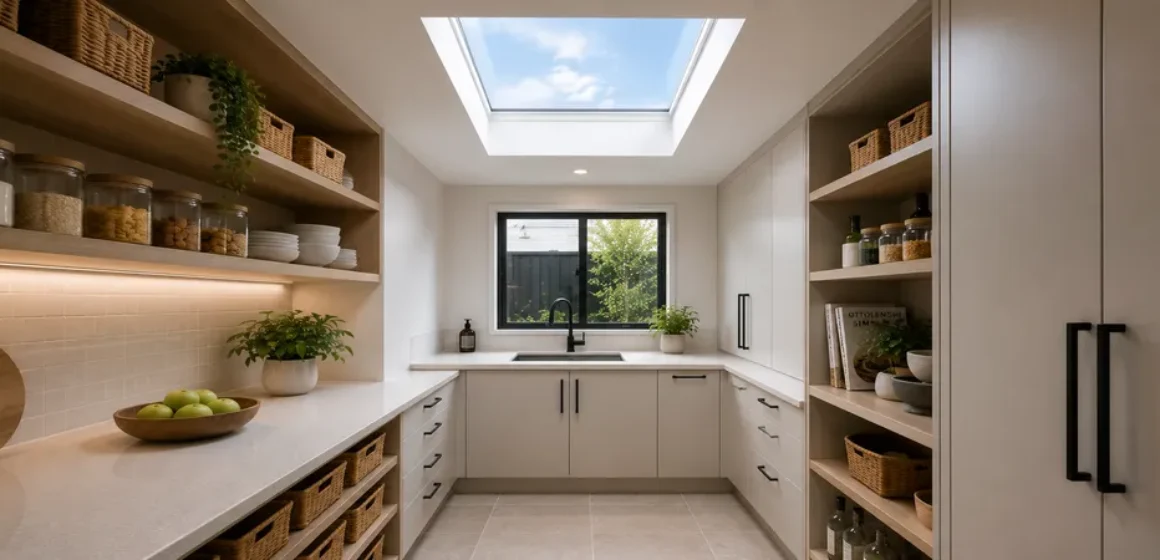
For homeowners considering a pantry skylight Matamata or scullery skylight Matamata solution, the goal is not to create a dramatic design feature.
The goal is more practical:
Make the kitchen support space easier to use during the day without overcomplicating the room.
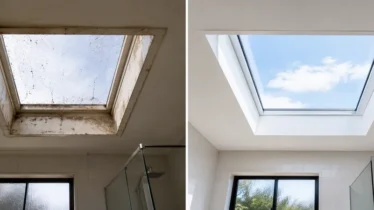
A tubular skylight or Sky tube may suit many pantries and sculleries because these spaces usually need practical daylight rather than a large visible skylight. A fixed skylight may suit larger sculleries where stronger daylight is wanted. A vented skylight may be considered only where airflow is genuinely part of the issue, but daylight and ventilation should still be treated separately.
This guide explains how to think clearly about skylights for pantries and sculleries in Matamata homes before making an enquiry.
Why pantries and sculleries are often dark
Pantries and sculleries are usually planned around function first.
That makes sense. Their job is to support the kitchen. They need shelving, storage, bench space, appliances, sinks, power points, easy access and good organisation. Natural light is often treated as secondary.
The result is that many pantries and sculleries have:
- No windows
- Small or borrowed daylight only
- Deep shelves that cast shadows
- Artificial lighting used every time
- A narrow or enclosed layout
- A location behind the kitchen
- Limited ceiling space
- Dark corners around storage
- Poor visibility on lower shelves
- A practical but closed-in feeling
This can become frustrating because these rooms are used more often than people realise.
A walk-in pantry may be entered many times a day. A scullery may be used for food preparation, cleaning, appliance storage, baking, dishes and entertaining overflow. If the room is dark, that daily use becomes less comfortable.
A skylight, tubular skylight or Sky tube may be worth considering where the space lacks useful daylight and the roof or ceiling layout allows a suitable option.
Matamata kitchens and support-space layouts
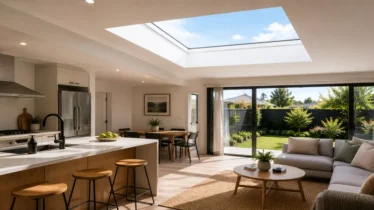
Matamata homes include a mix of older homes, family homes, renovated properties, newer builds and lifestyle properties. Kitchen layouts vary, but many homes share a common pattern: the main kitchen receives the best daylight, while the pantry or scullery sits deeper inside the floor plan.
This can happen in:
- Renovated kitchens with added walk-in pantries
- Open-plan homes with a hidden scullery
- Family homes with large storage needs
- Lifestyle homes with larger kitchens
- Compact homes where the pantry sits internally
- Older homes where storage spaces were adapted over time
- Newer homes where the scullery sits behind the main kitchen wall
The issue is often not the main kitchen.
The kitchen itself may feel bright enough. The problem is the support space that makes the kitchen work.
A pantry or scullery should not feel like a cupboard that needs a light switch every time. If it is used daily, it deserves practical daylight planning.
The winter daylight problem
Winter often makes internal kitchen support spaces feel more enclosed.
During June, July and August, natural daylight is weaker and shorter. The kitchen may still receive some light, but the pantry or scullery behind it may receive almost none. If the home is closed up, lights are used earlier, and neighbouring rooms are duller, these small spaces can feel even more dependent on artificial lighting.
Common winter signs include:
- The pantry light is used every time
- Shelves feel shadowed even during the day
- The scullery bench feels dull
- Stored items are harder to find
- The room feels like a cupboard rather than part of the kitchen
- The support space feels disconnected from the main kitchen
- The kitchen feels bright, but the pantry or scullery does not
- Dark cabinetry or shelving makes the issue worse
- The space feels worse in winter than summer
A daylight solution does not need to be large to improve this kind of room.
It simply needs to provide useful brightness where the space is actually used.
Why a tubular skylight or Sky tube often makes sense
A tubular skylight or Sky tube is often a strong option for pantries and sculleries.
These spaces usually do not need a full skylight opening or a view of the sky. They need practical daylight delivered into a compact internal room.
A tubular skylight works by bringing daylight from the roof through a reflective tube and delivering it through a ceiling diffuser.
This can suit a pantry or scullery where:
- The space has no window
- The room sits behind the main kitchen
- The light is used during the day
- The ceiling and roof path are suitable
- A full skylight would feel too large
- A subtle daylight source is preferred
- The goal is better visibility, not a major design feature
- The room is compact or narrow
A tubular skylight or Sky tube can help make shelving, benches and storage areas easier to use during daylight hours.
It can also help the pantry or scullery feel more connected to the kitchen, rather than feeling like a separate dark service space.
However, it still needs proper assessment. Roof type, roof pitch, tube path, bends, ceiling position, obstructions and diffuser placement all matter.
When a fixed skylight may suit a scullery
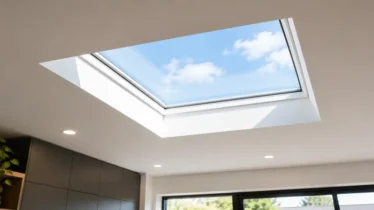
A fixed skylight may be worth considering in a larger scullery or kitchen support room.
This may apply where the scullery includes:
- A preparation bench
- A second sink
- Appliance storage
- Dishwashing space
- Baking area
- Open shelving
- A larger floor area
- Strong connection to the main kitchen
- A more designed or premium finish
In this type of space, a fixed skylight may provide a stronger daylight effect and make the scullery feel more like an extension of the kitchen.
A fixed skylight may be worth discussing when:
- The room is large enough to suit it
- Stronger natural daylight is wanted
- The roof and ceiling layout are suitable
- The skylight can be placed over a useful work zone
- Glare and light control can be managed
- Ventilation is handled separately where needed
However, many pantries and sculleries are compact. In those cases, a fixed skylight may be more than the room needs.
The question should be:
Does this space need a visible skylight, or does it simply need useful daylight?
In many cases, useful daylight is the more sensible goal.
Is a vented skylight needed in a pantry or scullery?
A vented skylight is not usually the first option for a pantry.
Most pantries need daylight, organisation and suitable artificial lighting. They do not usually need an opening skylight.
A scullery may be different if it includes a sink, dishwasher, food preparation, heat-producing appliances or poor airflow. Even then, a vented skylight should only be considered if airflow is genuinely part of the issue and the skylight can be operated conveniently.
A vented skylight may be worth discussing if:
- The scullery feels stuffy
- Warm air gathers near the ceiling
- The room has limited airflow
- The roof and ceiling layout are suitable
- The skylight can be operated practically
- The issue is not better solved by extraction or other ventilation
It is important to keep the distinction clear:
A fixed skylight improves daylight but does not provide airflow.
A tubular skylight or Sky tube improves daylight but does not ventilate the room by itself.
A vented skylight may support airflow in suitable conditions, but it should not replace appropriate kitchen ventilation where cooking, steam or appliances are involved.
For pantries and sculleries, daylight and ventilation should be assessed separately.
Pantry daylight: where should it land?
A pantry does not need general brightness only. It needs daylight where people actually look and reach.
In a pantry, daylight may need to support:
- Shelving
- Food storage
- Lower drawers
- Appliance shelves
- Bulk storage
- The entry area
- A small bench
- The darkest back wall
- Labels and packaging
- Everyday access
Diffuser placement matters.
If a tubular skylight diffuser is placed too close to the door, it may brighten the entrance but leave the rear shelves shadowed. If it is placed too far back, the entry may still feel dark. In a narrow pantry, central placement may work well. In a longer pantry, the ideal location may need more careful thought.
A walk-in pantry is a task space.
The daylight should support the task.
Scullery daylight: where should it land?
A scullery usually needs daylight differently from a pantry.
A scullery may include benches, a sink, storage, appliances and cleaning areas. It may be used for preparation, washing dishes, hiding mess during entertaining, or keeping the main kitchen clear.
In a scullery, daylight may need to support:
- The bench
- The sink
- Appliance storage
- Dishwashing area
- Open shelves
- Food preparation
- Cleaning tasks
- The transition from the main kitchen
- The back wall or darkest corner
A fixed skylight may be useful in larger sculleries where daylight over a bench or sink would improve daily use. A tubular skylight or Sky tube may be enough where the scullery is compact and mainly needs practical brightness.
The best scullery skylight is not necessarily the largest.
It is the one that makes the working part of the room easier to use.
Hidden sculleries and open-plan homes
Many modern kitchens use hidden sculleries.
These are designed to keep the main kitchen clean and open while the support work happens behind the scenes. That can be very practical, but it can also make the scullery darker because the space is tucked behind joinery or walls.
A hidden scullery may benefit from overhead daylight if:
- It has no window
- It feels dark when the main kitchen is bright
- It is used frequently
- It contains a sink or bench
- It feels closed in during winter
- The ceiling and roof path are suitable
- A subtle diffuser would suit the design
In these spaces, a tubular skylight or Sky tube may help without disrupting the clean look of the main kitchen.
For larger sculleries, a fixed skylight may also be considered if the homeowner wants a stronger daylight effect.
The goal is to make the hidden space work better, not to compete with the main kitchen.
Walk-in pantries in family homes
Family homes often rely heavily on the pantry.
It may hold lunchbox supplies, cereal, baking goods, snacks, pet food, cleaning items, bulk storage and small appliances. If the pantry is dark, it can become disorganised quickly because items are harder to see and reach.
A tubular skylight or Sky tube may suit a family pantry where:
- The space is used many times a day
- Shelves feel shadowed
- The pantry has no useful window
- Artificial lighting is always needed
- The room is internal
- The ceiling and roof path are suitable
- A full skylight would be unnecessary
A pantry skylight should support everyday use.
It should make the room feel clearer, not overly bright.
Good daylight can help a pantry feel less like storage and more like a useful part of the kitchen.
Pantries and sculleries in lifestyle homes
Matamata and surrounding areas include lifestyle properties where kitchens may be larger and support spaces more substantial.
A large pantry or scullery may function almost like a second kitchen area. It may be used for preserving, baking, storing bulk goods, preparing food from the garden, washing produce or managing household supplies.
In these homes, the daylight need may be stronger than in a compact suburban pantry.
A fixed skylight may be worth considering for a larger scullery where a workbench or sink needs better daylight. A tubular skylight or Sky tube may still suit pantry storage zones or smaller internal areas.
Consider:
- How often the space is used
- Whether it includes a working bench
- Whether food preparation happens there
- Whether the roof area above is suitable
- Whether multiple daylight points may be needed
- Whether airflow is also relevant
- Whether the space connects to a mudroom, laundry or garage
The larger the support space, the more important it is to plan daylight around actual use.
Pantry and scullery skylights during renovations
A kitchen renovation is one of the best times to consider daylight in a pantry or scullery.
Once cabinetry, shelving, appliances, lighting, ducting and ceiling services are fixed, skylight placement may become harder.
Early planning can help coordinate:
- Skylight or diffuser location
- Shelving layout
- Bench position
- Sink position
- Lighting
- Power points
- Appliance storage
- Extraction or ventilation
- Ceiling access
- Roof access
- Internal finishing
- Painting and cabinetry details
If a tubular skylight is being considered, the diffuser should work with the final shelf and ceiling layout. If a fixed skylight is being considered, the opening should support the work zone without creating glare or awkward finishing.
For Matamata homeowners planning a kitchen upgrade, pantry or scullery daylight should be considered before the final layout is locked in.
The best daylight decisions are usually made early.
Artificial lighting still matters
A pantry or scullery skylight does not remove the need for artificial lighting.
These spaces are often used early in the morning, at night, during bad weather and outside strong daylight hours. Good electric lighting is still important.
A practical pantry or scullery may need:
- Natural daylight from a tubular skylight, Sky tube or skylight
- Ceiling lighting
- Task lighting above benches
- Cabinet lighting in some layouts
- Good switch placement
- Light-coloured internal finishes
- Clear shelving visibility
- Ventilation where needed
Daylight and artificial lighting should work together.
A skylight can improve daytime use, but it should not be expected to replace all lighting.
This is especially important in a kitchen support space where tasks are practical and frequent.
Glare and reflective surfaces
Pantries and sculleries may include reflective surfaces, especially in renovated homes.
These may include:
- Stone benchtops
- Stainless appliances
- Gloss cabinetry
- Glass splashbacks
- Polished tiles
- White shelving
- Mirrors or glossy panels
- Sink areas
A skylight placed without considering these surfaces may create glare or uncomfortable reflections.
This is usually less of a concern with a tubular skylight or Sky tube because the daylight is diffused, but placement still matters.
A fixed skylight in a larger scullery should be planned carefully around benches, sinks and appliances.
The goal is practical visibility.
It should not create harsh brightness in a compact working space.
Moisture, sinks and appliances
Some sculleries include sinks, dishwashers or appliances that produce heat or moisture.
This does not mean the space automatically needs a vented skylight. It does mean ventilation should be considered separately from daylight.
Moisture or airflow concerns may relate to:
- Dishwashers
- Sinks
- Small appliances
- Poor air movement
- Lack of extraction
- Closed-off layout
- Connection to the main kitchen
- How often the space is used
- Whether doors are kept closed
A tubular skylight or fixed skylight can improve daylight, but it will not ventilate the room. A vented skylight may support airflow in suitable situations, but other ventilation methods may be more practical depending on the space.
The safe approach is to identify whether the problem is daylight, airflow, moisture, or a combination.
Then choose the solution accordingly.
Roof and ceiling considerations
A pantry or scullery skylight must work with the roof and ceiling.
Important considerations include:
- Roof type
- Roof pitch
- Roof profile
- Flashing requirements
- Roof condition
- Water flow direction
- Nearby valleys, ridges or gutters
- Existing roof penetrations
- Solar panels
- Ceiling cavity depth
- Rafters or trusses
- Wiring
- Plumbing
- Ducting
- Rangehood paths
- Insulation
- Ceiling lights
- Smoke alarms or sensors
- Internal finishing requirements
For tubular skylights and Sky tubes, the tube path from roof to ceiling is important. A shorter and straighter tube path is usually simpler. If bends are needed, they should be assessed.
For fixed skylights, roof opening, framing, flashing and internal lining need careful planning.
Because pantries and sculleries often sit near kitchens, there may be more services in the ceiling and roof space than expected.
A room may be small, but the installation still requires proper roof consideration.
When a pantry or scullery skylight may not be the first answer
A skylight may not be the right first step in every pantry or scullery.
Other improvements may be better if:
- The space is rarely used
- Artificial lighting is poor and easy to improve
- The roof path is blocked
- The ceiling is crowded with services
- The layout is about to change
- The room already has enough daylight
- Dark shelving or finishes are the main issue
- Ventilation is more important than daylight
- The roof above is unsuitable
- A skylight would create glare or too much light
- The homeowner expects daylight to solve moisture concerns
In some cases, better task lighting, lighter finishes, shelf redesign or ventilation improvements may be the first step.
In other cases, overhead daylight may be exactly what the space needs.
The right answer depends on the room’s actual problem.
Common mistakes with pantry and scullery skylights
Treating the pantry like a hallway
A pantry needs daylight where shelves and storage are used, not just general brightness.
Choosing a full skylight when a tubular skylight would be enough
Many pantries need diffused practical daylight, not a large skylight feature.
Ignoring the scullery work zone
A scullery may need daylight over the bench, sink or appliances.
Forgetting artificial lighting
Daylight helps during the day, but pantries and sculleries still need lights.
Ignoring ceiling services
Kitchen areas often have wiring, ducting, plumbing and rangehood paths nearby.
Confusing daylight with ventilation
A tubular skylight or fixed skylight does not ventilate the room.
Leaving skylight planning too late in a kitchen renovation
Cabinetry and lighting plans can limit the best diffuser or skylight position.
Over-lighting a small room
Compact spaces usually need practical brightness, not excessive light.
Avoiding these mistakes helps create a support space that is easier to use and better integrated with the kitchen.
The Matamata pantry daylight test
Before asking for a quote, assess the pantry or scullery during the day with the light off.
Ask:
- Can you use the space comfortably without artificial light?
- Are shelves and lower storage areas easy to see?
- Does the room feel like a cupboard?
- Is the scullery bench or sink area dull?
- Does the main kitchen feel brighter than the support space?
- Is the space worse in winter?
- Would a subtle diffuser be enough?
- Would a full skylight feel too much?
- Is airflow or moisture also a concern?
- Is the kitchen being renovated?
- Is there roof space above or nearby?
- Are there lights, ducts, vents or services in the ceiling?
This simple test helps clarify whether a tubular skylight, Sky tube, fixed skylight or another improvement may be worth considering.
It also helps identify where daylight should land.
Illustrative example only
A Matamata homeowner has a renovated open-plan kitchen with a walk-in pantry behind the main cabinetry. The kitchen receives reasonable daylight from the dining area, but the pantry has no window and always needs the light on. In winter, the pantry feels especially closed in, and items at the back of the shelves are harder to see.
The homeowner asks whether a skylight could help.
A tubular skylight or Sky tube may be worth considering because the pantry mainly needs practical daylight, not a large skylight feature. The diffuser would need to be placed where it helps the shelves and entry area, not simply where the ceiling looks empty. The roof path would also need to be reviewed because the pantry sits near kitchen wiring, ducting and cabinetry.
If the support space were a larger scullery with a bench and sink, a fixed skylight may also be assessed.
The correct option depends on how the space is used.
What to send when asking for a pantry or scullery skylight quote
Good information helps shape a better recommendation.
For a pantry or scullery skylight enquiry, send:
- Photos of the pantry or scullery from several angles
- A photo of the ceiling
- A photo of the entry from the main kitchen
- Photos of shelves, benches, sink areas or appliances
- A photo of the darkest section
- A photo of any existing lighting or ceiling fittings
- Roof photos above or near the space, if possible
- The approximate room size
- Whether the space is a pantry, scullery or combined support room
- Whether the room has a sink or appliances
- Whether moisture or airflow is a concern
- Whether the kitchen is being renovated
- Whether you prefer a tubular skylight, Sky tube or fixed skylight option
- The roof type, if known
- The time of day the room feels darkest
These details help determine whether a tubular skylight, Sky tube, fixed skylight or another solution may suit the space.
They also help avoid generic advice.
The best pantry or scullery skylight outcome
The best result is not a pantry or scullery that feels dramatic.
It is a support space that works better.
A good outcome may mean:
- Shelves are easier to see during the day
- The scullery bench feels more usable
- The space feels less enclosed
- The pantry feels better connected to the kitchen
- Artificial lighting is needed less during daylight hours
- The diffuser or skylight placement feels intentional
- Moisture and ventilation are considered separately where relevant
- The product suits the ceiling and roof structure
- The kitchen support space feels more complete
A pantry or scullery may sit behind the main kitchen, but it still affects how the kitchen works.
If it is used every day, it deserves practical daylight planning.
Planning your next step
If a pantry or scullery in your Matamata home feels dark, enclosed or overly dependent on artificial lighting during the day, it may be worth considering whether overhead daylight could help.
A tubular skylight or Sky tube may suit many pantries and compact sculleries because these spaces usually need soft, practical daylight rather than a large skylight feature. A fixed skylight may suit larger sculleries where stronger daylight is wanted over a bench, sink or working area. A vented skylight is usually only worth discussing where airflow is also a genuine concern.
Skylights NZ can help you review which option may suit your pantry or scullery, roof type, ceiling layout and desired outcome.
To start planning your options, use the Skylights NZ enquiry form:
https://inquiry.skylights.co.nz/inquiry
You may also find these useful:
- Skylight installation services
- Request a skylight quote
- Skylight options for NZ homes
- Kitchen Skylights in Hamilton Homes: Where Daylight Should Actually Land
- Tubular Skylights for Waikato Hallways, Toilets and Walk-in Wardrobes
- The 3pm Winter Test: Is Your Waikato Room Asking for Better Daylight?
- Fixed or Vented Skylight for a Waikato Home: How to Choose Room by Room
FAQs
Is a skylight a good idea for a pantry in Matamata?
A skylight may be a good idea for a pantry if the space lacks useful daylight and has a suitable roof and ceiling layout. In many pantries, a tubular skylight or Sky tube may be more practical than a full fixed skylight.
What type of skylight is best for a pantry?
A tubular skylight or Sky tube often suits pantries because it provides soft, practical daylight through a ceiling diffuser. A fixed skylight may suit larger sculleries or support rooms where stronger daylight is wanted.
Can a tubular skylight work in a scullery?
Yes, a tubular skylight or Sky tube may suit a compact scullery where practical daylight is needed. Larger sculleries with benches, sinks or preparation areas may also be assessed for fixed skylights depending on room size and roof suitability.
Does a pantry skylight provide ventilation?
A tubular skylight, Sky tube or fixed skylight does not provide ventilation by itself. If airflow, moisture or appliance heat is a concern, ventilation should be assessed separately. A vented skylight may be considered only where airflow is a genuine need.
Where should a pantry skylight diffuser be placed?
The diffuser should be placed where daylight helps the pantry function best. This may be near shelves, lower storage, the entry, a small bench or the darkest back section. Placement should also consider ceiling lights, cabinetry and roof path.
What should I send for a pantry or scullery skylight quote?
Send photos of the pantry or scullery, ceiling, shelving, benches, sink areas, darkest section and roof above or near the space if possible. Include the room size, roof type if known, whether ventilation is a concern and whether renovation work is planned.