Skylights for Low-Pitch Roofs in Waikato Homes: What Needs Careful Assessment
A low-pitch roof does not automatically rule out a skylight.
But it does mean the project needs careful assessment before anyone gives a confident answer.
Some Waikato homes have lower-pitch roof sections over extensions, garages, laundries, porches, lean-to areas, sleepouts, covered entries, modern additions, bathrooms or open-plan living spaces. These roof areas can sometimes be useful places for daylight, but they also need more attention because water moves differently across a low-pitch roof.
For homeowners searching for a low pitch roof skylight Waikato solution, the key question is not simply:
Can a skylight be installed?
The better question is:
Can the right skylight be installed in the right place, with the right flashing, on a roof pitch that suits the product and manages water properly?
Low-pitch skylight projects are less forgiving than straightforward pitched roof installations. Roof profile, product requirements, flashing, water flow, roof condition, ceiling structure, access and internal finishing all need to be reviewed.
This guide explains what Waikato homeowners should know before planning a skylight, tubular skylight or Sky tube on a low-pitch roof.
What is a low-pitch roof?
A low-pitch roof is a roof with a gentler slope.
From the ground, it may look almost flat, or it may simply have less fall than the main roof of the home. Some low-pitch sections are obvious. Others are not clear until viewed from the side or from roof level.
Low-pitch roof areas may be found over:
- Extensions
- Additions
- Garages
- Carports
- Laundries
- Bathrooms
- Entry porches
- Lean-to roof sections
- Sleepouts
- Utility rooms
- Modern open-plan additions
- Covered walkways
- Outdoor living connections
The issue with low pitch is water movement.
A steeper roof helps water move away more quickly. A lower-pitch roof may need more careful design because water may move more slowly, collect around obstructions, or be more affected by wind-driven rain, debris, roof profile and flashing details.
That is why roof pitch matters when planning a skylight.
Why low-pitch skylights need more care
A skylight becomes part of the roof system.
On a low-pitch roof, the roof has less slope to help water move away quickly. This makes product suitability, flashing and placement more important.
A low-pitch skylight project may need closer assessment because of:
- Slower water movement
- Greater sensitivity to flashing detail
- Higher reliance on correct product selection
- Roof profile limitations
- Nearby gutters, valleys or changes in roof plane
- Water ponding risks
- Debris build-up
- Wind-driven rain exposure
- Existing roof condition
- Difficulty using some standard skylight options
- Internal finishing complications
This does not mean every low-pitch roof is unsuitable.
It means assumptions are risky.
A skylight that works well on a steeper roof may not be the right product or placement for a low-pitch section.
Product suitability comes first
Not every skylight product is suitable for every roof pitch.
Some products have minimum pitch requirements. Some flashing systems are designed for certain roof types and slope ranges. Some tubular skylight or Sky tube options may have roof flashing requirements that need to be checked against the actual roof.
This is why product suitability must be confirmed before quoting.
For a low-pitch roof, the recommendation may need to consider:
- Product minimum pitch requirements
- Roof material
- Roof profile
- Flashing compatibility
- Roof condition
- Water flow
- Whether the skylight should be fixed, vented or tubular
- Whether a raised curb or specific flashing approach is required
- Whether the preferred internal location is realistic
The homeowner may want a particular product, but the roof may require a different answer.
A suitable product is not just the one that looks good in the room. It must also work properly with the roof.
Roof profile matters on low-pitch roofs
Roof profile is especially important on low-pitch roofs.
Waikato homes may have metal roofing, corrugated roofing, long-run roofing, tray-style profiles, concrete tiles, terracotta tiles or older roof materials. On lower slopes, the way the roof profile manages water becomes more important.
Roof profile can affect:
- Flashing selection
- Product compatibility
- Water flow around the skylight
- Risk of water slowing near the installation
- Whether the preferred placement is suitable
- Labour and detailing requirements
- Whether further roofing work may be needed
For example, a low-pitch metal roof section may need a different review from a standard pitched tile roof. A low-pitch extension may need a different approach from the main house roof.
This is why roof photos are essential.
A room photo shows why daylight is wanted. A roof photo helps show whether the roof can support the preferred solution.
Flashing is critical on low-pitch roofs
Flashing is always important, but on low-pitch roofs it becomes even more critical.
Flashing helps manage water where the skylight meets the roof. On a low-pitch roof, there is less slope to help water move quickly past the skylight. That means the flashing needs to be suited to the roof type, roof pitch and product.
Flashing assessment may include:
- Roof profile
- Roof pitch
- Skylight size
- Product type
- Water flow direction
- Nearby gutters or valleys
- Roof sheet length
- Existing penetrations
- Roof condition
- Whether debris may collect nearby
- Whether the skylight position needs adjustment
Poor flashing decisions can create problems.
A skylight on a low-pitch roof should not be approached with generic installation thinking. The flashing and water management need to be part of the core recommendation.
Weathertightness is not a small detail. It is the foundation of a good skylight job.
Water flow should guide placement
Low-pitch skylight placement should not be chosen only from inside the room.
The roof water flow must be considered.
Before deciding on placement, ask:
- Where does water naturally travel on the roof?
- Is the skylight near a valley?
- Is it near a gutter?
- Is it near a roof change or junction?
- Are there existing vents, flues or penetrations nearby?
- Could debris collect above the skylight?
- Is the roof area exposed to wind-driven rain?
- Does the preferred ceiling location sit under a suitable roof area?
A skylight placed in the wrong part of a low-pitch roof can create unnecessary risk.
Sometimes the best internal location needs to move slightly because the roof position is more suitable elsewhere. Other times, the preferred room location may be possible but requires more careful detailing.
A good recommendation balances daylight performance with roof performance.
Low-pitch metal roofs
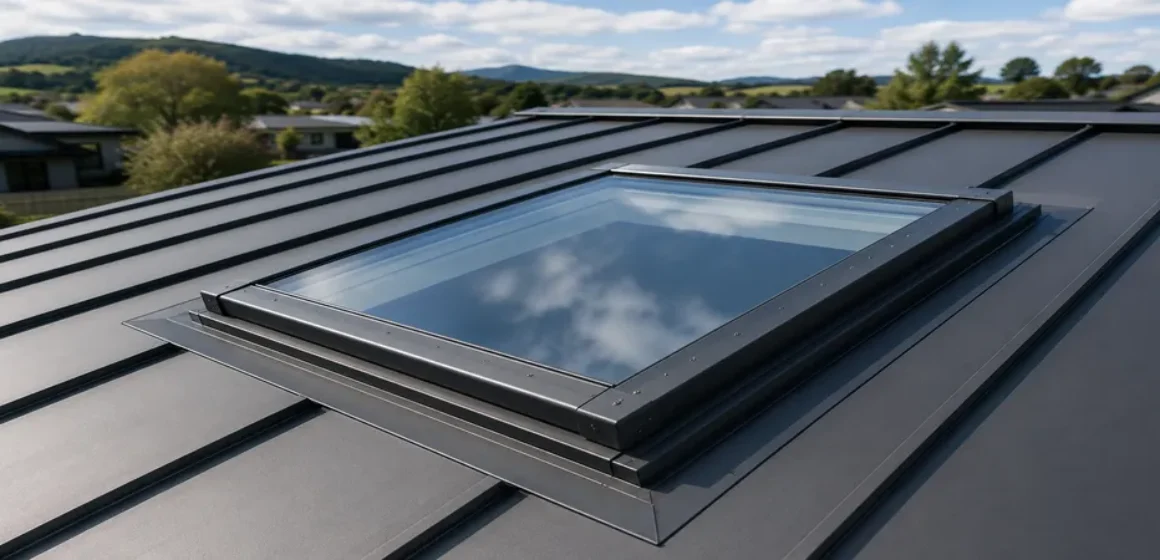
Low-pitch metal roofs are common on additions, garages, modern extensions and some utility areas.
They may be suitable for skylights in some cases, but they need careful product and flashing review.
Assessment may include:
- Metal roof profile
- Roof pitch
- Sheet direction
- Water flow
- Flashing compatibility
- Roof condition
- Existing fixings
- Nearby penetrations
- Access and safety
- Whether the roof is due for repair or replacement
A fixed skylight may suit some low-pitch metal roof areas where the product and flashing system are appropriate. A tubular skylight or Sky tube may suit compact internal spaces where the roof flashing can be matched to the roof. A vented skylight may be considered only if the product, roof pitch and room need support it.
A low-pitch metal roof should be assessed carefully before committing to a product.
The fact that a roof is metal does not make all skylight options equal.
Low-pitch tile roofs
Low-pitch tile roofs need particular care.
Tiles are designed to shed water through overlap and pitch. If a tile roof section is too low in pitch for the tile type or skylight product, the installation may become more complex or unsuitable.
Assessment may include:
- Tile type
- Tile condition
- Roof pitch
- Roof underlay
- Flashing requirements
- Water movement
- Whether tiles are brittle, cracked or weathered
- Whether the roof has previous repairs
- Whether the proposed skylight location is appropriate
Concrete tiles and terracotta tiles may need different handling. Older tiles may be more fragile, which can affect access and installation.
A skylight on a low-pitch tile roof should not be assumed without proper review.
In some cases, another daylight option, different placement or further roofing advice may be needed.
Fixed skylights on low-pitch roofs
A fixed skylight may be suitable on some low-pitch roofs if the product, flashing and roof pitch are appropriate.
Fixed skylights may suit:
- Kitchens
- Living rooms
- Bedrooms
- Home offices
- Open-plan additions
- Larger bathrooms
- Entries
- Utility rooms
For low-pitch roofs, the quote should consider:
- Product minimum pitch
- Flashing compatibility
- Roof profile
- Water flow
- Internal shaft design
- Ceiling structure
- Glare and blinds
- Roof access
- Whether the roof condition is suitable
A fixed skylight can provide strong daylight, but the product must suit the roof conditions.
If the roof pitch is not suitable for the preferred fixed skylight, another option may need to be considered.
The roof should lead the decision as much as the room.
Vented skylights on low-pitch roofs
A vented skylight may sound appealing because it provides daylight and airflow, but low-pitch roofs need extra care.
A vented skylight may be worth discussing only if:
- The product is suitable for the roof pitch
- The flashing system suits the roof
- The room genuinely needs airflow
- Operation and access are practical
- Water management can be handled properly
- Maintenance considerations are understood
A vented skylight may suit some bathrooms, kitchens, upper-level rooms or stuffier spaces. But it should not be chosen automatically.
On low-pitch roofs, extra moving parts and product requirements make suitability especially important.
If the room mainly needs daylight, a fixed skylight or tubular skylight may be more appropriate. If the room mainly needs ventilation, extraction or another ventilation solution may need to be considered separately.
Tubular skylights and Sky tubes on low-pitch roofs
A tubular skylight or Sky tube may suit some low-pitch roof situations, depending on the roof flashing and product suitability.
These systems are often considered for:
- Hallways
- Separate toilets
- Walk-in wardrobes
- Laundries
- Pantries
- Sculleries
- Internal bathrooms
- Storage areas
- Office nooks
- Garage entry zones
A tubular skylight brings daylight from the roof through a reflective tube and delivers it through a ceiling diffuser.
For low-pitch roofs, assessment may include:
- Roof flashing suitability
- Roof profile
- Roof pitch
- Tube path
- Tube length
- Bends
- Diffuser location
- Ceiling cavity obstructions
- Whether the roof location is practical
A tubular skylight or Sky tube does not provide ventilation by itself.
If the room is also damp, stuffy or affected by odour, ventilation needs separate review.
These products can be practical, but the low-pitch roof still needs proper assessment.
Low-pitch roofs over extensions
Many low-pitch roof areas are over extensions or additions.
These may include:
- Kitchen extensions
- Living room extensions
- Laundry additions
- Bathroom additions
- Garage conversions
- Sleepouts
- Lean-to spaces
- Covered entries
- Utility rooms
Extensions can create good daylight opportunities because they often sit over rooms that need natural light. But they can also create roof complexity because the extension roof may meet the main roof at a junction, valley, wall or gutter.
Assessment should consider:
- Where the extension roof joins the main home
- Whether water flows from the main roof onto the lower roof
- Whether gutters or valleys are nearby
- Whether the extension roof has enough pitch
- Whether the roof structure suits the product
- Whether the ceiling below is accessible
- Whether the room is being renovated
A skylight on an extension roof should be assessed as part of the roof system, not just the room below.
The connection to the rest of the roof matters.
Low-pitch roofs over garages and conversions
Garage roofs and converted garage spaces may have lower-pitch roof sections.
A garage conversion may need better daylight, especially if the space is being turned into a bedroom, office, studio, rumpus room or guest room.
A skylight may be worth considering if:
- The converted room has limited windows
- Privacy restricts wall-window options
- The room feels like a former garage
- The ceiling feels low or flat
- The roof and product are suitable
- The conversion is being planned early
However, garage conversions often involve broader building considerations. Insulation, ventilation, moisture, heating, compliance and room use all matter.
A low-pitch roof skylight may help with daylight, but it should not be treated as a full solution for making a garage habitable.
Product suitability and building requirements should be reviewed carefully.
Low-pitch roofs over bathrooms and laundries
Bathrooms and laundries are common places for low-pitch roof sections.
These rooms may be in additions, lean-to areas or rear parts of the home. They often need better daylight, but they also raise ventilation and moisture questions.
A skylight may be worth considering if:
- The room has limited daylight
- Privacy restricts windows
- The ceiling and roof are suitable
- The room is being renovated
- The homeowner wants practical daytime brightness
A vented skylight may be discussed if airflow is genuinely needed and the product suits the roof pitch. A tubular skylight or Sky tube may suit compact bathrooms or laundries where daylight is the main goal. A fixed skylight may suit larger bathrooms or utility rooms where stronger daylight is wanted.
Moisture should be treated separately.
A skylight can improve daylight. A vented skylight may support airflow. But extraction, dryer ducting, heating and moisture control still need proper planning.
Low-pitch roofs and internal rooms
Some internal rooms sit under low-pitch roof sections.
These may include:
- Hallways
- Walk-in wardrobes
- Pantries
- Storage rooms
- Sculleries
- Utility areas
- Office nooks
- Separate toilets
- Garage entry zones
A tubular skylight or Sky tube may suit many of these rooms, but roof pitch and flashing suitability still need checking.
The room may be small, but the roof requirement is still important.
For internal rooms, ask:
- Does the room need practical daylight?
- Would a diffuser be enough?
- Is there a suitable roof-to-ceiling path?
- Does the low-pitch roof support the required flashing?
- Are there ducts, wiring or framing in the ceiling cavity?
- Is ventilation also a concern?
A compact room may not need a large skylight, but it still needs the roof to be suitable.
Roof condition should be checked first
Low-pitch roofs should be checked for condition before skylight work.
This is important because low-pitch roofs may be more sensitive to:
- Debris build-up
- Slow water movement
- Previous leak issues
- Rust or corrosion on metal roofs
- Cracked or weathered tiles
- Older flashings
- Poor drainage
- Ponding
- Blocked gutters
- Previous repairs
- Roof areas nearing replacement
If the roof already has condition issues, installing a skylight may not be the first step.
It may be better to repair, replace or review the roof before adding a new roof penetration.
A skylight should be installed into a roof that is ready to receive it.
If the roof is not ready, the skylight decision should wait or be coordinated with roofing work.
Existing leaks or stains need diagnosis
If a room under a low-pitch roof already has ceiling stains, damp patches or leak history, those issues need to be understood before skylight planning.
A leak may be caused by:
- Roof condition
- Low pitch
- Poor drainage
- Failed flashing
- Blocked gutters
- Roof junctions
- Existing penetrations
- Condensation
- Internal moisture
- Previous roof repairs
A skylight should not be added near an unresolved roof problem without understanding the cause.
If the roof already struggles with water management, adding a skylight may not be appropriate until the roof issue is fixed.
Homeowners should send photos of any stains, roof concerns or past leak areas when asking for advice.
The existing roof performance matters.
Access and safety on low-pitch roofs
Low-pitch roofs may look easier to access because they are flatter, but that is not always true.
Access and safety may still be affected by:
- Roof height
- Roof surface material
- Slippery conditions
- Fragile roofing
- Limited side access
- Pergolas or covered areas
- Conservatories
- Solar panels
- Boundary constraints
- Weather exposure
- Internal access below
- Need for scaffolding or edge protection
Some low-pitch roofs may also be more difficult to stand or move on safely depending on material and condition.
Safe access should be included in planning and quoting.
A roof that looks simple from below may still require careful access arrangements.
Internal ceiling and shaft considerations
Low-pitch roof areas can affect the internal skylight finish.
Depending on roof and ceiling layout, there may be:
- Limited roof cavity
- Shallow ceiling space
- Deeper or awkward skylight shafts
- Low ceiling height
- Rafters or trusses close to the preferred location
- Wiring, plumbing or ducting in the way
- Insulation constraints
- Internal finishing challenges
For tubular skylights and Sky tubes, tube path and bends matter. For fixed or vented skylights, the internal shaft shape and finishing need careful thought.
A low-pitch roof may not always line up neatly with the preferred internal location.
This is another reason assessment is important.
The skylight needs to work both outside and inside.
Glare, heat and light control
Low-pitch roof sections may receive sunlight differently from steeper roof sections.
Depending on orientation, time of year and room use, a skylight may create glare or strong brightness at certain times.
Consider light control if the room is:
- A bedroom
- A nursery
- A home office
- A media room
- A living room
- A kitchen with glossy benchtops
- A dining area
- An open-plan room
- A room used heavily in summer
Blinds or diffuser choices may be relevant depending on product type.
A tubular skylight or Sky tube may provide softer daylight in compact rooms. A fixed skylight may provide stronger daylight but may also require more glare and light-control thinking.
The room’s use should guide the product.
Maintenance considerations
Low-pitch roofs may collect more debris than steeper roofs in some situations.
Leaves, moss, lichen, dust and other debris can affect water movement. This can matter around skylights, gutters, valleys and roof penetrations.
Before installing a skylight, consider:
- Are there trees nearby?
- Does the roof collect leaves?
- Are gutters often blocked?
- Is moss or lichen present?
- Is the skylight location easy to inspect?
- Will roof maintenance be practical?
- Are there existing drainage issues?
A skylight should be installed where the roof can be maintained properly.
This does not mean a low-pitch roof cannot have a skylight. It means maintenance access and water flow should be part of the planning.
A good skylight decision looks beyond day one.
When the answer may be no
Sometimes a low-pitch roof may not be suitable for the skylight the homeowner wants.
This may be due to:
- Product minimum pitch requirements
- Roof profile limitations
- Poor roof condition
- Water ponding
- Difficult flashing conditions
- Nearby valleys or roof junctions
- Existing leaks
- Access limitations
- Ceiling structure issues
- Obstructions in the roof cavity
- Glare or room-use concerns
- Renovation plans that are not yet clear
This can be disappointing, but it is better to know early.
A skylight that cannot be installed properly is not a good upgrade.
If the preferred product is unsuitable, there may still be alternatives. These might include a different skylight type, different placement, roof repair first, better artificial lighting, ventilation improvement, or revisiting the idea during renovation.
A careful “not there, not that product” is often better than a rushed yes.
What affects the quote?
A low-pitch roof skylight quote may be affected by:
- Product suitability
- Skylight type and size
- Roof pitch
- Roof profile
- Flashing requirements
- Roof condition
- Water flow
- Nearby gutters, valleys or roof junctions
- Access and safety requirements
- Internal ceiling structure
- Shaft or diffuser placement
- Number of skylights
- New installation or replacement
- Electrical work, if needed
- Blinds or controls, if included
- Plastering and painting
- Whether roof repairs are needed
- Whether the work is part of a renovation
- Location within Waikato
A low-pitch roof quote should be clear about assumptions and exclusions.
If further assessment is needed, that should be stated before the homeowner proceeds.
What photos help with a low-pitch roof skylight quote?
Photos are very important.
Send:
- Photos of the room from several angles
- A photo of the ceiling
- A photo of the darkest area
- Photos of existing windows or doors
- Roof photos showing the low-pitch area
- Wider roof photos showing how the low-pitch section connects to the rest of the home
- Photos of gutters, valleys or roof junctions nearby
- Photos of roof profile and material
- Photos of existing skylights, vents or penetrations
- Photos of any ceiling stains or leaks
- Photos showing access around the home
Do not climb onto the roof to take photos.
Safe photos from the ground, driveway, upper windows, neighbouring vantage points or existing safe access points are enough to start the discussion.
The more clearly the roof is shown, the better the first recommendation can be.
What details should homeowners include?
Alongside photos, include:
- Waikato location
- Room type
- Approximate room size
- Roof type, if known
- Whether the roof is low-pitch or almost flat
- Whether the roof is metal, tile or another material
- Whether the room needs daylight only or airflow as well
- Whether there are existing leaks or stains
- Whether the roof has been repaired before
- Whether the roof is due for replacement
- Whether the skylight is new or replacing an old one
- Whether renovation work is planned
- Whether glare, privacy or blinds are concerns
- Whether you are considering fixed, vented, tubular skylight or Sky tube options
You do not need to know the exact roof pitch at the enquiry stage.
Clear photos and context are enough to begin a sensible review.
Common mistakes with low-pitch roof skylights
Assuming low-pitch means impossible
Some low-pitch roofs may still suit a skylight with the right product and flashing.
Assuming low-pitch means easy
A gentler roof can be more sensitive to water movement and flashing detail.
Choosing the skylight from inside the room only
The roof conditions must also support the location.
Ignoring product minimum pitch
Not every skylight product suits every roof pitch.
Forgetting roof condition
Existing leaks, rust, cracked tiles or poor drainage should be reviewed first.
Treating ventilation and daylight as the same issue
A fixed skylight and tubular skylight improve daylight. They do not provide airflow.
Not showing the roof in photos
Low-pitch skylight advice depends heavily on roof photos.
Installing into a roof that needs repair soon
This can create avoidable double-handling.
Avoiding these mistakes helps homeowners make a safer and more practical decision.
Illustrative example only
A Waikato homeowner has a dark laundry in a rear extension with a low-pitch metal roof above it. The room has no useful window and needs the light on during the day. The homeowner asks whether a skylight can be installed.
A tubular skylight or Sky tube may be worth considering if the roof flashing suits the low-pitch metal profile and there is a practical tube path. If the laundry also has moisture or dryer ventilation concerns, those need separate review.
In another home, a low-pitch roof section over an open-plan living area may suit a fixed skylight only if the product, flashing and roof pitch are appropriate. If the preferred location is close to a roof junction or existing drainage issue, the skylight position may need to change.
Both homes have low-pitch roofs.
The right answer depends on the product, roof and room together.
The best outcome for a low-pitch roof skylight
The best result is not simply adding daylight to a difficult roof.
It is choosing a solution that respects the roof conditions and improves the room.
A good outcome may mean:
- The product suits the roof pitch
- Flashing is properly considered
- Water flow is understood
- Roof condition is reviewed
- The room receives useful daylight
- Ventilation is discussed separately where needed
- Internal finishing is clear
- Access and maintenance are considered
- The quote explains assumptions and exclusions
- The skylight does not create unnecessary future risk
Low-pitch roofs require more careful thinking, not automatic rejection.
The right product in the right place can make a meaningful difference, but only when the roof supports the solution.
Planning your next step
If you are considering a skylight on a low-pitch roof in Waikato, start by taking clear photos of the room, ceiling and roof area if safe to do so.
Include your roof type if known, room type, whether the space needs daylight only or airflow as well, and whether you are considering a fixed skylight, vented skylight, tubular skylight or Sky tube.
Skylights NZ can help review whether your low-pitch roof area may suit a skylight and what needs closer assessment before quoting.
To start planning your options, use the Skylights NZ enquiry form:
https://inquiry.skylights.co.nz/inquiry
You may also find these useful:
- Skylight installation services
- Request a skylight quote
- Skylight options for NZ homes
- Skylight Installation Cost in Waikato: What Affects the Final Quote?
- Getting a Skylight Quote in Waikato: What Photos and Details Help Us Recommend the Right Option
- Metal Roof Skylights in Hamilton Homes: What Homeowners Should Know Before Installing
- Tile Roof Skylights in Cambridge Homes: Flashing, Placement and Product Suitability
FAQs
Can you install a skylight on a low-pitch roof in Waikato?
A skylight may be possible on some low-pitch roofs, but the roof pitch, roof profile, product suitability, flashing requirements, water flow and roof condition need careful assessment before confirming.
Why does roof pitch matter for skylights?
Roof pitch affects water movement, flashing performance, product suitability and placement. Low-pitch roofs have less slope to move water away quickly, so the skylight and flashing must be appropriate for the roof.
What type of skylight is best for a low-pitch roof?
The best option depends on the roof and room. A fixed skylight, vented skylight, tubular skylight or Sky tube may be possible in some situations, but each product has suitability requirements that need to be checked against the roof pitch and profile.
Can a tubular skylight or Sky tube work on a low-pitch roof?
It may work in some cases if the roof flashing suits the roof type and pitch, and if there is a practical tube path to the ceiling. The roof must still be assessed carefully before confirming suitability.
Is a low-pitch roof more likely to leak around a skylight?
A properly assessed and installed skylight should manage water correctly, but low-pitch roofs are more sensitive to flashing, water flow, roof condition and product suitability. This is why careful assessment is important before installation.
What should I send for a low-pitch roof skylight quote?
Send photos of the room, ceiling, roof area, roof profile, gutters, valleys or roof junctions nearby, and any existing leaks or stains. Include your Waikato location, room type, roof type if known, and whether the room needs daylight only or airflow as well.