Open-plan renovations: how to use top-down light to make spaces feel larger without harsh glare
Open-plan renovations are meant to create flow.
One shared space. One rhythm. One area where the house actually happens.
But in Auckland, many open-plan homes end up with the same daylight issue:
- bright near the sliders
- dull in the middle
- harsh in late afternoon
- and lights on earlier than they should be, even in summer
That is not because the plan is wrong.
It is because the daylight plan is incomplete.
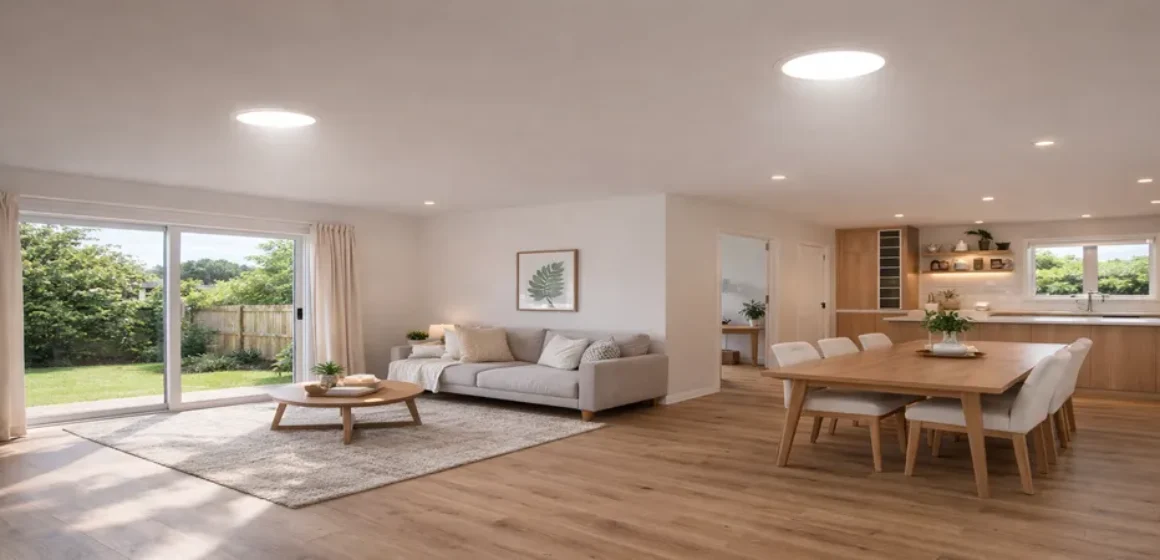
A well-placed open plan skylight can solve the hardest part of open-plan design: lifting the centre zone without creating glare, hot spots, or a room that feels uncomfortable on clear afternoons.
This guide shows you how to plan that properly.
The open-plan daylight trap
Open-plan rooms often rely heavily on one edge of glazing.
That creates two zones:
- edge zone: bright, sometimes too bright
- centre zone: flat, underlit, and visually heavy
On grey-bright Auckland days, the centre zone becomes more obvious.
On clear days, glare becomes the problem.
The open-plan skylight decision is really about fixing both.
Step 1: Identify your open-plan centre zone
Do not start with where a skylight can fit.
Start with where the room stops working.
In most open-plan homes, the centre zone is:
- between kitchen and living
- in the main circulation strip
- near the dining table
- the area you walk through constantly
This is the zone skylights should lift.
Not the perimeter that is already bright.
Step 2: Decide which problem you’re solving
Open-plan skylights can solve different problems depending on the room.
Problem A: “The room feels dull in the middle”
You need overhead daylight that spreads.
Problem B: “We close curtains to stop glare”
You need a second daylight source that keeps the room usable even when you control side sun.
Problem C: “The space feels smaller than it is”
You need ceiling lift. A brighter ceiling changes perceived space.
Problem D: “The TV and desk glare is annoying”
You need placement that respects screen zones.
Most homes have a mix.
Pick the primary one.
Step 3: The placement rule that makes open-plan skylights work
Place skylights to lift the ceiling and centre zone, not to spotlight the floor.
Spotlighting is where open-plan skylights go wrong.
A bright patch on the floor can:
- create uncomfortable contrast
- make the rest of the room feel darker
- increase glare on screens
- contribute to “heat spike” perception
Ceiling lift is where it goes right.
A bright ceiling makes the space feel taller, wider, calmer.
Step 4: Choose skylight types based on the size of the space
Fixed skylights
Often the best fit for open-plan centre lift because they:
- provide broader overhead daylight
- create a more architectural ceiling glow
- reduce the bright-edge/dull-centre imbalance
Tubular skylights
Can work in open-plan zones when:
- the space is small-to-medium
- you are targeting a specific internal strip (like an entry or corridor that joins the open-plan area)
- roof space constraints prevent larger openings
But tubes can feel underpowered if you expect them to lift a large open-plan room.
Opening skylights
Only choose opening if:
- Ventilation is a real goal
- There is a clear airflow path
- The operation is practical
Many open-plan spaces get better results from fixed skylights plus good ventilation design elsewhere.
If you want a types overview:
Step 5: The glare and screen protection plan
Open-plan spaces almost always include screens now:
- TV viewing
- work-from-home desk
- laptop use at the dining table
Glare control is usually a placement and planning issue.
Key rules:
- avoid placing skylights directly over TV walls or screen reflection paths
- avoid glossy surfaces directly under skylights where possible
- consider light control options if the room has strong west or north-west exposure
If you want deeper screen planning:
Step 6: Make it work on Auckland’s grey-bright days
Open-plan skylights are most valuable when the sky is bright but diffuse.
That is Auckland’s common daylight condition.
A skylight plan that performs on grey days will feel excellent on clear days.
This is why centre-zone daylight anchors matter.
Illustrative Example Only: the open-plan room that always felt like two rooms
A homeowner renovated into open-plan but still felt like the space was split:
- bright at the glass edge
- dull and heavy near the kitchen centre
They relied on side windows for daylight, but that also created glare and curtain-closing behaviour.
A centre-zone overhead daylight plan made the room feel like one unified space.
Their reflection afterwards:
“It finally feels like the whole room is part of the day, not just the edge.”
A practical open-plan skylight checklist
Use this before finalising placement.
- Where is the centre zone that feels dull?
- What time of day is the room most uncomfortable?
- Are there screens or desks we must protect?
- Is glare the real driver, or is it daylight distribution?
- Does the skylight plan lift the ceiling, not spotlight the floor?
- Would blinds or control be useful for seasonal tuning?
- What roof structure constraints exist above this zone?
If you want a recommendation based on your Auckland layout and roof type:
For Auckland coverage:
FAQs (unique to this topic)
Do open-plan skylights make rooms hotter?
Not automatically. Comfort depends on placement, glazing choice, and whether the skylight creates direct sun patches. A centre-lift approach often improves usability without heat spikes.
How many skylights does an open-plan space need?
It depends on the size of the centre zone you want to lift. Some spaces work with one broader fixed skylight, others perform better with multiple smaller light points.
Can skylights reduce the need to close curtains for glare?
Often, yes. Overhead daylight can keep the room usable even when you control harsh side sun, reducing the “glare or gloom” trade-off.
Are tubular skylights suitable for open-plan areas?
Sometimes, especially for smaller spaces or targeted internal strips. For large open-plan centre zones, fixed skylights usually provide better spread.
What is the biggest open-plan skylight mistake?
Creating a spotlight effect that increases contrast and glare. The best results come from lifting the ceiling and centre zone evenly.