The ‘lights-on-at-noon’ problem: what it costs across a year
If your home needs the lights on at midday, you already know the feeling.
It’s not dramatic.
It’s just… constant.
A hallway that never catches the sun.
A bathroom with no window.
A kitchen corner that stays grey even on a clear day.
You flick the switch without thinking.
And because it’s “only a few lights”, it’s easy to assume it doesn’t matter.
But in 2026, with cost-of-living pressure and power bills top-of-mind, those small habits are worth looking at.
Not to obsess over pennies.
To understand what you’re paying for a home that doesn’t naturally light itself.
This is a practical NZ guide to the reduce lighting costs NZ question: what the “lights-on-at-noon” pattern costs across a year, and what changes the equation.
First: the honest truth about lighting costs
For most homes, lights are not the biggest part of the power bill.
Heating and hot water often dominate.
So if you are expecting daylighting to “halve your bill”, this article is not going to sell that story.
What it will do is show:
- where lighting costs quietly add up
- why the real value is often daily comfort and habit change
- and when daylight from above can reduce reliance on switches in the rooms that matter
The lights-on-at-noon pattern (what it usually looks like)
In NZ homes, this pattern tends to show up in:
- hallways and corridors
- internal bathrooms and ensuites
- stairwells
- laundry areas
- kitchen work zones under bulkheads or deep eaves
These spaces don’t just affect power.
They affect how the home feels.
A dim hallway makes the whole house feel smaller.
A gloomy bathroom feels damp even when it’s clean.
A kitchen corner that needs a light at midday changes how you use the room.
A simple way to estimate what it costs (no spreadsheets required)
Let’s keep this practical.
You can estimate annual lighting cost with three pieces of information:
- How many lights are on during the day?
- How many hours per day?
- Rough electricity price per kWh
Most NZ homes now use LEDs, which helps.
But even LEDs add up when they run every day.
A worked example (Illustrative Example Only)
Say you have:
- 4 LED downlights
- each around 9W
- on for 5 hours/day (midday through late afternoon)
That’s 36W total.
Over 5 hours, that’s 180Wh per day (0.18 kWh).
Over a year, that’s about 65.7 kWh.
Multiply by your electricity rate.
If your rate is, for example, around 30 cents/kWh, that’s roughly $19.70/year for those four lights.
Not huge.
Now add:
- a hallway light that’s on 8 hours/day
- a bathroom light used frequently because the room is dim
- a kitchen zone that stays lit for long periods
The cost grows — but more importantly, it reveals something else.
The home is missing daylight where it needs it most.
Why this matters even if the dollar figure isn’t massive
If you only look at the annual dollars, you may shrug and move on.
But the “lights-on-at-noon” pattern usually signals:
- an interior zone that doesn’t get natural light
- a space that feels less inviting
- and a home that relies on artificial lighting for basic usability
So the upside of daylighting isn’t only the electricity line item.
It’s that the home becomes easier to live in.
You stop reaching for switches.
Rooms feel more open.
And in some homes, daylighting can reduce the feeling that the house is “always a bit dim”.
Where top light changes the equation
Daylight from above does something windows often can’t.
It reaches into the centre of the home.
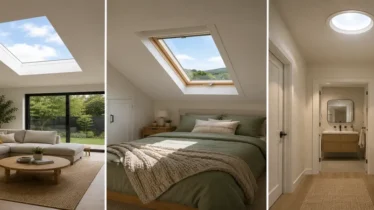
It lifts circulation spaces.
It brightens rooms with privacy limits.
And it can reduce the number of hours your lights need to be on — especially in those midday zones.
That is where “reduce lighting costs NZ” becomes realistic.
Not as a grand savings claim.
As a daily habit shift.
The three spaces where lighting reliance is most ‘fixable’
1) Hallways and corridors
Hallways often have no windows and are used constantly.
A small amount of top light can remove the “always on” light habit.
2) Bathrooms and ensuites
Many bathrooms keep windows small for privacy.
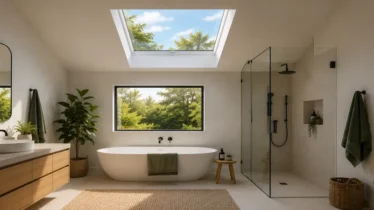
Top light can brighten the room without compromising privacy.
3) Kitchen work zones
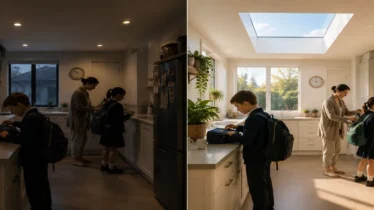
Deep kitchens often have shadowed benches.
Better daylight can reduce how often task lights run during the day.
The common mistake: chasing savings instead of targeting behaviour
If you place daylighting where you already have good natural light, you won’t see a habit change.
If you place it in the spaces that force lights on at noon, you often do.
So the question isn’t “how many watts will I save?”
It’s:
“Which lights do we use because the home doesn’t have daylight there?”
That’s the high-value zone.
What to consider before you act
A practical checklist:
- Which lights are on most often between 10am–4pm?
- Which spaces feel dim even on bright days?
- Are there privacy limits that keep windows small?
- Is the space central, with no external wall?
- Would a smaller top-light solution remove the need for daytime switching?
If you can answer those, you can usually prioritise the best daylighting upgrade without guesswork.
Illustrative example only: the hallway that stopped needing a switch
A homeowner in Hamilton noticed they turned on the hallway lights every day, even in summer.
It wasn’t a dramatic problem.
Just constant.
Once daylight was introduced from above, the habit changed.
They didn’t “save a fortune”.
They simply stopped paying for a dark zone to be artificially lit all day.
And the home felt brighter in a way that windows hadn’t been able to deliver.
That is the quiet win.
A calm next step
If you have lights on at noon, it usually means one part of the home is missing daylight.
If you tell us which lights are on during the day (and for how long), and share a couple of photos of the spaces, we can suggest the most effective top-light options — often starting with hallways, bathrooms, or kitchen zones — so the home feels brighter and relies less on switches.
Start here: https://inquiry.skylights.co.nz/inquiry