Skylights for Separate Toilets in Waikato Homes: Small Rooms That Need Daylight
A separate toilet is one of the smallest rooms in the home, but it can still affect how the home feels.
It may sit off a hallway, beside a bathroom, near the laundry, close to the garage entry, or tucked into a compact corner of the house. It is not a room people usually spend long periods in, so it is easy to overlook. As long as it works, it often stays exactly as it is.
But many Waikato homeowners know the feeling of walking into a separate toilet during the day and still needing the light on.
The room may have a tiny window. It may have no window at all. The window may be frosted, shaded, privacy-limited or facing a fence. The space may feel like a cupboard rather than part of the home. In winter, the problem can feel worse because the days are shorter, nearby rooms are darker, and borrowed light from the hallway may not do much.
For homeowners considering a toilet skylight Waikato solution, the goal is not to create a dramatic skylight feature.
The goal is simpler and more practical:
Make a small everyday room feel cleaner, clearer and less closed in during daylight hours.
A tubular skylight or Sky tube may suit many separate toilets because the room usually needs practical daylight, not a large visible skylight. A fixed skylight may suit some larger powder rooms or toilet spaces where a stronger daylight opening is wanted. A vented skylight may be worth considering only where airflow is genuinely part of the issue, but daylight and ventilation should be understood separately.
This guide explains how to think clearly about skylights for separate toilets in Waikato homes before making an enquiry.
Why separate toilets are often dark
Separate toilets are often placed where they fit, not where they receive the best daylight.
In many homes, the best natural light goes to the living room, kitchen and bedrooms. Bathrooms may get privacy-focused windows. The separate toilet is often given a small leftover space, sometimes between other rooms, along a hallway, beside a laundry or near a back entrance.
That can mean:
- No window
- A very small window
- A frosted window
- A shaded side-facing window
- A window facing a fence or wall
- A room that relies on hallway light
- A compact room with limited ceiling area
- A space that feels closed in during winter
Because the room is small, the problem may seem minor.
But small rooms are often where daylight makes a noticeable practical difference. A separate toilet does not need to feel like a feature room. It simply should not feel dark every time someone uses it during the day.
A skylight, tubular skylight or Sky tube may be worth considering where the room lacks useful natural light and the roof and ceiling layout can support a suitable option.
The Waikato winter effect
Winter often makes small rooms feel more enclosed.
In Waikato homes, separate toilets can feel noticeably darker from June onwards. Nearby hallways may receive less borrowed light. Doors may stay closed more often. Curtains and blinds in adjacent rooms may be drawn earlier. The sun sits lower, and side-facing windows may bring in less useful daylight.
A separate toilet may feel worse in winter if:
- It sits in the centre of the home
- It is connected to a dark hallway
- It has no direct window
- Its window faces a shaded side path
- It relies on borrowed light from nearby rooms
- It has darker flooring or wall colours
- It sits beside a bathroom, laundry or garage
- It is used often during the day but always needs the light on
This is the kind of room where practical overhead daylight can make a difference.
The improvement does not need to be dramatic. It needs to make the room feel less forgotten.
Why a tubular skylight often makes sense
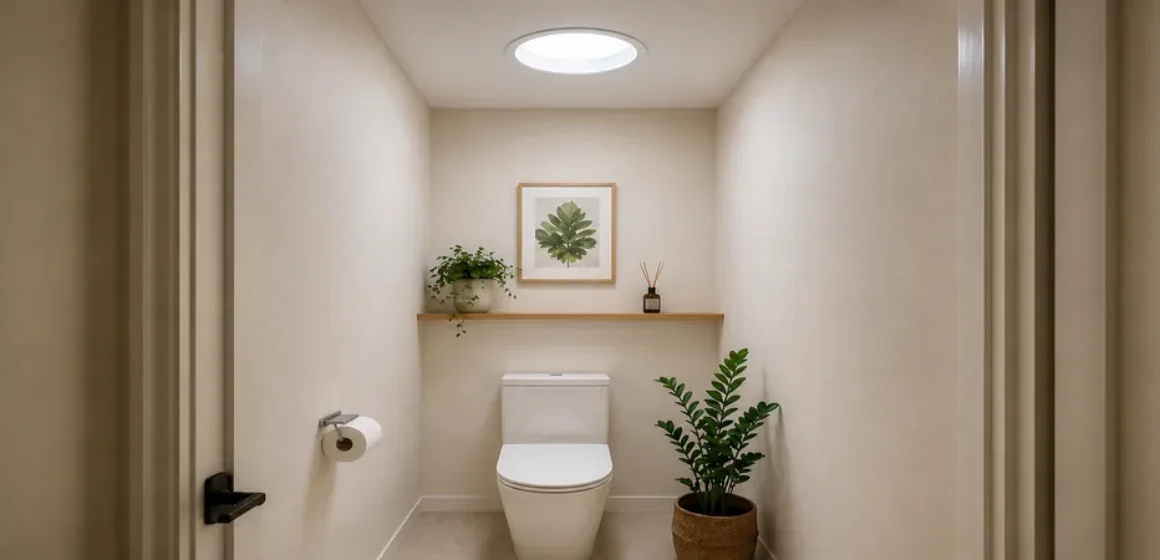
A tubular skylight or Sky tube is often one of the most practical options for a separate toilet.
This is because the room is usually small and does not need a large skylight opening. The aim is typically to bring natural daylight into the room through a ceiling diffuser, not to create a view of the sky.
A tubular skylight may suit a separate toilet where:
- The room has no useful window
- The light is used during the day
- Privacy limits the existing window
- The room is compact
- A full skylight would feel too visually large
- The ceiling and roof path are suitable
- The goal is practical brightness rather than a feature
A tubular skylight brings daylight from the roof through a reflective tube and delivers it through a diffuser in the ceiling. In a small toilet room, that diffuser may be enough to make the space feel clearer and more natural during the day.
However, a tubular skylight still needs proper assessment.
The roof position, roof pitch, roof type, ceiling location, tube length, bends and possible obstructions all matter. A small room still connects to the roof system, so installation quality and flashing are important.
A tubular skylight is subtle, but it is not casual.
When a fixed skylight may suit a separate toilet
A fixed skylight may suit some separate toilets, but it is not always the first option.
It may be worth considering where:
- The room is larger than a standard toilet
- It functions like a powder room
- The homeowner wants a stronger daylight opening
- The ceiling height or room proportion can support it
- The roof and ceiling layout are suitable
- A visible skylight would feel appropriate
- Privacy and light control can be considered properly
A fixed skylight can bring more direct overhead daylight and may make a larger powder room feel more open.
But in many standard separate toilets, a full fixed skylight may be more than the room needs. It may feel visually too large or create unnecessary complexity compared with a tubular skylight or Sky tube.
The question should be:
Does this room need a skylight feature, or does it simply need useful daylight?
For many separate toilets, useful daylight is enough.
When a vented skylight may be considered
A vented skylight may be worth discussing only if airflow is genuinely part of the room’s problem.
A separate toilet may need ventilation for odour control or general air movement, but this does not automatically mean a vented skylight is the best answer. Existing extraction, window opening, ducting, room layout and building conditions all matter.
A vented skylight may be considered if:
- The room needs daylight and airflow
- The roof and ceiling layout are suitable
- The skylight can be operated conveniently
- The room is larger or part of a bathroom zone
- Existing ventilation is limited
- The homeowner wants natural airflow as part of the solution
However, for many separate toilets, mechanical extraction or other ventilation methods may be more appropriate than relying on an opening skylight.
A fixed skylight improves daylight but does not provide airflow.
A tubular skylight or Sky tube improves daylight but does not ventilate the room by itself.
A vented skylight may support airflow in suitable situations, but it should not be treated as the only ventilation answer without proper assessment.
Daylight and ventilation should be discussed together, but not confused.
Privacy is one of the strongest reasons to consider overhead daylight
Separate toilets are private rooms by nature.
A wall window may face a neighbour, fence, driveway, side path or outdoor area. Even if the window exists, it may need to be frosted, kept closed, covered or made very small. That limits how much useful daylight it can provide.
Overhead daylight can be useful because it may reduce reliance on a side-facing window.
This can help in rooms where:
- The existing window is very small
- The window faces a fence
- The window faces a neighbouring property
- Frosted glass reduces brightness
- The room feels private but dark
- Wall window changes are not practical
- The room is internal or semi-internal
Privacy should still be considered. Roof angle, neighbouring upper windows, hillside sites and glazing options may matter in some homes. But in many separate toilet situations, overhead daylight can be a practical way to improve the room without compromising privacy.
The room can remain private and still feel less enclosed.
Separate toilets beside bathrooms
Many separate toilets sit beside the main bathroom.
This is common in older homes and family homes where the toilet and bathroom are split for practical use. The toilet may sit between the bathroom and hallway, often with a small window or no effective daylight.
This arrangement can create a strong daylight contrast.
The bathroom may have a window, extractor fan and more ceiling space, while the separate toilet feels darker and more enclosed. In winter, this contrast can become more obvious.
A tubular skylight or Sky tube may be useful where:
- The separate toilet relies on hallway light
- The room has no meaningful window
- The adjacent bathroom receives better light
- The toilet is used frequently during the day
- A full skylight would feel too large
- The ceiling and roof path are suitable
If the bathroom is also dark, both spaces may need separate assessment. The bathroom may need daylight and ventilation considered together, while the toilet may only need practical daylight.
The two rooms may sit side by side, but they may not need the same solution.
Separate toilets off hallways
A separate toilet off a dark hallway can feel even more enclosed.
If the hallway itself lacks natural light, the toilet room receives almost no borrowed brightness. The result is a small room that needs the light on every time, even during the day.
In this situation, the homeowner may need to consider both the hallway and the toilet.
Possible approaches include:
- A tubular skylight in the hallway
- A tubular skylight or Sky tube in the toilet
- One daylight point that improves the hallway transition
- Separate daylight points if the spaces both need help
- A fixed skylight in a wider hallway or entry
- Improved artificial lighting if skylight suitability is limited
The best option depends on room layout and roof path.
Sometimes the toilet itself needs daylight. Sometimes the hallway leading to it is the bigger problem. Sometimes both spaces contribute to the feeling of darkness.
Assessing the connected spaces helps avoid solving only half the issue.
Guest toilets and powder rooms
Some homes have a guest toilet or powder room near the entry, living area or hallway.
These rooms are small, but they influence how visitors experience the home. A powder room that feels dark or enclosed can make the space feel less considered, even if the rest of the home is bright.
A skylight may be worth considering where:
- The powder room has no useful window
- The room is used by guests
- The space sits near an entry or hallway
- Privacy limits wall window daylight
- The homeowner wants a more finished feel
- The roof and ceiling layout are suitable
In a compact powder room, a tubular skylight or Sky tube may be enough. In a larger or more designed powder room, a fixed skylight may be worth assessing.
The aim is not luxury for the sake of it.
The aim is a small room that feels clean, natural and intentional.
Toilets near laundries and back entrances
Separate toilets are often located near laundries, back doors, garage access zones or utility areas.
These parts of the home can already feel darker than the main living spaces. If the toilet sits within that utility zone, it may feel even more removed from natural daylight.
A tubular skylight or Sky tube may suit:
- Toilets beside laundries
- Toilets near internal access garages
- Back-entry toilet rooms
- Utility zone toilets
- Toilets near storage or mudroom areas
- Older additions or service areas
In these cases, daylight may improve more than just the toilet. It may help the transition through that part of the home feel less gloomy.
However, if the laundry or hallway also lacks daylight, the overall utility zone may need a broader daylight plan.
A separate toilet should not be assessed in isolation if the surrounding area is also dark.
Ceiling diffuser placement
For a tubular skylight or Sky tube, diffuser placement is important.
A separate toilet is small, so the diffuser often has a clear role: provide practical daylight where it will make the room feel less enclosed.
Placement may depend on:
- Ceiling size
- Toilet position
- Door swing
- Existing light fittings
- Extractor fan position
- Ceiling vent location
- Roof path above
- Wall colour and reflectivity
- Whether the room includes a small basin
- Whether the space feels narrow or square
In many cases, a central diffuser may work well. In others, placement may need to shift because of roof structure, fan location or ceiling fittings.
A diffuser should feel intentional. It should not clash with existing lights, fans or vents if that can be avoided.
Even in a small room, placement matters.
Tube path and roof access
The roof-to-ceiling path matters for tubular skylights.
The roof collector needs to capture daylight, and the reflective tube needs a practical path to the ceiling diffuser. The simpler and more direct the path, the cleaner the planning often is.
Considerations include:
- Roof type
- Roof pitch
- Roof profile
- Flashing suitability
- Roof condition
- Water flow direction
- Nearby valleys or ridges
- Roof access
- Ceiling cavity depth
- Rafters or trusses
- Wiring
- Plumbing
- Ducting
- Insulation
- Extractor fan ducting
- Existing ceiling lights
- Whether bends are needed
Separate toilets are often near bathrooms or laundries, where plumbing and ducting may already be present. This makes roof and ceiling assessment important.
The room may be small, but the roof space above may be busy.
Good photos can help identify what needs review before recommending an option.
Artificial lighting still matters
A skylight does not remove the need for a light in a separate toilet.
It improves daytime natural light in suitable conditions. The room will still need artificial lighting at night, early morning, on very dark days and whenever daylight is low.
The best setup may include:
- Natural daylight from a tubular skylight, Sky tube or skylight
- A suitable ceiling light
- Ventilation or extraction where needed
- Light wall colours or finishes
- Practical cleaning access
- Privacy maintained through layout and glazing choices
A separate toilet is a functional room. The aim is to make it work better during the day, not to replace every other feature.
A skylight supports the room. It does not do everything.
Ventilation and odour control
Separate toilets need some form of ventilation or air movement, but that does not automatically mean a skylight is the ventilation solution.
Depending on the room, ventilation may involve:
- A window
- An extractor fan
- Ducting
- Passive ventilation
- Door undercuts or air pathways
- Natural airflow from connected spaces
- A vented skylight in suitable cases
If odour control or airflow is the main concern, that should be assessed separately from daylight.
A tubular skylight or Sky tube will not ventilate the room. A fixed skylight will not ventilate the room. A vented skylight may provide airflow, but it may not be the most practical or complete ventilation option for every separate toilet.
The safest approach is to ask:
- Does the room need daylight?
- Does the room need ventilation?
- Are those needs best solved by the same product or separate solutions?
In many cases, daylight and ventilation may be handled by different systems.
That is not a weakness. It is good planning.
Small room, big perception shift
A separate toilet does not need a dramatic renovation to feel better.
Small changes can influence how the room is perceived.
Better daylight may make the room feel:
- Cleaner
- Less enclosed
- Easier to use during the day
- More connected to the home
- Less like a cupboard
- More comfortable for guests
- More intentional
- Less dependent on the light switch
This is why separate toilets deserve attention in daylight planning.
They may not be the most glamorous spaces in the home, but they are used frequently. A small room that feels dark every day can quietly reduce the overall comfort of the home.
A tubular skylight or Sky tube may be a modest upgrade, but the practical effect can be meaningful in the right room.
Waikato homes where this may be relevant
Separate toilet skylights may be worth considering across many types of Waikato homes.
This may include:
- Older family homes with split bathroom and toilet layouts
- Homes with central hallways
- Brick-and-tile suburban homes
- Renovated homes with internal powder rooms
- Compact townhouses
- Homes with garage-side utility zones
- Rural or lifestyle homes with deeper floor plans
- Homes where privacy limits side-window daylight
- Homes where winter makes small rooms feel darker
The common factor is not the home style.
It is the room problem.
If the separate toilet lacks useful daylight during the day and the roof and ceiling layout are suitable, a daylight option may be worth assessing.
Renovation timing
A separate toilet renovation is a good time to consider daylight.
Many homeowners focus on flooring, wall lining, paint, tapware, basin options, toilet suite, ventilation and lighting. Those details matter, but daylight can change how the small room feels.
Early planning can help coordinate:
- Skylight or diffuser placement
- Ceiling light position
- Extractor fan location
- Ducting
- Painting
- Wall finishes
- Basin placement
- Roof access
- Electrical work
- Internal finishing
If skylight planning is left too late, the best ceiling position may already be taken by a fan, light or service.
For Waikato homeowners planning winter or spring upgrades, it is worth reviewing daylight before the room layout and ceiling plan are finalised.
Small rooms benefit from early planning because there is less space to adjust later.
When a toilet skylight may not be the first answer
A toilet skylight may not be the right first step in every situation.
Other options may need review first if:
- The room already has enough daylight
- The main issue is poor artificial lighting
- The room needs ventilation more than daylight
- The roof path is blocked by services
- The roof above is unsuitable
- The room is about to be reconfigured
- The existing window could be improved
- Dark paint or finishes are absorbing light
- A ceiling fan or ducting leaves no practical diffuser location
- The homeowner expects daylight to solve odour or dampness issues
In these cases, lighting, ventilation, layout changes or renovation planning may be more important.
A skylight should solve the right problem, not simply add a product to a small room.
Common mistakes with toilet skylights
Choosing a full skylight when a tubular skylight would be enough
Many separate toilets need practical daylight, not a large skylight feature.
Forgetting ventilation
Daylight does not manage odour or airflow by itself.
Ignoring the extractor fan
Fans, ducting and vents may affect ceiling placement and roof path.
Placing the diffuser without considering the room layout
Even small rooms need sensible placement.
Assuming the window is enough
A window may exist, but privacy or shading may make it ineffective.
Treating the toilet room in isolation
The hallway, bathroom or laundry nearby may also affect how dark the area feels.
Forgetting night lighting
A skylight supports daytime use only.
Ignoring roof suitability
The room may be small, but the roof still needs proper flashing and installation planning.
Avoiding these mistakes helps create a more practical result.
The simple daylight test for a separate toilet
Before making an enquiry, test the room during the day.
Turn the light off and ask:
- Can the room be used comfortably without artificial light?
- Is there any useful natural daylight?
- Does the window provide brightness or only privacy?
- Does the room feel like a cupboard?
- Is the issue worse in winter?
- Does the hallway outside also feel dark?
- Is ventilation also a concern?
- Is there an extractor fan in the ceiling?
- Would a subtle diffuser be enough?
- Would a full skylight feel excessive?
- Is there roof space above or nearby?
This simple test helps clarify whether a tubular skylight, Sky tube, fixed skylight or another solution may be worth considering.
It also helps prepare a better enquiry.
Illustrative example only
A Waikato homeowner has a separate toilet beside the main bathroom. The toilet has a small frosted window facing a side fence. During winter, the room feels dark even in the middle of the day, and the light is switched on every time. The adjacent hallway is also slightly dull.
The homeowner asks whether a skylight could help.
A tubular skylight or Sky tube may be worth considering because the room mainly needs practical daylight, not a large skylight feature. The diffuser placement would need to consider the existing ceiling light and extractor fan. The roof path would also need review because the toilet sits beside bathroom plumbing and ventilation ducting.
If the hallway is also dark, the homeowner may consider whether the hallway needs a separate daylight point.
The room is small, but the decision still needs proper planning.
What to send when asking for a toilet skylight quote
Good information helps avoid generic advice.
For a toilet skylight enquiry, send:
- Photos of the toilet room from the doorway
- A photo of the ceiling
- A photo of the existing window, if there is one
- A photo showing what the window faces, if relevant
- A photo of the hallway or adjoining room
- A photo of any ceiling fan, vent or light fitting
- Roof photos above or near the room, if possible
- The approximate room size
- Whether the toilet is separate or part of a bathroom area
- Whether the room has an extractor fan
- Whether ventilation or odour control is a concern
- Whether privacy is the main reason the window is limited
- Whether the room feels worse in winter
- Whether you prefer a tubular skylight, Sky tube or fixed skylight option
- Whether renovation work is planned
These details help determine whether a tubular skylight, Sky tube, fixed skylight or another approach may be suitable.
They also help identify whether the connected hallway, bathroom or laundry should be considered at the same time.
The best toilet skylight outcome
The best result is not a separate toilet that feels dramatic.
It is a small room that feels normal, clear and naturally usable during the day.
A good outcome may mean:
- The room feels less enclosed
- The light switch is needed less during daylight hours
- The room feels cleaner and more pleasant
- Privacy is maintained
- The hallway transition feels better
- A small guest toilet feels more considered
- Ventilation is addressed separately where needed
- The diffuser or skylight placement suits the ceiling
- The product suits the roof and room together
A separate toilet may be small, but it is still part of everyday home comfort.
If it feels dark every day, it may be worth improving.
Planning your next step
If a separate toilet in your Waikato home feels dark, enclosed or overly dependent on artificial lighting during the day, it may be worth exploring whether overhead daylight could help.
A tubular skylight or Sky tube may suit many separate toilets because the room usually needs practical daylight rather than a large skylight feature. A fixed skylight may suit some larger powder rooms. A vented skylight may be considered where airflow is genuinely part of the issue, but ventilation and daylight should still be assessed separately.
Skylights NZ can help you review which option may suit your separate toilet, roof type, ceiling layout and desired outcome.
To start planning your options, use the Skylights NZ enquiry form:
https://inquiry.skylights.co.nz/inquiry
You may also find these useful:
- Skylight installation services
- Request a skylight quote
- Skylight options for NZ homes
- Why Waikato Homes Feel Darker in Winter, and When a Skylight Can Help
- Bathroom Skylights in Waikato: Daylight, Privacy and Ventilation Explained
- Tubular Skylights for Waikato Hallways, Toilets and Walk-in Wardrobes
- The 3pm Winter Test: Is Your Waikato Room Asking for Better Daylight?
FAQs
Is a skylight a good idea for a separate toilet in Waikato?
A skylight may be a good idea for a separate toilet if the room lacks useful natural daylight and has a suitable roof and ceiling layout. In many cases, a tubular skylight or Sky tube may be more practical than a full fixed skylight.
What type of skylight is best for a small toilet room?
A tubular skylight or Sky tube is often suitable for a small separate toilet because it provides practical daylight through a ceiling diffuser without needing a large visible skylight. A fixed skylight may suit larger powder rooms where a stronger daylight opening is wanted.
Does a tubular skylight ventilate a toilet?
No. A tubular skylight or Sky tube brings daylight into the room but does not provide ventilation by itself. If odour control, airflow or moisture is a concern, extraction or another ventilation solution may also need to be considered.
Can a toilet skylight help with privacy?
A toilet skylight may help improve daylight while reducing reliance on a side-facing window that may face a fence, neighbour, driveway or path. Privacy still depends on roof angle, neighbouring properties, glazing and placement.
Should I install a skylight in the toilet or hallway?
It depends on where the daylight problem is strongest. If the toilet itself is dark, it may need its own daylight point. If the hallway outside is also dark, a tubular skylight or Sky tube in the hallway may also be worth considering.
What should I send for a toilet skylight quote?
Send photos of the toilet room, ceiling, existing window, hallway outside, any fan or ceiling fittings, and the roof above or near the space if possible. Include the room size, roof type if known, whether ventilation is a concern and whether renovation work is planned.